






ATA Carnet for Underwater Photographers and Videographers: What Nobody Tells You
July 2026, Cozumel International Airport. A tourist leaves with a bill of almost $400 (around 6,600 pesos): Mexican customs has just reclassified his underwater photography equipment — camera body, housing, lights, arms, dome ports, lenses, batteries and chargers — as "merchandise" rather than personal recreational equipment, and applied a 19% tax on its estimated value. ANAM, Mexico's customs agency, notes for its part that travellers' personal luggage normally enters duty-free — but no Mexican authority has publicly commented on this specific case to date.
Would an ATA Carnet have avoided this bill? That's the question this case raises. The answer is less clear-cut than it looks.
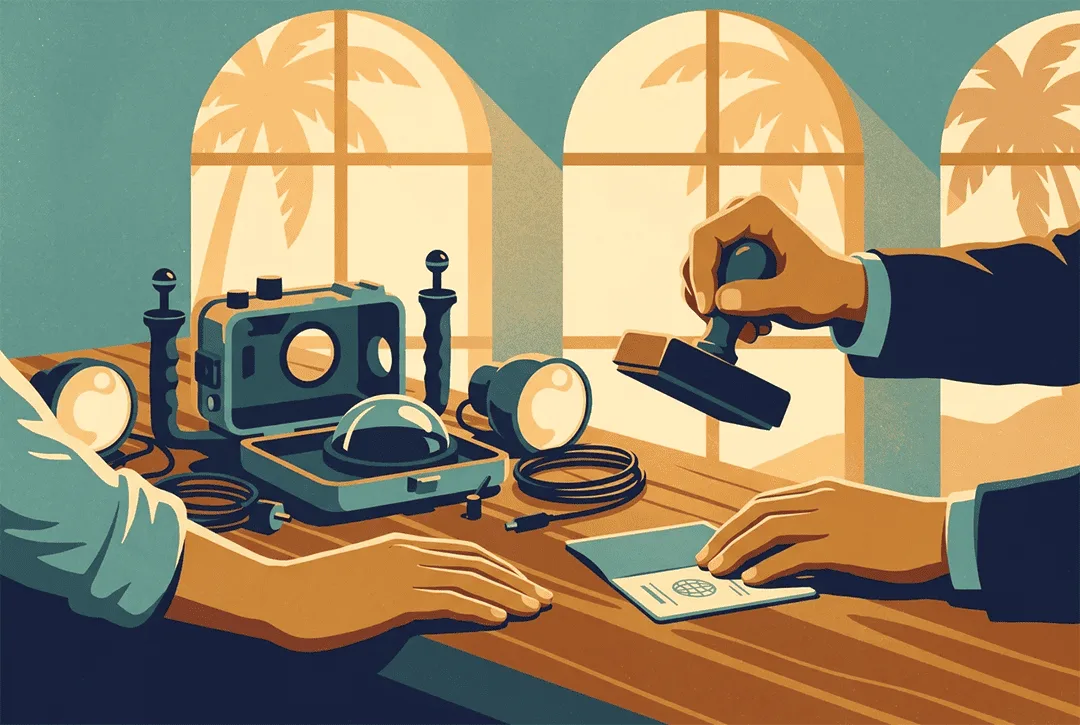
What Exactly Is an ATA Carnet?
The ATA Carnet (Admission Temporaire / Temporary Admission) is an international customs document that lets you temporarily import goods into a foreign country without paying duty, provided you bring them back intact. It's recognised in 87 countries belonging to the Istanbul Convention, administered by the World Chambers Federation (WCF).
On paper, it's exactly what you need to travel with €15,000 of photo and video gear without getting taxed on it at every border. In practice, it's a document built for professionals on business trips — trade-show exhibitors, film crews, technicians servicing industrial equipment. The people who handle ATA Carnets at production houses are specialists who do it as a full-time job. And for good reason.
Three Things Nobody Tells You
1. Your itinerary has to be declared in advance. The carnet requires you to specify exactly where you'll be, on what dates, and in which country you'll be using the equipment. If your plans change — a dive cancelled for bad weather, an unplanned stopover, one extra night — you fall outside the declared scope. For a diving holiday whose pace depends on sea conditions, that's a structural mismatch.
2. The equipment has to leave the country with you, in the same state it arrived in. If you lose a strobe (it happens), if a housing gets damaged and needs repairing on the spot, if a part is wrongly confiscated at customs... you've got an administrative problem to sort out before you can head home. The carnet guarantees that you bring back exactly what you brought in.
3. This is far from a five-minute online form. Depending on your country of residence and the chamber issuing the carnet, you'll need to supply an exhaustive list of every piece of equipment with its serial number, put up a financial guarantee (insurance or a bank security), and sometimes turn up in person to collect the document.
How It Actually Works
The principle is simple to state, harder to stick to: the equipment goes in, gets used, and comes back out — the same equipment, in the same condition, within the set deadlines. The ICC, which coordinates the system worldwide, sums up the three obligations that structure the whole regime: bring the goods back as they were, don't sell or modify them abroad, and respect the expiry date and the deadlines set by the destination country's customs. In practice, it plays out in four steps.
Before departure. You draw up a detailed list of the equipment — make, model, serial number, and the pre-tax value of each item — and lodge it with the issuing body (in the UK, this means the LCCI). The carnet travels with a financial guarantee behind it: an insurance premium or a security bond, refundable once the carnet is correctly closed out.
Leaving the UK. The carnet has to be stamped by customs before you board — present the equipment itself, not just the paperwork. A carnet that was never stamped on departure can be challenged on arrival: customs in the destination country need to be able to confirm that the export genuinely took place from the UK.
On entry and in transit. You need to find the right customs desk — often not the same as the airport's routine security check — and get the temporary import counterfoil stamped. Stopping over in a third country? A transit counterfoil may be needed too.
On return. The equipment leaves the destination country, comes back into the UK, and the corresponding counterfoils are stamped at each stage. It's this complete chain of stamps that allows the carnet to be closed out without a claim being raised.
Every missed stamp is a weak link — that's where things go wrong far more often than at the initial paperwork stage.

Can You Get One as a Private Individual?
Yes — in all six countries we cover, a private individual can technically obtain an ATA Carnet. Here's where to apply, and what it actually costs for a setup worth €5,000 to €15,000.
France — CCI (via formalites-export.com)
A fully online process. One of the simplest in Europe.
- Filing fee (1 round trip): €75 incl. tax
- Guarantee premium for €11,000–20,000 of equipment: €115
- Customs stamp: €30 excl. tax
- Estimated total: around €220–250, 48-hour turnaround
French customs also offers a rarely-mentioned free alternative — see below.
Germany — IHK (via e-ata.de)
- Filing fee (non-IHK member): €105
- Built-in DIHK insurance (value under €9,999): €46
- ICC fee: approx. €14
- Estimated total: €165–180, 2–5 working days
The advantage in Germany: the guarantee (full security) is built into the DIHK insurance premium — no separate bank bond to arrange.
Italy — Camera di Commercio (CCIAA)
- Standard carnet (12-month validity, unlimited trips): €122 incl. tax
- Mandatory Generali insurance (minimum): €56
- Estimated total: €178–223
Turnaround is 3 working days in Turin, up to 10 days at some provincial chambers. Private individuals have to go through the paper process (there's no standalone digital portal) and provide a statement of financial standing.
Spain — Cámara de Comercio (via eATA)
- Filing fee (2 trips): €205
- Insurance (0.75% of declared value): €38–113
- Express option (1-hour processing): approx. +€120
- Estimated total: €243–318, 48 hours as standard
A Spanish NIF/DNI is required. The process requires prior registration by email with the local chamber.
UK — LCCI / Boomerang Carnets (ecarnet.co.uk)
This is the most developed market for specialist intermediaries in Europe — proof that the process is complicated enough to support dedicated providers.
- LCCI fee (non-member): £444 incl. tax
- Security fee (estimate for £5,000–15,000): £100–300
- Estimated total: £550–750, 24 hours as standard, 2 hours express
Firms such as ATA Carnet Express or Brunel Shipping will handle the whole application for you, for an extra £50 to £150. If you've never done an ATA Carnet before, this is often the least stressful route.
Portugal — CCIP (Câmara de Comércio e Indústria Portuguesa, Lisbon)
A single national issuing body, based in Lisbon.
- Filing fee (non-member, standard): €185
- Guarantee (above €6,000: quote on request from ata@ccip.pt)
- Estimated total: €220–280, 48 hours standard, under 24 hours urgent
The carnet has to be collected in person in Lisbon (or sent by express courier for €24.60 + VAT). There's no standalone online portal.
DIY or Use a Specialist?
In France, Germany and Spain, the online process is manageable for an organised private individual. Budget one to two hours to put together the equipment list (precise description, serial numbers, pre-tax unit value of each item) — that's the part that takes time.
In the UK, the complexity of the security fee and the number of players involved often justify using a specialist intermediary, even though it's not compulsory. This is where the market for intermediaries is most developed and most transparent about its rates: firms such as ATA Carnet Express or Brunel Shipping (listed on ecarnet.co.uk, the LCCI's own portal) handle the whole file for you — equipment list, filing, follow-up — for £50 to £150 on top of the official fees, bringing the all-in total to roughly £600–£900 for a first carnet.
In Italy and Portugal, private individuals have to go through a more manual process. Unless you live near a chamber of commerce with an ATA desk, factor in time for postal delivery or a trip in person.
How do you find a specialist outside the UK? France, Germany, Spain, Italy and Portugal don't have as structured a market of intermediaries. Two practical options: ask the issuing body itself (CCI, IHK, Cámara de Comercio, CCIAA, CCIP) for a list of agents or freight forwarders used to putting together ATA files — many will recommend one without requiring it — or use an international freight forwarder you already work with for other professional shipments, who can usually handle an ATA carnet alongside its regular business. We don't have a reliable rate to quote for these five countries: unlike the UK, there's no published fee schedule, and the price depends entirely on the provider. A specialist saves you time, not necessarily money — the underlying procedure doesn't get any cheaper in their hands.
Who Does It Actually Make Sense For?
The ATA Carnet starts to pay for itself if at least two of these apply to you:
- Equipment worth more than €5,000 (below that, the risk of being taxed is limited in most destinations)
- A destination outside the European Union (see below)
- Several trips a year to destinations where the carnet is accepted
- A fixed itinerary, set dates, and tight organisation
If you're taking one two-week trip a year to Cozumel with a Sony housing and two strobes, the €220 carnet is still a valid option — but read on before deciding.
Within the EU: The ATA Carnet Is Pointless
An essential point not to miss: if you live in an EU country and dive in another EU country (France, Italy, Spain, Greece, Malta, Croatia...), there's no customs control at all between member states. Free movement of goods applies. An ATA Carnet would be a paid-for document solving a problem that doesn't exist.
The UK, of course, left the EU in January 2021. An EU resident bringing expensive photo or video gear into the UK, or a Briton heading off to dive outside the UK, may genuinely need an ATA Carnet.
The Free Alternative Nobody Mentions (France)
French residents have access to an almost unknown tool: the carte de libre circulation (free circulation card), issued free of charge by any French customs office on presentation of the equipment and its receipts. It's valid for 10 years and proves that the equipment is of French origin and hasn't been imported from a third country.
It doesn't replace the ATA Carnet in every case — some destinations specifically require the carnet for formal temporary admission. But for a diver travelling occasionally with recognisable, well-used personal gear, it's an effective first line of defence — free, and with no waiting time.
Ask at your local French customs office, or check douane.gouv.fr.
Where Is the ATA Carnet Accepted?
Across the destinations we cover, the ATA Carnet is recognised in 29 countries, the main ones being: Mexico, Egypt, Jordan, Saudi Arabia, Thailand, Indonesia, the Philippines, the Maldives, Australia, Japan, South Africa, the USA, India, Sri Lanka, Malaysia, Mauritius, Madagascar, French Polynesia, New Caledonia, the Canary Islands, the Azores, and Norway.
It is not accepted (or not applicable) in 24 destinations, mainly small islands in the Caribbean, Oceania and East Africa where local customs authorities haven't signed up to the system: Colombia, Belize, Costa Rica, Ecuador, Panama, Guatemala, Honduras, Cuba, Kenya, Mozambique, Tanzania, Myanmar, the Seychelles...
Each destination's customs page on DivingDeal states whether the ATA Carnet is accepted there.
Frequently Asked Questions
Does the ATA Carnet protect against theft or damage? No. It's a customs document, not insurance. Your equipment still needs to be covered separately.
What happens if I lose a strobe or a lens abroad? You need to declare it to the local authorities and sort the situation out before the carnet can be closed — otherwise, the corresponding duties and taxes can be claimed back from you after the fact.
Is an ATA Carnet enough to film underwater or enter a protected area? No. It covers the equipment, not the activity. A filming permit, a diving licence or a research permit remain separate requirements, specific to each country.
Is paper the only format available? The system is moving towards e-ATA, already operational in several countries including France. Whether it's actually available depends on your exact itinerary — check with the issuing body before counting on it.
Our Take on All This
The ATA Carnet is a serious, useful tool, and one that's accessible to private individuals. It's not some pipe dream reserved for multinationals. But the Cozumel case doesn't prove it would have solved everything: no Mexican authority has confirmed, in this specific case, that the equipment would have escaped reclassification as "merchandise" had it travelled under a carnet. What the case really shows is the underlying risk — a set of identifiable, valuable professional equipment that customs has no easy way of telling apart from stock destined for resale.
For a tourist with an expert-level setup (€10,000 and up, a destination outside the EU, an itinerary known well in advance), it's worth the €200–250 and the 48 hours of preparation. For everyone else, real protection still comes down to a well-kept equipment list, serial numbers, photos of receipts on your phone — and knowing the local rules, country by country.
That's precisely why this page exists.
Sources: Riviera Maya News — Tourist fined nearly $400 for bringing camera gear into Mexico (the Cozumel case) · CCI France (formalites-export.com), IHK Hamburg, Camera di Commercio di Torino, Cámara de España, LCCI / Boomerang Carnets, CCIP Portugal — rates verified January–July 2026 · French Customs · CCI Paris Île-de-France · ICC — ATA Carnet Solution. Article updated 9 August 2026.