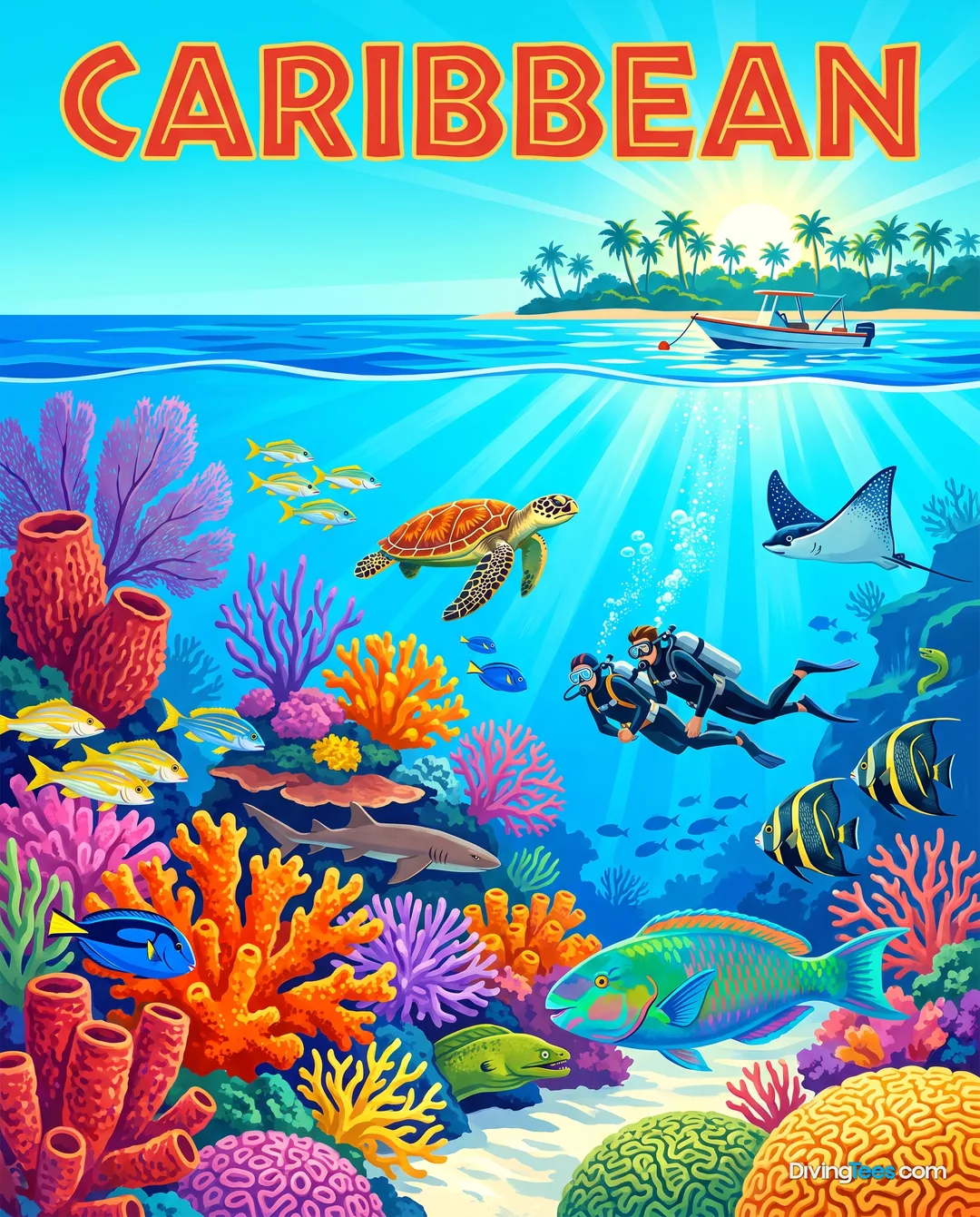
Caribbean
Saint-Martin: two sides, year-round island diving
Saint-Martin links Rocher Créole, Proselyte Reef and the Man of War Shoal Marine Park across an island split between Saint-Martin and Sint Maarten.
What makes this country unique
- Rocher Créole on the Saint-Martin side
- Proselyte Reef among Sint Maarten departures
- Man of War Shoal Marine Park
- Tintamarre and the Histoire tug wreck
- Saint-Martin and Sint Maarten administrations
- The rainy season and cyclonic-season buffer
For subtitles in English: start the video firstthen click the gearat the top right of the video, select “Subtitles/CC”, then “Auto-translate” and choose “English”.
This country for a diver
Saint-Martin is a two-sided diving destination rather than a single, uniform coast. Saint-Martin and Sint Maarten sit on the same island but divide departures, operators and practical planning between separate administrations. That distinction matters more here than a supposed change in diving level: the country suits all levels, with variable current, mixed reef and wreck diving, mixed reef health and moderate tourism pressure. Rocher Créole and Proselyte Reef are useful anchors for understanding that split. Sint Maarten also differs through the possibility of a cruise-based visit, while Saint-Martin does not.
How the country divides
The useful division is administrative as much as geographical. The Saint-Martin side is the French part of the island, with departures connected to sites such as Rocher Créole and with protected-site planning linked to the natural reserve. Sint Maarten is the other administration, where Proselyte Reef belongs and where a cruise-based visit is possible. These are not interchangeable labels for one booking: centres and departure points are spread across the two sides, so the name on a reservation needs checking before flights and transfers are fixed. Divers wanting a shore-based stay should choose the side that matches the operator and site plan; cruise passengers need to treat Sint Maarten as a separate arrival pattern. The common ground is a mixed programme suitable for all levels, but current remains variable and the condition of the reef is not uniform. The country page therefore works as a choice of side, not as a single coastal circuit.
Diving destinations


Dive centres


Hotels

When to go, and where by month
Saint-Martin has a year-round diving calendar: January, February, March, April, May, June, July, August, September, October, November and December all belong to the season. There is no opposing seasonal pattern that makes one side the automatic answer while the other closes. That does not make every week equally dependable. The rainy season and tropical disturbances can interrupt boat plans, while the cyclonic season can bring swell, cancellations and sharply reduced visibility on exposed sites. Keep a reserve day in the itinerary rather than filling every day with diving. This is particularly sensible when crossings or a side change are involved, because weather can affect both the boat programme and the transfer plan. The year-round label is therefore a scheduling advantage, not a reason to remove all flexibility. A quiet month on paper can still need the same practical margin as a busier one when conditions turn.
Marine life, coast by coast
Saint-Martin does not lend itself to a single wildlife promise detached from the site. The useful country-wide reference is the Man of War Shoal Marine Park, where reef, wreck and protected fauna belong to the same planning context. That protection is a reason to treat the park as a distinct part of the itinerary, not as a description of every departure from Saint-Martin or Sint Maarten. Rocher Créole and Proselyte Reef should likewise remain side-specific anchors rather than interchangeable wildlife stops. The Histoire tug, off Tintamarre to the north of Saint-Martin, gives the island a separate wreck-led focus. Plan wildlife interest around the named site and its protection status, and do not assume that visibility or encounters carry unchanged from one side of the island to the other.
Getting between the areas
Moving between Saint-Martin and Sint Maarten is not a simple change of dive site. The two administrations divide centres and departure zones, so changing sides can alter the operator, the meeting point and the day’s boat plan. Treat a side change as a transfer decision rather than an incidental add-on to a week based in one place. The two sides can be compared when choosing an itinerary, but they should not be booked as though every departure were interchangeable. Sint Maarten’s cruise possibility also creates a different rhythm from a Saint-Martin stay. Crossings and weather-sensitive boats deserve slack in the programme, particularly when a return flight follows a transfer. A reserve day protects the diving plan from swell, tropical disruption or a missed connection without pretending that the island works as one seamless dive base.
Take off your mask
Saint-Martin’s most distinctive non-diving character is its divided identity. Saint-Martin and Sint Maarten share one island while belonging to separate administrations, and that boundary shapes the practical rhythm of a stay as much as the diving does. Tintamarre gives the northern waters a named island presence, while the Histoire tug is associated with the sea off its northern side. For a wider Caribbean reference, the British Virgin Islands lie west of Saint-Martin; there, a historical warship was scuttled on 14 April to become an artificial reef and an underwater artwork. That detail belongs to the surrounding region rather than to Saint-Martin itself, but it places the island within a Caribbean culture of maritime history and deliberate wreck creation. Away from the water, the concrete point is to decide which administration forms the centre of the trip, rather than treating the island’s two names as interchangeable.
What holds true everywhere here
The practical constant is the need for margin. Build a reserve day into any programme exposed to swell or tropical disturbances, particularly during the cyclonic season, because a cancelled boat can otherwise unsettle the whole return journey. Keep a day without diving before the flight home; crossings, weather and the usual surface-interval rules all affect the final schedule. Rental provision varies between centres, so bring a dive computer and thermal protection when your configuration or size is uncommon. On the French side, choose a centre registered as a partner of the natural reserve for protected sites. The Man of War Shoal Marine Park can add reefs, wrecks and protected fauna to the plan, but visibility should never be assumed to match across Saint-Martin and Sint Maarten.
Frequently asked questions about St. Martin
When should you visit Saint-Martin for diving?
Plan around the rainy season and allow for the cyclonic-season buffer when choosing your Saint-Martin stay. The destination links sites on both Saint-Martin and Sint Maarten, so timing should be considered alongside your intended departures and itinerary, rather than treated as a single island-wide diving condition.
What can you see while diving around Saint-Martin?
Saint-Martin offers several distinct diving focuses. Rocher Créole is on the Saint-Martin side, Proselyte Reef is associated with Sint Maarten departures, and the Man of War Shoal Marine Park combines reef, wreck and protected fauna. Near northern Saint-Martin, the Histoire tug off Tintamarre adds a separate wreck-led option.
How should you choose dive sites in Saint-Martin?
Choose Saint-Martin sites by their location and character instead of treating them as interchangeable. Keep Rocher Créole tied to the Saint-Martin side, Proselyte Reef to Sint Maarten departures, and the Histoire tug to Tintamarre. Plan wildlife interest around the named site and the protection status of Man of War Shoal Marine Park.
How should you plan a Saint-Martin diving stay across the island?
Build your Saint-Martin itinerary with both administrations in mind, since the island is split between Saint-Martin and Sint Maarten. Decide whether you want the Saint-Martin-side Rocher Créole, Sint Maarten departures for Proselyte Reef, Man of War Shoal Marine Park, or the Histoire tug near Tintamarre, then account for the rainy and cyclonic seasons.