
半島海人 Beyond The Surface, Harry Ding
Google 5/5 (991 reviews)
Taiwan · Asia
Shallow Houbihu reefs, 20 to 30-metre drop-offs, coral spawning and turtles give Hengchun a practical base for exploring Taiwan’s southern peninsula.
Houbihu’s shallow coastal reefs make a useful starting point for a Hengchun dive holiday, whether the first immersion is a course session or a gentle re-acquaintance with warm-water diving. From there, the peninsula opens towards Nanwan, Kenting and deeper boat sites reaching roughly 20 to 30 metres. The attraction is flexibility rather than a single signature dive: on a suitable day, beginners can stay shallow, while more experienced divers can move on to drop-offs and deeper reef terrain.
Hengchun mixes shore diving with boat outings. Around Houbihu, shallow, relatively calm reefs provide room for training and first dives. Nanwan offers accessible reef diving, while other sites around the peninsula add drop-offs and depths of about 20 to 30 metres. Some reefs have gentle currents, but conditions are not uniformly benign: currents can strengthen with the site and sea state, so a downcurrent or drift dive should never be assumed from the map alone. Visibility is changeable, commonly about 5 to 25 metres, with better figures possible in good conditions. Wind, rain, waves, typhoons and runoff can stir sediment. That makes the practical appeal of Hengchun clear: the day’s sheltered coast can matter more than a fixed itinerary, and a boat trip is useful when the sea allows it.
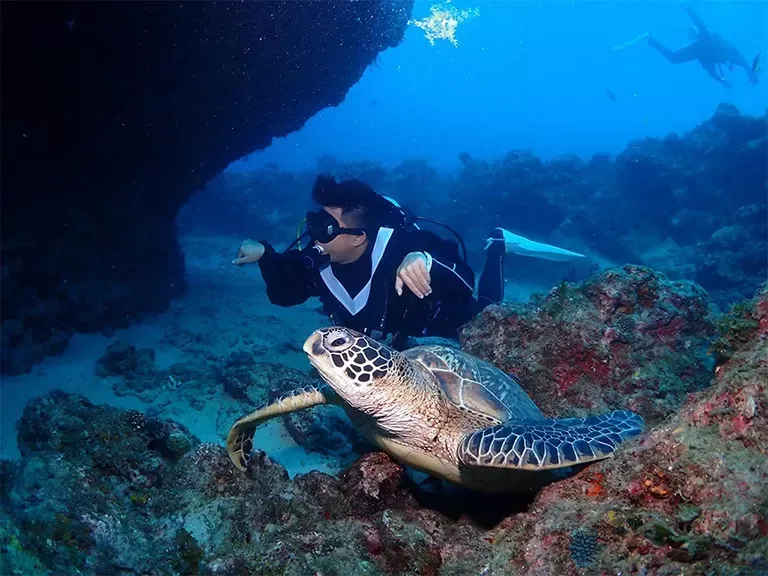
Sea turtles are a regular possibility around Hengchun, but they are not a reason to chase an animal across the reef. Leave them space and let the encounter happen on its own terms. Coral is the underlying feature of the shallow sites, with coral reproduction reported from March to May, when the reef can feel especially active. From September to November, migratory fish may add movement to the usual reef life, although their appearance is occasional rather than guaranteed. The sensible expectation is a coral-reef dive with turtles as a recurring highlight, rather than a destination built around a long species list. Good buoyancy matters here because the reefs sit within a protected national-park environment and living coral is easily damaged by a careless fin or knee.
April, May, September, October and November offer the most useful balance. These transition months avoid much of the winter north-east monsoon exposure at Nanwan while carrying less of the summer risk from typhoons, heavy rain and sediment stirred by runoff. June, July and August are the awkward period for a tightly packed programme, because a typhoon or rough sea can close a planned launch and reduce visibility. Winter can still produce worthwhile diving on the coast that is workable that day, but Nanwan may be more exposed. Keep the itinerary flexible rather than treating year-round possibility as a year-round guarantee.
Hengchun suits every level, provided the site matches the conditions. Houbihu is the natural place for a beginner, a refresher or an open-water course, with shallow reefs and relatively calm water when the sea is settled. Divers heading for deeper sites or boat dives should have Advanced Open Water, or comparable depth experience through BSAC, PADI or SSI. Expect variable currents rather than assuming every reef will be gentle. Confident divers should still be comfortable changing site, shortening a dive or missing a launch when waves and wind make the planned water unsuitable.
From London Heathrow, London Gatwick or Manchester, the journey is a flight followed by overland travel. Hengchun is not served directly by European airlines, and there is no compulsory ferry leg. From Taoyuan International Airport, continue south by road or other ground transport, then follow the peninsula road to Hengchun. Travellers arriving via Kaohsiung continue by road or coach. Allow room in the plan for those connections, especially if the first dive is scheduled soon after arrival. Once in the area, the sites are spread between Hengchun, Nanwan, Kenting and Houbihu. A scooter, taxi or centre shuttle is therefore more useful than relying on walking, with Houbihu about fifteen minutes by road from Hengchun in normal conditions.
Treat the coast as a daily decision. In winter, do not build every dive around Nanwan, because the north-east monsoon can leave it exposed; ask which shore is sheltered instead. In summer, leave a buffer day for typhoons, rough water and the sediment they can bring, rather than trying to rescue a fixed run of dives. Red flags and excessive waves are not a nuisance to work around: Kenting National Park prohibits shore and boat diving in those conditions. Stay out until restrictions lift. Book or arrange road transport before dive days, since accommodation in Hengchun, Nanwan and Kenting is not always close to a launch. Pack seasonal thermal protection for winter, and do not mistake a calm Houbihu training session for proof that every site has mild currents. Never touch coral or pursue turtles.
Plan on a land-based stay of five to seven days, using the extra time to move between Houbihu, Nanwan and deeper boat sites as weather permits. Nanwan is convenient for access to several centres, while Houbihu requires a road transfer from Hengchun. A scooter, taxi or available shuttle simplifies those daily moves. The same base also works for non-divers, with Kenting’s beaches, coastal scenery and forest areas, plus Hengchun’s historic town and old gates for days when the sea is closed.
Hello, I'm Marina, DivingDeal.com's AI assistant. I guide you through destinations, areas and countries.
Thinking about the whole trip and the flights? Talk it over with Edith →
Marina is an AI. Some links are affiliate links: DivingDeal may earn a commission, at no extra cost to you. Bookings are made with the partner.
April, May, September, October and November offer a useful balance between winter north-east monsoon exposure and summer typhoon, heavy rain and runoff risks. Winter can still provide worthwhile coastal diving, while summer may disrupt launches and visibility. Keep your schedule flexible and check which coast is sheltered each day.
Hengchun suits different experience levels when you choose sites according to conditions. Houbihu’s shallow, relatively calm reefs support beginners, refreshers and open-water courses. Deeper boat sites and drop-offs require Advanced Open Water or comparable depth experience. Currents can vary, so be ready to change sites, shorten a dive or skip a launch.
You can expect coral-reef diving, with sea turtles a regular possibility around the peninsula. Coral reproduction from March to May can make shallow reefs feel especially active, while migratory fish may add movement from September to November. Gentle currents occur at some sites, but visibility and marine life vary with weather and sea conditions.
Use Hengchun as a land-based base and allow time to move between Houbihu, Nanwan and deeper boat sites as weather permits. Arrange a scooter, taxi or centre shuttle because sites are spread along the peninsula. Leave flexibility for rough seas and closures, and consider Kenting beaches, coastal scenery, forest areas and Hengchun’s historic town on non-diving days.