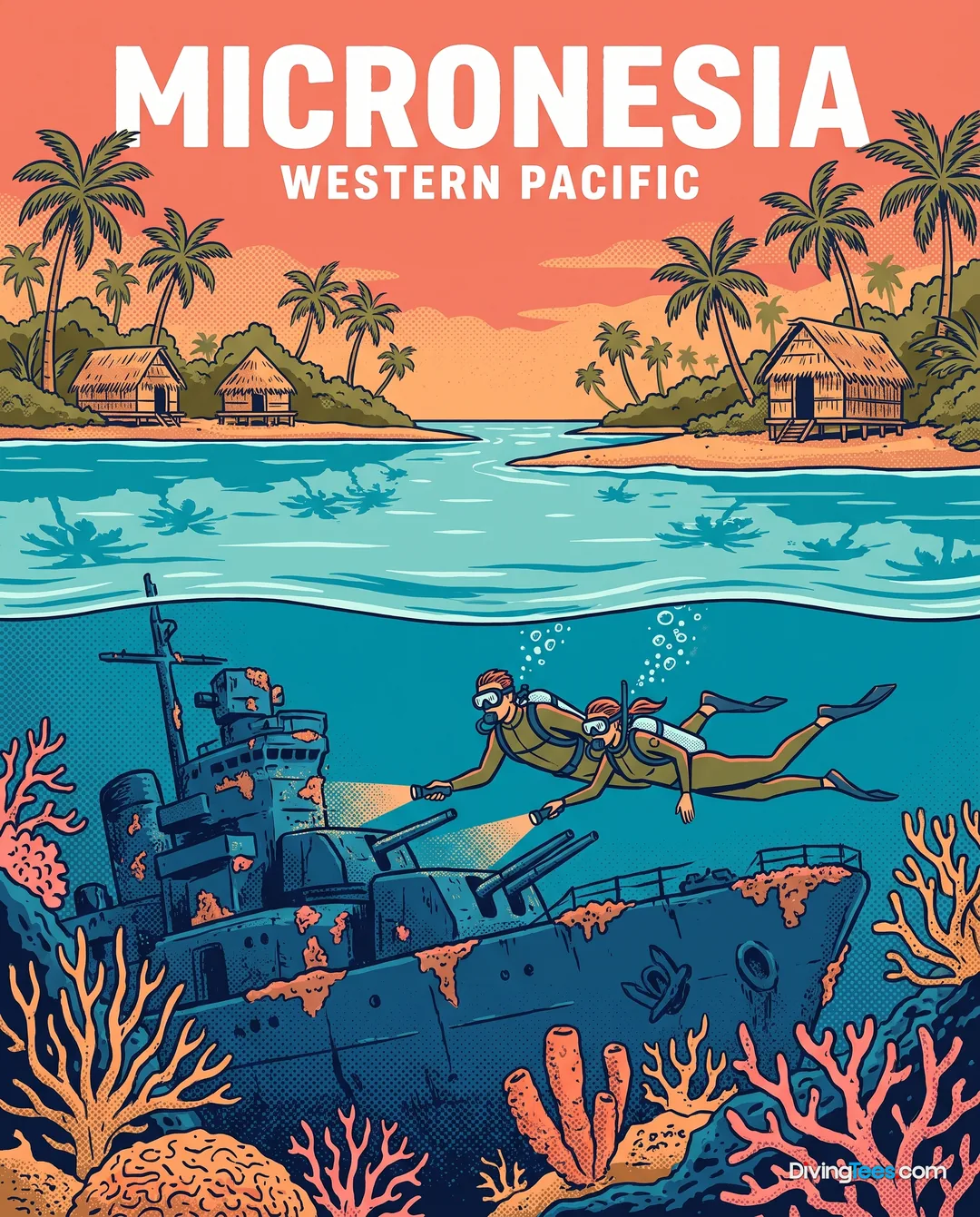
Liveaboards · Micronesia
Pacific Master — a working dive boat for Truk Lagoon and Bikini Atoll
What makes this boat unique
- A steel-hulled liveaboard built around diving, with a spacious dive deck, individual stations, storage and a dedicated camera area.
- Pacific Master carries up to 20 guests in air-conditioned cabins, from standard singles and twins with shared bathrooms to en-suite classic and premium cabins.
- Nitrox, DIN adaptors, technical diving and rebreather support are available, with rental equipment and gases offered as options.
- Cruises cover Truk Lagoon in 8 to 11 nights or Bikini Atoll in 11 nights, with transfers from the airport and hotel included.
For subtitles in English: start the video firstthen click the gearat the top right of the video, select “Subtitles/CC”, then “Auto-translate” and choose “English”.
The invitation
Pacific Master is for divers who choose the wrecks and the water first, then decide how much cabin comfort they need. The boat was built as a working dive platform, not as a floating resort: there is room to leave equipment assembled, a proper dive platform, two diver tenders and a camera area that gives photographers somewhere to work between dives. Truk Lagoon and Bikini Atoll are the reason to come. Both routes suit divers prepared for a focused liveaboard trip, including technical and rebreather divers who need more than a standard recreational setup. The boat welcomes snorkelers and non-divers too, but its character is clear. It is a practical base for serious diving, with a crew and galley that score better than the hull itself: boat 8.5, crew 9.0, food 9.7 and diving 9.3.
Boarding
From the dock, Pacific Master presents as a compact, purposeful steel vessel rather than a polished yacht. Built in 2004 and previously operated as M/V Taka in the Solomon Islands, it has the look of a boat that was made to work: equipment belongs on the dive deck, divers move directly towards the platform, and the main deck keeps the lounge and dining area close to the centre of life on board. Inside, the air-conditioned saloon and dining room provide a useful retreat from heat, weather and wet kit. Outside, the sun deck gives the boat its breathing space. The layout is easier to understand once the diving starts; the route from cabin to station to platform is the part that matters.
The atmosphere on board
Pacific Master feels more like a small working dive community than a large cruise ship. With a maximum of 20 guests, the same faces return to the dive deck, the dining table and the saloon after every jump. The crew's role is visible in the practical details: stations stay organised, equipment has somewhere to go, and the boat is set up so divers can move through the day without carrying their entire kit around the living spaces. The strongest onboard impression comes from the people and the galley rather than from the ageing hull. That is reflected in the scores: crew 9.0 and food 9.7 against boat 8.5. The trade is straightforward—less polish, more useful diving space and a crew that carries the experience.
The sites you’ll dive
The recorded itineraries are Bikini Atoll from Kwajalein to Kwajalein in 12 days and 11 nights, and Truk Lagoon from Weno to Weno in 8, 10 or 11 days and 7, 9 or 10 nights. Bikini Atoll is the longer expedition-style route; Truk Lagoon offers several shorter and longer versions from the same port. No individual site descriptions are available here, so no wreck name, wall, pinnacle, depth or species claim is added. The value of Pacific Master on these routes lies in the platform it gives divers for the destination: a spacious working deck, two tenders and support for technical and rebreather diving.
Who puts you in the water
The dive team operates in English. Pacific Master is set up for recreational, technical and rebreather diving, and a private dive guide can be arranged as an option. The onboard safety equipment includes emergency oxygen, first-aid kits, lifejackets, lifeboats, a VHF/DSC/SSB radio and a locating beacon, with crew trained in first aid. The boat's published information does not give guide numbers, group ratios, qualification requirements, logged-dive minimums, course availability or a recall system. What is clear is the intended level: this is a boat for divers who are comfortable managing their own equipment and dives, with additional support available for technical and rebreather configurations.
The dive deck and the gear
The dive deck is the boat's main argument. Individual dive stations provide room to set up and store accessories, while the platform leads directly into the water. Freshwater rinse tanks are available for equipment, with a separate camera area for photographers and charging stations for batteries and lights. Divers return to freshwater deck showers after the dive, and two tenders support entries and pickups away from the hull. Pacific Master offers nitrox, DIN adaptors, equipment rental, technical diving and rebreather support; nitrox, rental equipment and the gases or cylinders needed for technical and rebreather diving are optional extras rather than automatic inclusions. The published specifications do not give tank volume, tank material, compressor model, SMB provision or a tender boarding arrangement, so those details are not used to dress up the description.
Between dives
Between dives, the main-deck saloon is the dependable refuge: air-conditioned, furnished for sitting, and equipped with a library and audio-video entertainment. The terrace and sun deck offer the opposite choice when the weather is right, with space to sit outside rather than remain in the lounge. Divers can use the outdoor showers to rinse salt and gear, while kayaks provide another way to get off the main boat when the itinerary allows it. Photographers have a dedicated area and charging stations, so cameras do not need to be packed away after every dive. The spaces are arranged for the gaps that matter on a liveaboard: drying off, eating, checking a computer, charging a camera and finding shade.
A day on board
A day on Pacific Master is organised around the dives rather than around a hotel timetable. The first briefing comes before the first entry; after the dive, equipment returns to the individual station, cameras go into their dedicated area, and divers move towards breakfast or the next surface interval. Further briefings, meals, snacks and freshwater showers mark the spaces between entries, while the boat can be underway between parts of the route. The saloon offers air-conditioning and the library or video system; the sun deck and terrace provide shade or open air when the weather allows. The exact number and timing of dives depend on the itinerary and dive plan, so the useful certainty is the order: briefing, water, recovery, food, surface interval, then back to the deck.
What you eat aboard
Full-board meals are included, with a buffet built around Western and local cooking. Vegetarian options are available, and tea, coffee, drinking water and snacks are provided through the day. Beer and wine are available, while alcoholic and non-alcoholic drinks beyond the included service are optional. The large main-deck dining area gives meals a practical role on a diving trip: it is where the group refuels, compares notes and gets ready for the next entry rather than simply sitting down for a formal dinner. Food is the boat's strongest scored area, at 9.7, which is a useful signal for anyone spending more than a week aboard.
Nights at sea
The cabin choice is practical rather than uniform. Standard single and twin cabins have air-conditioning but share bathroom facilities on the dive deck, while the classic twin, classic twin/double and premium double categories have private bathrooms. That distinction matters on a longer wreck trip: a standard cabin keeps the cost and space simple, while an en-suite cabin gives more privacy after a full day in a wetsuit. Storage is provided for dive belongings, and cabin and deck towels are included. The boat is not trying to disguise its working character with oversized rooms. Its better decision is the separation between sleeping space and the generous dive deck, where wet equipment and cameras have somewhere to live instead of taking over the cabin.
Standard Single Cabin
Standard Twin Cabin
Classic Twin Cabins
Classic Twin/Double Cabins
Premium Double Cabins
What to know before boarding
Truk Lagoon trips depart from and return to Weno; Bikini Atoll trips depart from and return to Kwajalein. Airport and hotel transfers are included, and the arrangements are provided with the trip information. Arriving the night before is sensible, especially for an international journey, so a delayed connection does not put the embarkation at risk.
- Year built
- 2004
- Length
- 30 m
- Maximum number of passengers
- 20
- Number of cabins
- 12
- Number of bathrooms
- 11
- Engines
- 1800 hp MTU 2000 vl2
- Cruising speed
- 11 knots
- Website
- masterliveaboards.com ↗
Hello, I'm Marina, DivingDeal.com's AI assistant. I answer in detail about hotels, dive centres and liveaboards.

Thinking about the whole trip and the flights? Talk it over with Edith →
Marina is an AI. Some links are affiliate links: DivingDeal may earn a commission, at no extra cost to you. Bookings are made with the partner.