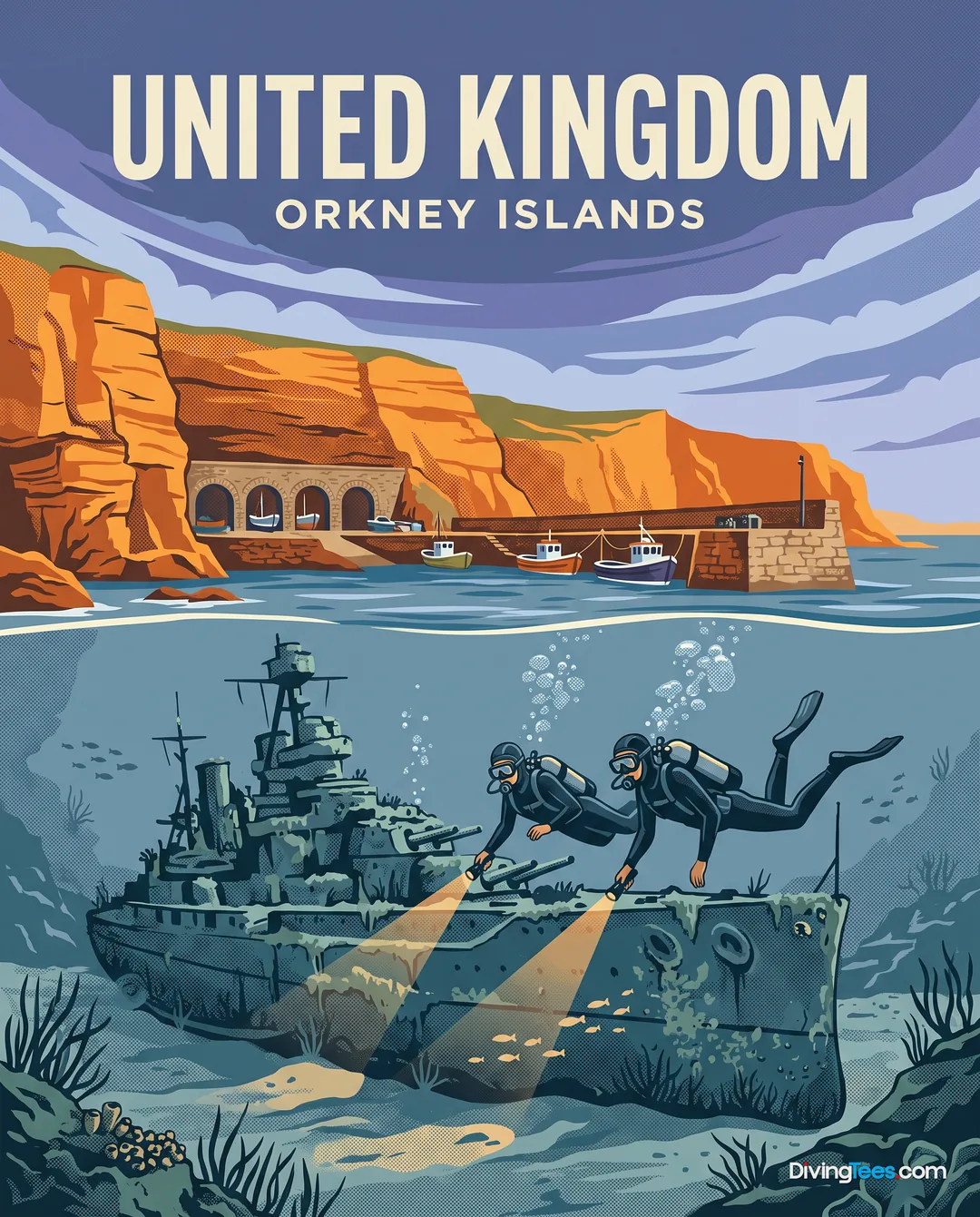
United Kingdom · Atlantic
Diving Scapa Flow: First World War German Wrecks
German First World War wrecks, the James Barrie’s deep trawler hull, and 43-metre seabeds define Scapa Flow’s demanding Orkney diving.
What makes this destination special
- German fleet wrecks linked to the 1919 scuttling
- James Barrie trawler wreck from 33 to 43 metres
- Protected waters around the Orkney islands
- Boat diving shaped by tides and slack water
- Visibility of 10 to 20 metres on James Barrie
- Historic Marine Protected Area protecting the wrecks
- Cold-water repetitive diving on major metal structures
For subtitles in English: start the video firstthen click the gearat the top right of the video, select “Subtitles/CC”, then “Auto-translate” and choose “English”.
Overview
Scapa Flow is a destination for divers who want history under their hands and a substantial wreck beneath their fins. The focus is the German fleet scuttled in 1919, explored from boats operating around the sheltered waters of the Orkney islands. This is not a gentle introduction to wreck diving: depth, cold-water exposure, tides and boat logistics all matter. For an experienced diver, the reward is the scale of the structures and the chance to make sense of a naval story underwater.
Diving here
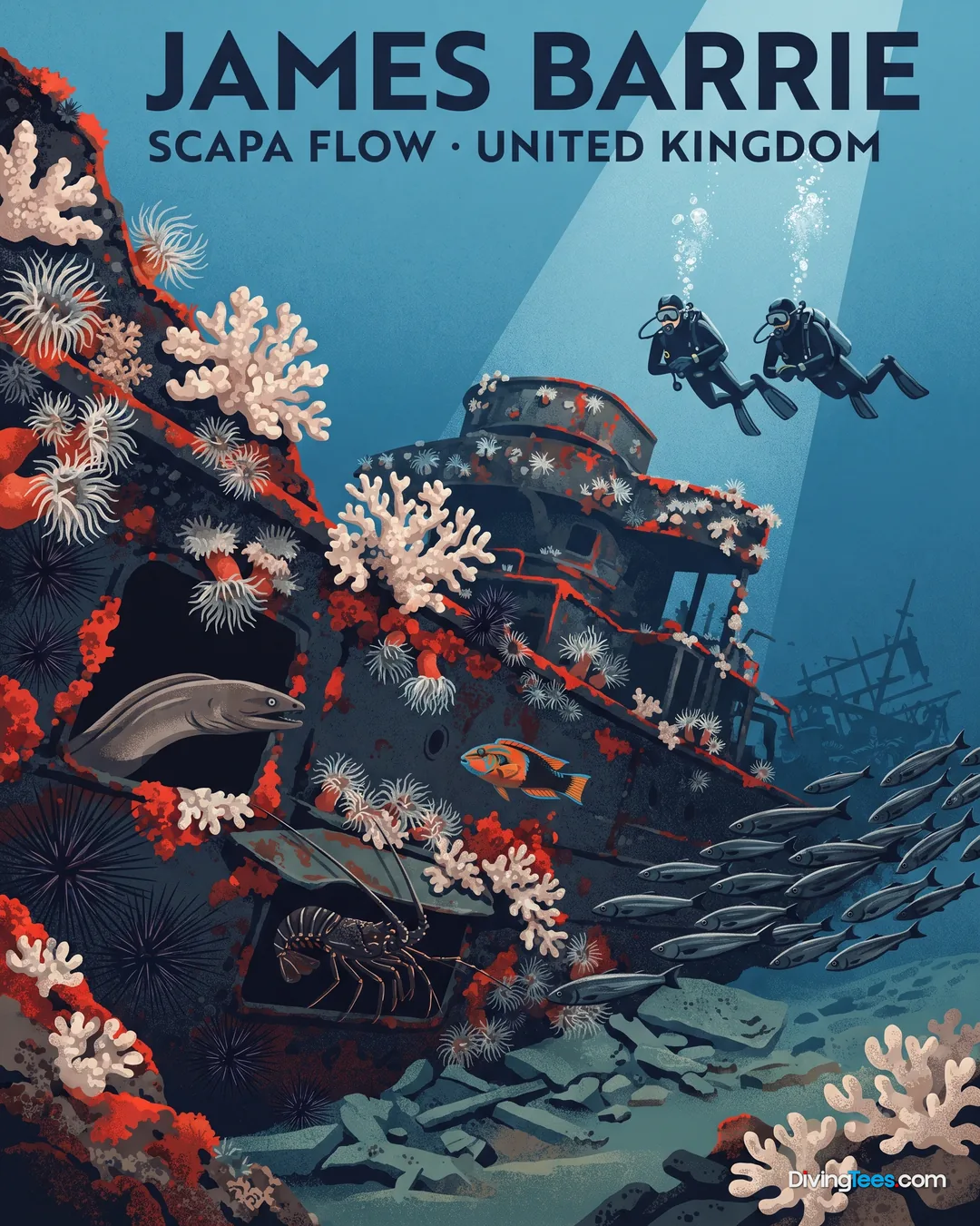
The diving is dominated by large metal wrecks rather than coral formations or a mixture of shallow shore sites. Depth and tide shape the day. The James Barrie shows the point clearly: its port railing begins at about 33 metres and the seabed reaches 43 metres, with visibility reported between 10 and 20 metres. Outside a short slack-water window, currents can be strong, so timing is not a minor detail to be left until the descent. Most dives are boat dives, with the order of wrecks adjusted to weather, sea state and tidal conditions. Plans may involve decompression, particularly when experienced divers choose deeper profiles or repeated wreck dives. Nitrox, where appropriate to the diver’s training and plan, is useful to consider, but it does not remove the need for disciplined gas, exposure and time management.
One dive not to miss
The underwater wildlife
Scapa Flow’s defining encounter is with wreckage rather than a named seasonal animal. The eye is drawn to railings, bows, stern sections, superstructures and the broken details of warships and working vessels. On the James Barrie, the change from the wreck’s upper edge at roughly 33 metres to the seabed at 43 metres creates a clear underwater profile to follow, rather than a shallow meander among reef life. Historical interpretation is part of what the diver encounters: the shape of a vessel, the position of its remaining structure and the pieces that have separated over time. The site’s appeal is therefore consistent across the season: it lies in reading the wreck itself.
When to go
Scapa Flow rewards a flexible schedule rather than a rigid promise of a particular month. Weather, sea state and the brief slack-water period can decide which wreck is practical on a given day, so a week with room to rearrange dives is more useful than an itinerary built around one fixed sequence. The right season is consequently the one that fits the local boat programme and allows spare days for weather. The reason to avoid a tightly packed plan is simple: here, conditions determine access to the wrecks, not just comfort on the surface.
Level required
This is for experienced divers who are already comfortable with boat procedures, cold water, depth and the practical demands of wreck diving. A wreck qualification is useful, while Deep and Nitrox training may be relevant to the planned profiles. BSAC, PADI and SSI divers should match their certification and logged experience to the actual depth and decompression demands. Scapa Flow is not a general beginner destination or a place to rebuild basic confidence; the James Barrie alone reaches 43 metres and requires careful tidal timing.
On the ground
From London Heathrow, Gatwick or Manchester, the journey is built around reaching the Orkney islands and then completing the essential ferry crossing. There is no direct road or shore route to the wrecks themselves: once on the islands, divers still travel by road to the local embarkation point and go out by boat. The ferry is therefore the structural constraint, not a minor transfer at the end of the trip. Connections need enough margin for the crossing and for local road movements, while the diving schedule must remain coordinated with the boat departure. Scapa Flow is best treated as an island journey with organised sea access, not as a shore-diving base where sites can be reached independently on foot.
Local tips
Arrive prepared for a week governed by boats, tides and weather, rather than assuming that a named wreck will be visited on a particular day. Keep the itinerary flexible and allow room for a missed or rearranged outing; the short slack-water window is especially important on sites such as the James Barrie, where currents outside it can be strong. Bring a configuration suited to repeated cold-water dives, and be honest about whether depth and decompression experience match the plan. Read about the German fleet and the 1919 scuttling before travelling: the superstructures and separated pieces make more sense when the history is familiar. Do not arrive expecting tropical reef colour or a macro-focused wildlife trip. The main attraction is the scale and history of the wrecks, reached by boat after the ferry and island road journey.
Planning your stay
A fixed stay on the Orkney islands suits divers who want repeated boat outings while retaining flexibility when conditions change. A liveaboard is another option for those aiming to maximise wreck diving over a week, but the land-based format makes it easier to absorb weather delays and explore the islands between dives. Non-divers can use the same stay for coastal walks, heritage visits and Orkney landscapes, so the destination can work for a travelling companion without turning the trip into a purely underwater schedule.
Hello, I'm Marina, DivingDeal.com's AI assistant. I guide you through destinations, areas and countries.

Thinking about the whole trip and the flights? Talk it over with Edith →
Marina is an AI. Some links are affiliate links: DivingDeal may earn a commission, at no extra cost to you. Bookings are made with the partner.