Liveaboards · Turks & Caicos Islands
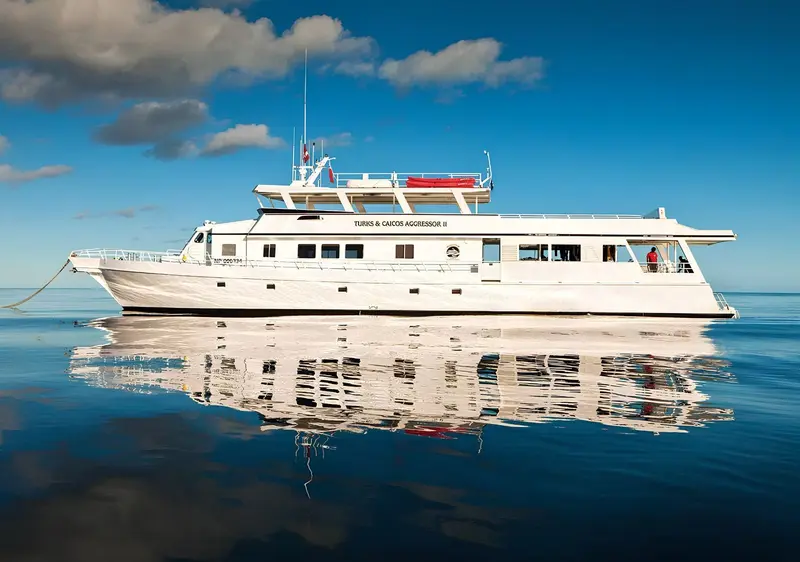
Turks and Caicos Explorer — A Purpose-Built Caribbean Dive Yacht
Deal on this boat
Per person
£2,611$3,491€3,119 £2,014$2,692€2,405
Discount calculated by us, against the boat's usual price for a trip of the same length.
See all discounted dates ↓What makes this boat unique
- A custom-designed dive yacht with Naiad stabilizers, a heavy keel and space for up to 20 passengers in 10 private en-suite staterooms.
- The dive deck has shaded work space, DIN adapters, separate camera and gear rinse tanks, and rigid-hull inflatable tenders for diver pickup.
- Turks and Caicos trips run for 8 days and 7 nights from Caicos Marina in Providenciales.
- Alcoholic and non-alcoholic drinks, meals, snacks and the dive package are included; nitrox and rental equipment are optional extras.
For subtitles in English: start the video firstthen click the gearat the top right of the video, select “Subtitles/CC”, then “Auto-translate” and choose “English”.
The invitation
Turks and Caicos Explorer is for divers who want the boat built around the water rather than a resort with tanks on the back. The hull was designed for open-water work around the remote Turks and Caicos islands, with stabilizers and a heavy keel that matter when the sea is moving and the boat is still serving as a dive platform. Providenciales gives access to clear Caribbean diving, while the same vessel can make the open-water run to Silver Bank for humpback whale snorkeling from January through April. It is also a boat with a long working life: built in 1995 and renovated in 2005, it carries more history than a new yacht but keeps the practical layout expected of a dedicated dive vessel. The reason to choose it is simple: a week where diving, not decoration, sets the shape of the trip.
Boarding
From Caicos Marina in Providenciales, the boat presents itself as working dive equipment on a yacht scale: an aluminum hull, broad side decks and a dive platform ready for tanks rather than luggage alone. Its stabilizers and heavy keel are not decorative details; they are there for the open-water passages and the long hours spent moving between remote islands. Once aboard, the layout separates the places that get wet from the places where people eat and sleep. The shaded dive area keeps divers out of direct sun while gear is prepared, and the upper outdoor areas give the group somewhere to spread out after a dive. It is a vessel with a serviceable, established character rather than a minimalist new-build feel.
The atmosphere on board
The atmosphere is shaped less by formal luxury than by a crew that stays close to the diving operation. The team speaks English and includes local and international crew, with deck staff handling the practical work that makes repeated entries and exits less tiring. Passenger feedback gives the crew a stronger mark than the boat itself, while food scores highest of all; that points to the real balance of the vessel. The hull has an established, working-boat character, but the people aboard are what turn it into an easy week. By the second day, the same crew members are watching for a loose strap, a camera that needs careful handling or a diver who wants help with a tank. Evenings are for the bar, the salon or the deck after the last dive, with drinks already part of the onboard routine.
Who puts you in the water
The dive staff runs briefings and in-water support in English. The boat welcomes both experienced divers and novices, with nitrox and scuba certification courses available on board. Divers have access to oxygen, first-aid kits, life jackets, life rafts and marine communications equipment including VHF, SSB and DSC radio. Briefings cover the day’s conditions, entry plan, tender pickup and limits before divers get wet.
The dive deck and the gear
The dive deck is shaded and set up for repeated diving, with tank racks, gear rinse tanks and a separate freshwater rinse for cameras. DIN adapters are available, and air is produced by two Bauer K-14 compressors with cascade storage banks. Nitrox is made through a membrane system producing 32% nitrox; it is available as an optional extra rather than included by default. Rental equipment is also optional, while snorkeling equipment can be rented aboard. A dedicated camera area, charging stations and separate camera-rinse space suit photographers better than a shared bucket beside the scuba gear. Divers enter from the platform, and rigid-hull inflatable tenders handle transport and pickup away from the yacht. That tender work matters in open water: the boat can stay clear of the site while the tender collects divers where they surface.
Between dives
Between dives, the shaded dive space is the practical centre of the boat: a place to check gear, rinse cameras and get out of the sun without disappearing below deck. The boat also has an air-conditioned interior salon, outdoor terrace space, a bar and a barbecue area for time when the group is not preparing for the next entry. Photographers have a dedicated camera room and separate camera rinse facilities, which keeps wet regulators and salt water away from delicate equipment. Those who are not diving can snorkel, and non-divers are welcome aboard. Surface intervals are therefore easy to use in different ways: remain close to the gear, settle into the cooled salon, or move outside for open air and a view of the water.
A day on board
The day starts with breakfast and the first briefing, then two morning dives separated by a snack. Lunch at 12:30 marks the middle of the working day before two afternoon dives, again with food waiting between entries. Dinner follows at around 6:30, when the tanks are quiet and the deck becomes a place to talk, review photographs or sit with a drink. A night dive may extend the day, followed by hot cocoa and the chance to settle outside under the sky. The exact order matters more than a rigid timetable: eat, brief, dive, recover, and repeat until the last cylinder is secured. The boat's movement between sites fills the gaps, while the shaded deck and air-conditioned salon give divers somewhere comfortable to come back to.
What you eat aboard
The galley serves three meals a day, with snacks between dives and a menu that combines local recipes, American favourites and the chef's own dishes. Breakfast comes before the two morning dives, lunch lands at 12:30, and dinner follows the two afternoon dives at around 6:30. Vegetarian and vegan options are available, alongside buffet service, local cuisine and a broad wine selection. Beer, wine, soft drinks, tea and coffee are available, and alcoholic drinks are included. The table matters here because divers do not have to leave the boat or search for food between tanks: a pastry or cookies can bridge the interval, a proper lunch restores the body, and dessert closes the working part of the day.
Nights at sea
The 10 staterooms are arranged as lower-deck, main-deck and VIP categories, with private bathrooms, hot-water showers, air conditioning and standard windows or portlights. Cabins sit on the upper deck level in the listed accommodation layout, while the VIP rooms have the most direct connection to the boat-deck space. The important part after four dives is control: each cabin has its own air conditioning, and nobody has to share a bathroom. Ocean views are available from the cabins, but this is still a dive boat, not a floating suite hotel. At night, the boat's machinery and movement are part of the background of life at sea; the reward is stepping straight from a shower into a quiet, cooled cabin without leaving the vessel.
Lower deck stateroom
Main deck stateroom
VIP stateroom
What to know before boarding
Turks and Caicos Explorer departs from and returns to Caicos Marina in Providenciales on 8-day, 7-night trips. An airport transfer from Providenciales is available as an optional service, and hotel transfers can also be arranged. Guests should arrive in Providenciales the night before boarding so a delayed flight does not put the embarkation at risk.
Deck plan
What the boat does for the ocean
Turks and Caicos Explorer is certified by Green Fins as an eco-liveaboard. Green Fins certification means the operator has committed to the Green Fins Code of Conduct and met a minimum environmental-performance standard during annual assessments.
Itineraries, dates and prices
Prices per person. Each month shows its lowest price: click a month, or pick an itinerary.
Next departures · 42 departuresfrom £2,014$2,692€2,405
November 2026
December 2026
Green dot: a discounted departure that month. Discount calculated by us, against the boat's usual price for a trip of the same length.
See dates and prices
If you click these links and make a purchase on the partner site, DivingDeal may earn a commission, at no extra cost to you.
Dates and prices taken from liveaboard.com, updated 26 October 2026
- Year built
- 1995
- Year renovated
- 2005
- Length
- 37.8 m
- Beam
- 6.7 m
- Maximum number of passengers
- 20
- Number of cabins
- 10
- Number of bathrooms
- 10
- Engines
- 2 × GM 12 V 71 450 hp eac
- Tenders
- Yes
- Website
- explorerventures.com ↗
Hello, I'm Marina, DivingDeal.com's AI assistant. I answer in detail about hotels, dive centres and liveaboards.
Thinking about the whole trip and the flights? Talk it over with Edith →
Marina is an AI. Some links are affiliate links: DivingDeal may earn a commission, at no extra cost to you. Bookings are made with the partner.