Liveaboards · Seychelles
Sea Pearl — a historic schooner for island-hopping divers
What makes this boat unique
- Sea Pearl is a traditional sailing vessel built in 1915 and renovated in 1999.
- The seven-night Seychelles Diving Safari runs between Praslin and Praslin.
- A dedicated tender supports the diving and gives non-divers access to snorkelling, kayaking and island excursions.
- The boat carries up to 20 passengers in eight air-conditioned cabins, with four bathrooms.
- Diving is guided by a PADI instructor, with DIN adapters, rinse tanks and optional rental equipment.
For subtitles in English: start the video firstthen click the gearat the top right of the video, select “Subtitles/CC”, then “Auto-translate” and choose “English”.
The invitation
Sea Pearl is for divers who want the Seychelles as an archipelago, not as a hotel with a daily boat transfer. She carries the history of a working sailing vessel into a week built around granite islands, open water and diving. The appeal is the combination: a traditional schooner, a dedicated tender for the divers, and enough non-diving activity for partners or family to enjoy the same route without sitting out the day. It is a particularly sensible choice when the group is mixed. Divers get access to the inner-island sites with a PADI instructor on board; snorkellers can follow their own programme; everyone returns to the same vessel for meals and the next crossing. Sea Pearl is not the polished yacht option. Her character comes from the older hull and the life she has carried.
Boarding
Sea Pearl began life in 1915 as a Dutch sailing and fishing vessel named Dirk, and her working past remains central to the experience. She became Sea Pearl in 1999, but the point of the renovation was not to erase the boat's identity. Boarding is closer to stepping onto a preserved ship than entering a modern yacht: the vessel's history is part of what you notice before the first dive. Her size keeps the group human rather than anonymous, while the covered aft lounge, dining salon, upper sun deck and bow net give people several places to spread out. Underway, the engine provides a steady cruising speed when the sails are not doing the work. The setting is traditional; the practical side is current, with air conditioning, hot-water showers, charging points and safety equipment.
The atmosphere on board
Sea Pearl's social life is close and practical. With no connected cabins and a limited number of guest spaces, people meet quickly in the dining salon, on deck and around the dive operation. The crew speaks English and French, and the crew includes local and international members. Their role is visible in the small transitions that make a liveaboard work: meals appearing after dives, cabins being serviced, the tender handling the return from the water, and the boat being made ready for the next move. The ratings show a useful distinction: the boat scores 8.0, while the crew reaches 8.9 and the food 9.4. In other words, guests gain warmth and care from a historic vessel rather than the finish of a newer yacht. Evenings are suited to conversation, audio-video entertainment and a drink from the bar, not formal resort ceremony.
What you’ll meet underwater
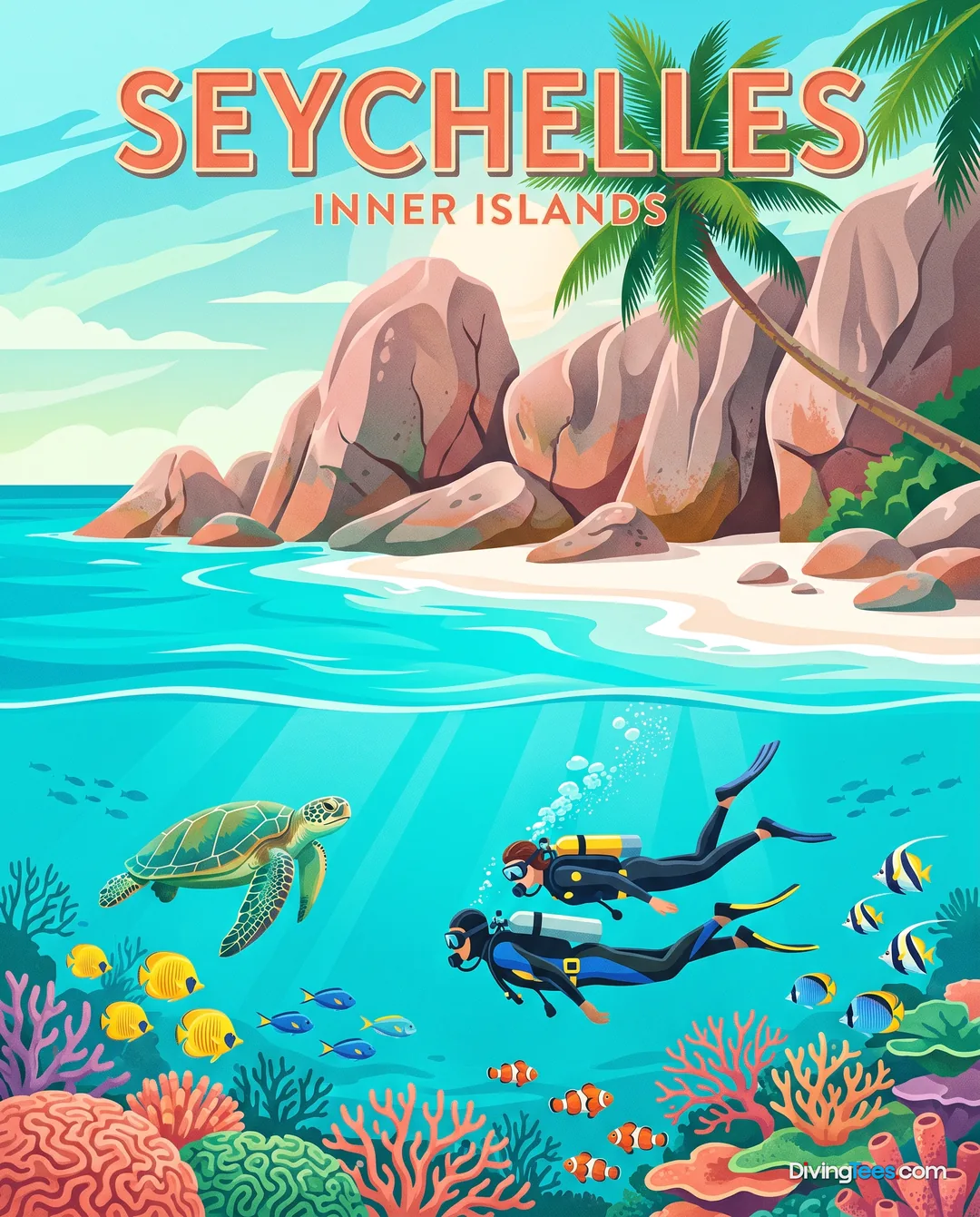
The diving programme is aimed at the characteristic underwater scenery of the Seychelles' inner islands: large granite boulders, passages, caves, coral reefs and wrecks. Tropical fish occupy the reef and rock formations, while turtles, rays and pelagic fish may appear along the route. The larger encounters described for the safari include sharks, barracudas, jacks and tunas, but none should be treated as guaranteed sightings. The reason to choose this route is the range in a single week: sheltered-looking granite formations for a close, structured dive, then open-sea sites reached when conditions allow. The dedicated tender matters here because it gives the dive team mobility beyond the vessel's anchorage. There are no verified site-specific species records for this itinerary, so the honest promise is variety of habitat rather than a particular animal at a named site.
Who puts you in the water
A dedicated PADI dive instructor is on board for the diving programme. The boat also offers introductory dives, PADI Open Water Diver courses for guests arriving with a referral or e-learning certificate, and PADI Advanced Open Water Diver courses; courses must be arranged before the cruise. The service is therefore open to both newly certified divers and experienced guests, but the published information does not give a fixed logged-dive requirement, guide-to-diver ratio or dive-group size. English and French are spoken by the crew. Safety equipment includes oxygen, first-aid kits, life jackets, lifeboats, fire alarms and extinguishers, radio equipment, radar, GPS and an emergency position-indicating radio beacon. The briefings and group organisation are handled by the instructor, with the tender providing the working platform for entries and recoveries.
The dive deck and the gear
The diving setup is built around a dedicated tender, so divers do not have to make every water entry directly from the schooner's hull. The tender takes groups to the site and returns to collect them, giving the crew room to pick up divers where they surface and leaving Sea Pearl available to non-diving guests. On board, divers find rinse tanks and DIN adapters. Diving equipment can be rented, but the published setup does not give tank volume, tank material, compressor type, nitrox availability, camera-table provision, SMB provision or hot-water facilities on the return route. Those are important questions for a diver bringing a full personal setup or planning more demanding profiles. The practical inclusions are clear: the tender supports the diving, rinse tanks protect equipment between entries, and DIN users can connect without bringing an adapter.
Between dives
The gaps between dives are built around the islands rather than around a large resort deck. Guests can lie on the upper sun deck or the bow net, sit in the covered aft lounge, or move straight back into the water with a kayak or stand-up paddleboard. Snorkelling equipment is available, and non-divers can join island excursions or follow the guide on a snorkelling outing while the divers are away. When Sea Pearl is underway, the crossing itself becomes part of the day: the boat links the next anchorage without packing gear, finding a ferry or changing accommodation. Fishing is also available, and beach barbecues give one of the quieter periods a clear destination. The spaces are enough for a mixed group to separate for an hour without losing contact with the rest of the boat.
A day on board
A day begins with the dive team preparing before the first briefing, followed by the tender taking divers to the site. After the first dive, guests return to food, water and a short pause before the next entry. The boat's schedule is shaped by the sites and conditions rather than by a published clock: there are opportunities to dive on most days, with surface intervals filled by meals, snacks, sailing, snorkelling or a quiet hour on deck. The tender handles the movement between Sea Pearl and the divers, while non-divers can kayak, visit an island or stay aboard. Later, the boat settles into dinner and an evening in the salon or outside. The next day's preparation is never far away; tanks, equipment and the route have to be ready before the group sleeps.
What you eat aboard
The chef serves full board, with three meals a day, water, tea and coffee, juice at breakfast and afternoon snacks. The cooking combines local Creole dishes with Western food, served buffet-style, with vegetarian and vegan options available. A beach barbecue is part of the trip, which gives the meal a different setting from the air-conditioned dining salon. Food matters more on a diving cruise than it does on a sightseeing voyage: divers need something substantial after getting out of the water, something ready without a long wait, and enough choice for different appetites across a week. Sea Pearl's food score of 9.4 is the strongest of the published ratings, and the structure of the service explains why. The galley feeds the whole boat repeatedly, not just at dinner.
Nights at sea
The cabins are on the lower deck, with portholes and air conditioning. Category A cabins are doubles, with one bunk available in some cabins; Category B cabins use bunk beds, and a triple cabin combines a double bed with an extra single bed. The arrangement is functional rather than spacious, and the four bathrooms are shared between the cabins. That is the trade-off for choosing a vessel whose appeal lies in its age and sailing character rather than a private bathroom in every room. A washbasin is provided in the cabins, electrical sockets are available there and in the salons, and daily housekeeping keeps the compact spaces workable through the week. Sea Pearl has no cabin minibar, shampoo or hairdryer, so the nights are simple: a cool room, a porthole, and the muted sounds of a live vessel around it.
Triple Cabin A
Double Cabin A
Twin Cabin B
What to know before boarding
The recorded cruise route departs from and returns to Praslin, over seven days and six nights. Airport and hotel transfers are available as optional arrangements rather than as a default part of the cruise. Since the boat's departure is tied to the cruise operation, arriving in the Seychelles the night before is the sensible plan.
Deck plan
- Year built
- 1915
- Year renovated
- 1999
- Length
- 36 m
- Beam
- 6.6 m
- Maximum number of passengers
- 20
- Number of cabins
- 8
- Number of bathrooms
- 4
- Engines
- Cummins MPC 300 hp
- Cruising speed
- 7 knots under engine power
- Tenders
- Yes
- Website
- seychelles-cruises.com ↗
Hello, I'm Marina, DivingDeal.com's AI assistant. I answer in detail about hotels, dive centres and liveaboards.

Thinking about the whole trip and the flights? Talk it over with Edith →
Marina is an AI. Some links are affiliate links: DivingDeal may earn a commission, at no extra cost to you. Bookings are made with the partner.