Indian Ocean
Seychelles: granite islands and isolated atolls
From Victoria’s market to the granite pinnacles off La Digue, Seychelles puts Creole life and boat diving within the same island journey.
What makes this country unique
- Mahé wrecks and granite sites around Beau Vallon
- La Digue between bicycles and Channel Rock
- Desroches and the remote Astove Atoll
- January to April across three island bases
- Carangue, grouper and yellow snapper sightings
- Octopus curry and satini reken at Mahé tables
- Victoria Market, Beau Vallon and Festival Kreol
- Takamaka rum with Creole fish and rice
For subtitles in English: start the video firstthen click the gearat the top right of the video, select “Subtitles/CC”, then “Auto-translate” and choose “English”.
This country for a diver
Seychelles is an isolated Indian Ocean archipelago where granite islands drop into boat-diving territory, while distant coral islands feel more like outposts than seaside towns. Mahé and La Digue share the inhabited-island rhythm: working ports, local food and access to a spread of sites, with currents that can change from gentle to demanding. Desroches is the counterpoint, built around a remote resort and marine activities. Across the country, diving suits all levels, but the dominant format is by boat and reef condition is mixed rather than uniformly pristine.
How the country divides
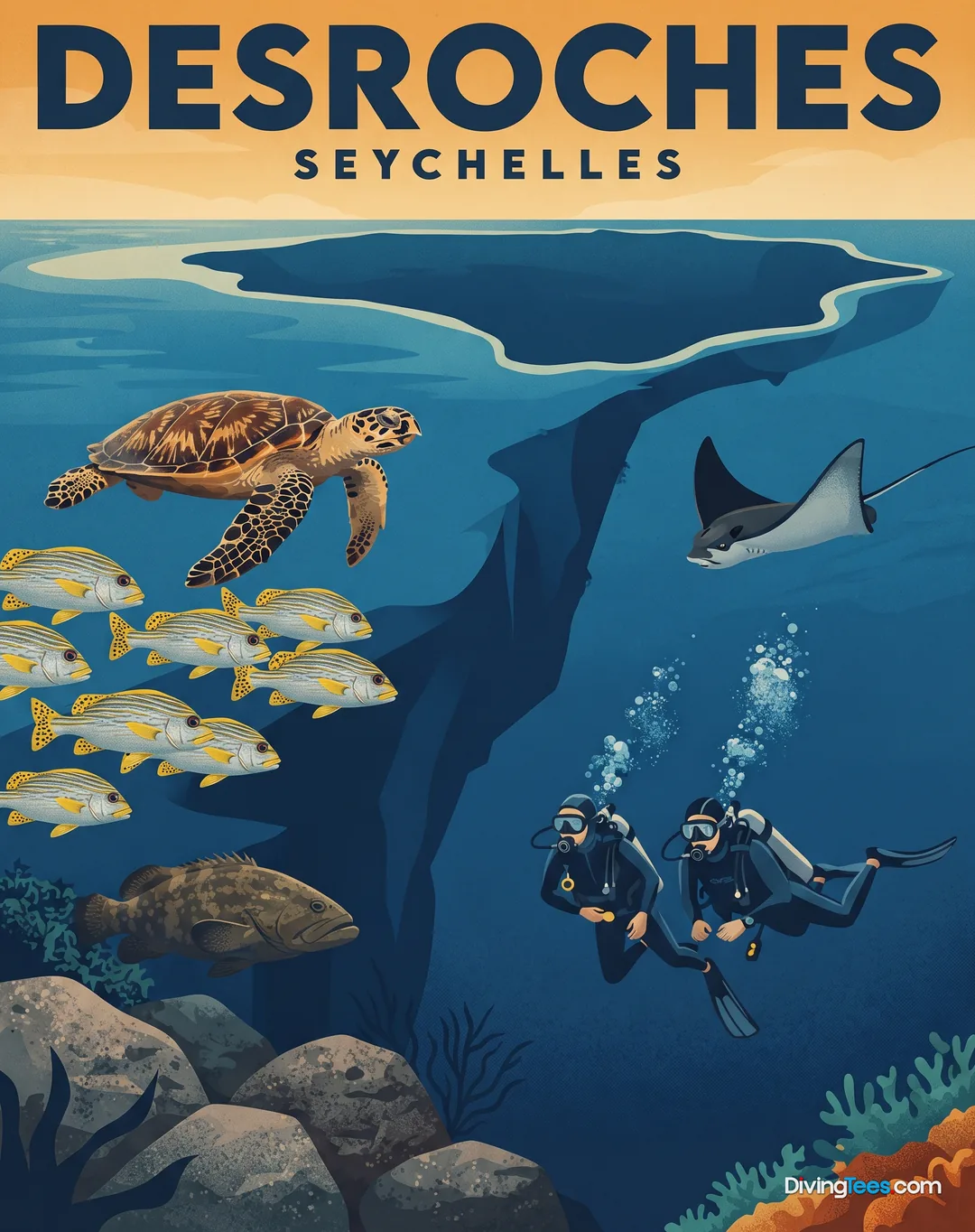
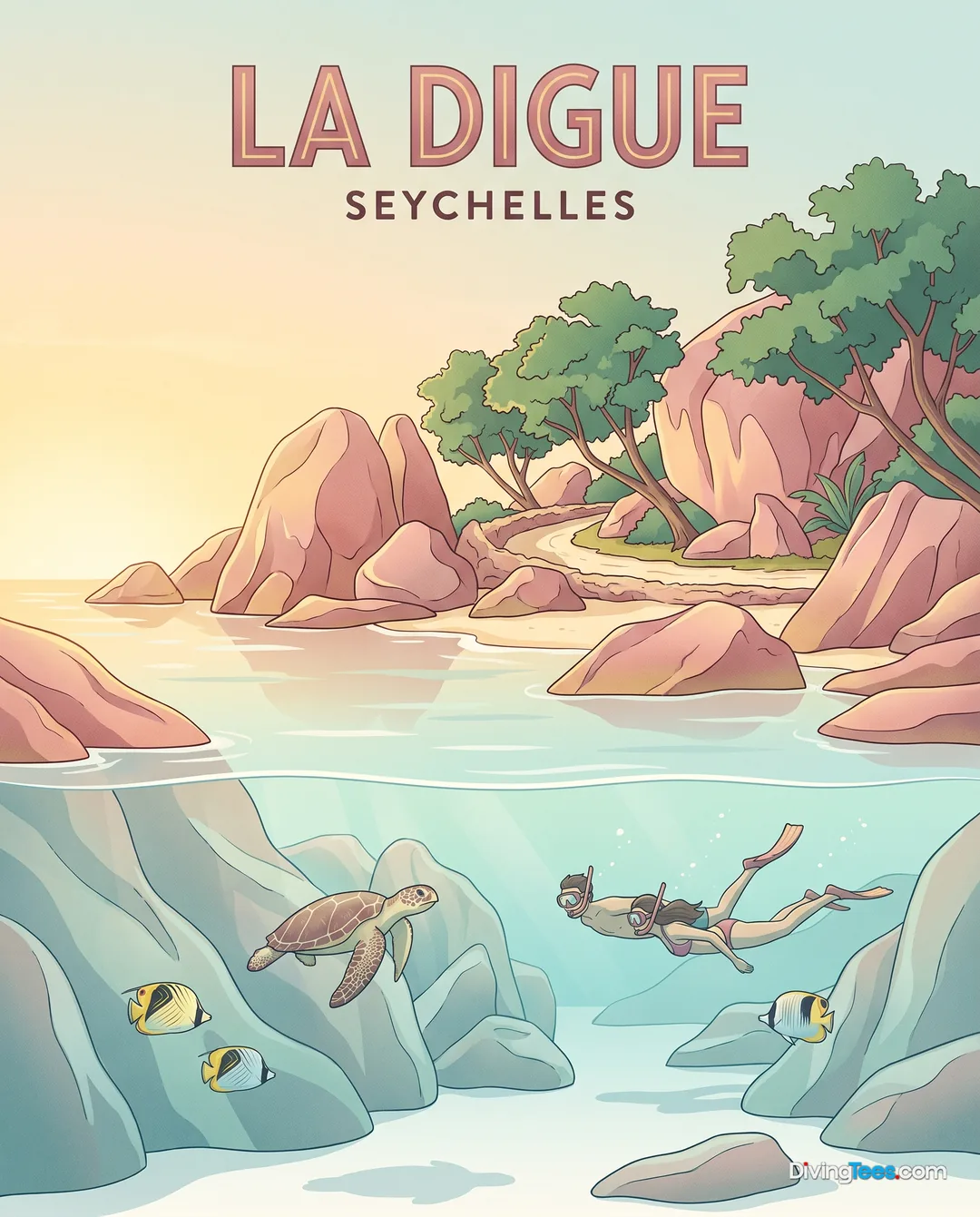
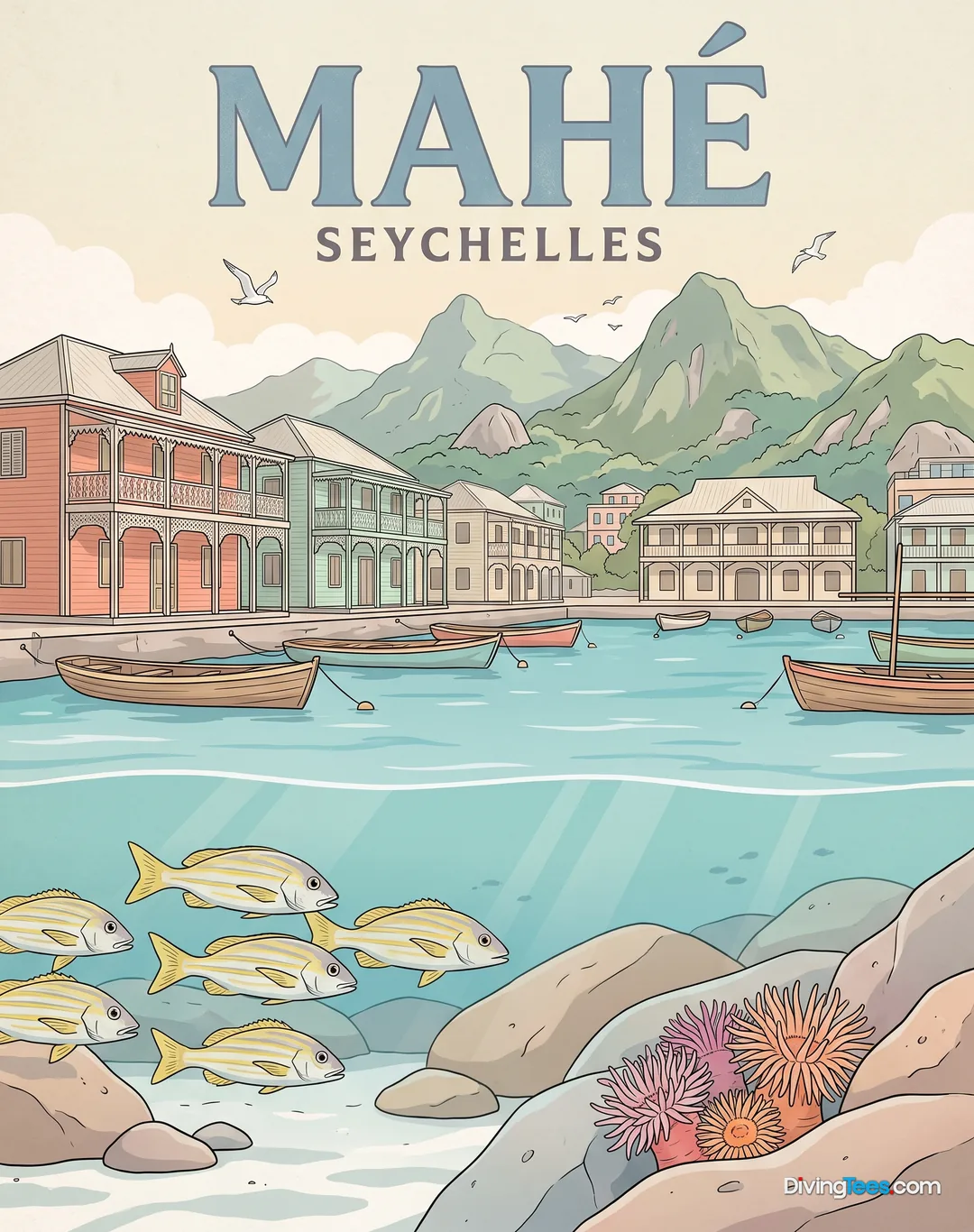
The practical division is between the inhabited granite islands and the distant outer island of Desroches. Mahé is the service centre, with Victoria, Beau Vallon and the broadest choice of transport, equipment and accommodation. Its diving programme includes wreck anchors such as Ennerdale Wreck and Dredger Wreck, alongside offshore granite sites. La Digue is smaller and slower, with bicycles, guesthouses and a village atmosphere; it suits divers who want island character around their diving, with Bitter Rock as one of its named anchors. These two islands can be considered within one journey, although ferry timing matters. Desroches belongs to a different kind of trip: an isolated resort setting, reached by air from Mahé, with little independent life beyond the property. It is for divers happy to pay for seclusion and to let the resort organise the rhythm of their stay.
Diving destinations
Dive centres

Hotels
Liveaboards
When to go, and where by month
The broadest shared window runs from January through April, when Mahé, La Digue and Desroches all fall within their stated season periods. This is the simplest time to combine islands, although the monsoon cycle still makes a flexible plan sensible. In May, the calendar narrows to La Digue, whose season extends from November to May, while Mahé closes after April and Desroches does likewise. June, July, August and September sit outside the stated season windows for every area. October reopens Mahé alone, whose season runs from October to April, making it the logical choice for a Mahé-focused trip or a Festival Kreol visit. November and December restore the full three-island choice: La Digue and Desroches open from November, while Mahé remains in season. The transition months are the useful compromise when wider site access matters, rather than the core monsoon periods.
Marine life, coast by coast
Mahé and La Digue share the clearest common wildlife picture. A diver moving between them can reasonably expect the same broad cast of reef and rocky-island fish: giant grouper, morays, stingrays, stonefish, scorpionfish, lionfish, fusiliers and yellow snapper. Trevally, sweetlips, batfish and the striking giant grouper give the shared itinerary more than a succession of small reef subjects. This overlap matters when choosing between the two inhabited islands: the decision is shaped more by transport, atmosphere and site programme than by a completely different wildlife brief. Desroches stands apart geographically and in character, with its own outer-island setting and resort-based organisation. It should therefore be treated as a separate wildlife experience rather than an automatic extension of a Mahé and La Digue trip.
Getting between the areas
La Digue and Mahé are the workable pairing, separated by 53 km but joined through the inter-island ferry network, normally with Praslin involved in the journey. Missing a return sailing can add a night to the connection back to Mahé, so a tight flight day is poor planning. La Digue also has a smaller hire-equipment pool than Mahé or Praslin; divers staying several days may prefer independent luggage. Desroches is a different logistical proposition. It lies 400 km from Mahé and 453 km from La Digue, and access depends on an Islands Development Company flight from Mahé rather than a simple ferry. Adding it to both granite islands within two weeks makes transfers and accommodation changes consume valuable time. Mahé and La Digue allow a coherent island-hopping trip; Desroches works better as the main purpose of a shorter, self-contained stay.
Take off your mask
Mahé gives the strongest sense of everyday Seychelles. In Victoria, the Sir Selwyn Selwyn-Clarke Market is the place for fish, fruit, spices and small craft, while the compact centre can be explored on foot. Beau Vallon adds restaurants, evening activity and the setting for the Round Table Regatta. The calendar can change the feel of a visit: Festival Kreol brings dance, theatre, food and markets to Victoria and Beau Vallon, while the Seychelles Ocean Festival focuses on underwater images, conservation and talks. La Digue is markedly more village-like. Around La Passe, bicycles, ox-carts, old houses and small shops create a slower scene, and the Fête de l’Assomption fills the port and streets with decorated boats and processions on 15 August. Eating means rice, fish and curry: poison ek diri, octopus curry, satini reken, cari bernique and kat-kat banane appear in Mahé’s Creole restaurants and market snacks, and around La Passe in take-away shops or guesthouses. Desroches concentrates meals in the resort, mixing international cooking with Creole dishes. Takamaka rum, Seybrew and fresh lime juice complete the local table.
What holds true everywhere here
Across Seychelles, boat diving and variable current make the briefing more than a formality. Ask how the site handles a downcurrent, where the safety stop is made, and whether a drift dive can be altered when the sea changes. Granite reefs and shallow coral areas reward careful buoyancy: contact with the bottom quickly spoils the view and damages a fragile surface. Marine parks also mean respecting local rules and leaving wildlife alone. Moorings are preferable to anchoring over sensitive reef. Build in a weather margin around ferries and boat departures, because a missed connection or a changed sea state has a disproportionate effect on an island itinerary. The monsoon transition months are the most practical compromise for broader access.
Frequently asked questions about Seychelles
When should you plan a Seychelles diving trip?
Plan your Seychelles diving trip between January and April, the period highlighted for visiting across three island bases. This timing can fit an itinerary combining Mahé, La Digue and other island experiences, while leaving room for Victoria’s market, Creole food, Festival Kreol, or time between boat dives.
What should you consider about dive-site style and experience level in Seychelles?
Seychelles combines boat diving with varied sites, including Mahé wrecks, granite formations around Beau Vallon, Channel Rock near La Digue, and remote Astove Atoll. Consider which site programme fits your experience and interests, especially when choosing between inhabited-island diving and the separate outer-island setting of Desroches.
What marine life and underwater scenery can you see in Seychelles?
In Seychelles, you can encounter giant grouper, morays, stingrays, stonefish, scorpionfish, lionfish, fusiliers and yellow snapper around Mahé and La Digue. Trevally, sweetlips and batfish add variety, while granite sites, wrecks, Channel Rock, Desroches and Astove Atoll create different underwater settings.
How can you plan a Seychelles stay around diving and island life?
Plan your Seychelles stay around three island bases, using boat diving as the link between places. Mahé offers wrecks, Beau Vallon and Victoria Market; La Digue combines diving with bicycles and Channel Rock; Desroches provides an outer-island, resort-based experience. Add Creole fish and rice, octopus curry or Takamaka rum.