Mediterranean
Tunisia: a Djerba-centred seasonal dive country
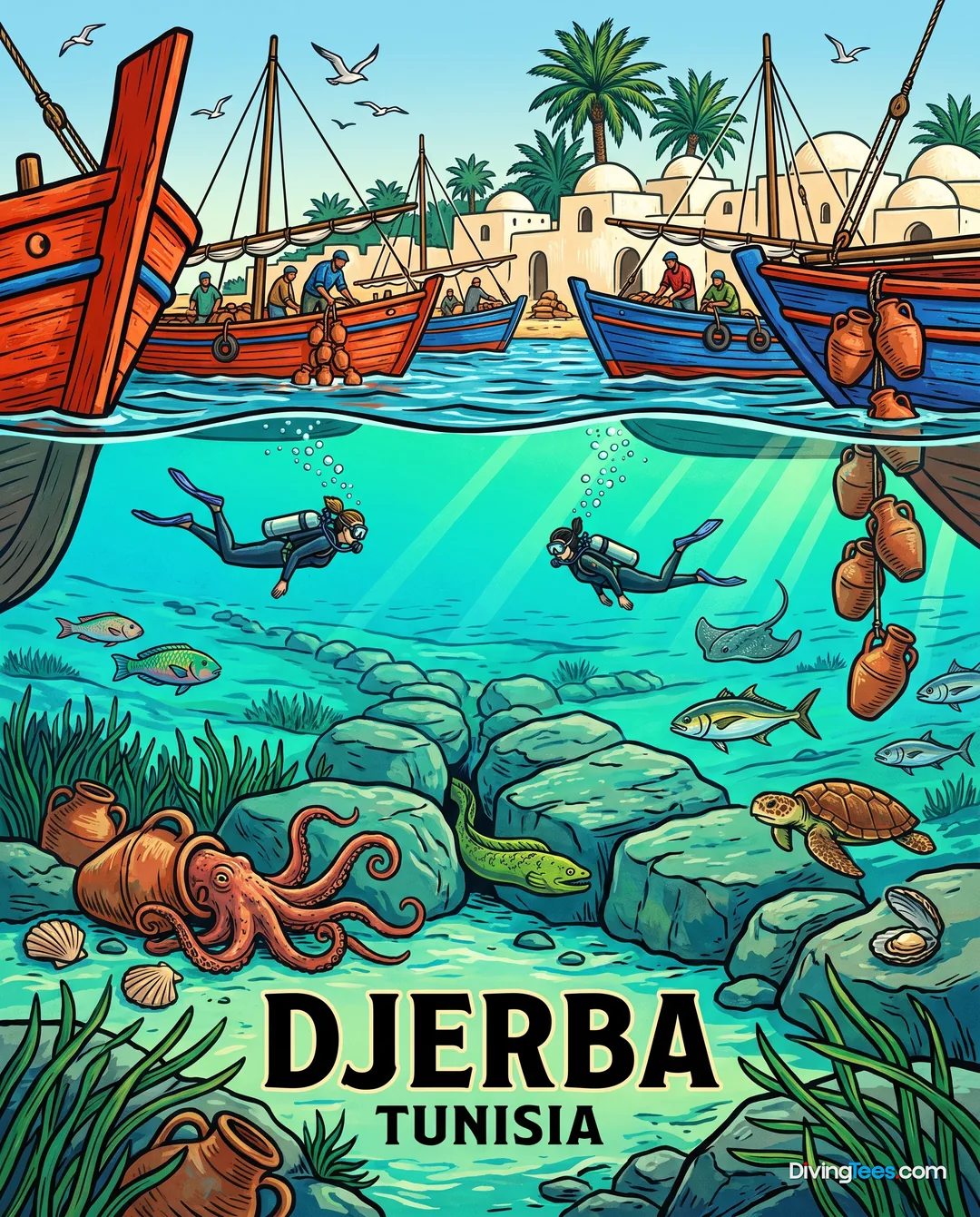
Tunisia’s dive season gathers around Djerba, where Rochers Poulpe and Epave Ricardo mark a distinctly seasonal underwater itinerary for travelling divers.
What makes this country unique
- Djerba’s June through November window for diving
- Rochers Poulpe as a named Djerba dive site
- Octopus Reef within Djerba’s seasonal planning
- Epave Ricardo as a Djerba underwater anchor
- Sidi Soliman in the Djerba site picture
- The Rock Of Ras Turgueness at Djerba
For subtitles in English: start the video firstthen click the gearat the top right of the video, select “Subtitles/CC”, then “Auto-translate” and choose “English”.
This country for a diver
Tunisia is a concentrated dive destination rather than a country of contrasting underwater regions. Djerba provides the country’s clear diving identity, with a continuous operating window from June through November and a group of named sites that give an itinerary its shape. Rochers Poulpe, Octopus Reef and Epave Ricardo are useful anchors when comparing days underwater, while Sidi Soliman and The Rocks Of Mongi belong to the same Djerba framework. The common thread is therefore geographical and seasonal: diving is organised around Djerba, not around a chain of unrelated coasts.
How the country divides
Djerba is the country’s defining diving grouping. It suits divers who want to build a trip around one named zone, rather than divide their time between contrasting regions with opposing calendars. The useful planning question is therefore not which Tunisian coast to choose, but how to use Djerba’s June-to-November window and which sites should frame the underwater programme. Rochers Poulpe and Octopus Reef provide two recognisable reference points; Epave Ricardo, Sidi Soliman and The Rock Of Ras Turgueness show the breadth of the names associated with the same zone. The Rocks Of Mongi belongs to that grouping too. This makes Djerba the natural choice for a straightforward seasonal trip, particularly for divers who value a single geographical base over a complicated national circuit. There is no second Tunisian diving grouping here to set against it, so the area choice is unusually clear.
Diving destinations
Dive centres


Hotels


When to go, and where by month
Tunisia’s diving calendar is straightforward: Djerba is in season from June through November. June opens the usable run, and July and August continue it without a change of area. September and October remain part of the same Djerba window, with November closing the sequence. January, February, March, April and May do not place Djerba in the country’s diving season, and December sits outside it as well. This is not a case of following summer on one coast and winter on another. There is no opposite-season pattern requiring a coast-to-coast handover, and no month in which another Tunisian diving zone takes over the calendar. For a European diver planning annual leave, the practical result is a single decision: choose a month between June and November, then keep the itinerary centred on Djerba. The named sites can be considered within that same seasonal frame rather than used to chase a changing national season.
Marine life, coast by coast
Wildlife does not provide a separate country-wide route here. The wildlife question remains attached to the Djerba grouping, just as the season does, so it does not create a reason to switch between Tunisian regions. A diver considering Rochers Poulpe, Octopus Reef or Epave Ricardo is still planning within the same Djerba context; Sidi Soliman and The Rock Of Ras Turgueness do not alter that national-level structure. The sensible distinction is therefore between individual underwater experiences and the country’s itinerary logic. Tunisia’s named diving places are gathered under one seasonal area, and wildlife should be treated as part of that local choice rather than as a cross-country promise. No country-wide creature encounter can be used here to justify a second regional plan.
Getting between the areas
Movement between diving areas is not the defining practical issue in Tunisia, because the country-level diving plan is centred on Djerba. There is no second diving grouping to combine with it, no opposing seasonal zone to link, and no multi-area circuit to build around a change of coast. That keeps the travel logic plain: a trip can be planned around Djerba without reserving time for an inter-area transfer. Within the zone, the named sites provide the points around which the underwater programme can be arranged, but their names alone do not imply a route or a transfer time. Rochers Poulpe, Octopus Reef and Epave Ricardo should therefore be read as Djerba anchors, not as stages in a national itinerary. For a high-cost annual trip, the advantage is clarity rather than variety: the country does not require a complicated link-up plan.
Take off your mask
Away from the water, Djerba remains the clearest place-name around which a Tunisian trip can be described. The same Djerba-centred character that shapes the diving also keeps the country-level picture focused rather than scattered across several cultural regions. Rochers Poulpe, Octopus Reef and Epave Ricardo belong to the underwater vocabulary of that setting, while Sidi Soliman and The Rock Of Ras Turgueness offer further names to recognise when discussing the destination. There is no separate national sequence of named towns, dishes, sights or local events to attach to the journey here. That makes plain speaking preferable to padding: a Tunisia trip built from the supplied places is a Djerba trip, with the non-diving programme left open rather than dressed up with invented detail. The country’s identity on this page is consequently one of geographical concentration, seasonal clarity and a short set of underwater names, not a manufactured cultural circuit.
What holds true everywhere here
The feature that holds Tunisia’s diving picture together is its Djerba focus. The country does not present several named diving zones with different calendars, so there is no national balancing act between a rainy season in one region and a monsoon or cold-water upwelling in another. From June through November, the planning frame stays with Djerba; outside those months, the same frame does not shift to a second area. That consistency matters more here than a broad list of general diving advice. Rochers Poulpe, Octopus Reef and Epave Ricardo can be used as recognisable points of reference, but they remain part of one geographical story. Tunisia’s shared country-level characteristic is therefore concentration: one named diving zone, one continuous seasonal window, and no cross-country wildlife or travel pattern to complicate the choice.
Frequently asked questions about Tunisia
When should you plan a diving trip to Tunisia?
Plan your Tunisia diving trip around Djerba’s June through November diving window. This seasonal period is associated with Rochers Poulpe, also named Djerba dive site Octopus Reef, and helps shape an itinerary that includes the area’s other named underwater sites, including Epave Ricardo, Sidi Soliman, and The Rock Of Ras Turgueness.
What can you see while diving in Tunisia?
In Tunisia, the named underwater experiences are gathered around Djerba. Your site choices include Rochers Poulpe, also identified as Octopus Reef, along with Epave Ricardo, Sidi Soliman, and The Rock Of Ras Turgueness. These places form the destination’s stated underwater picture rather than a country-wide collection of separate regional routes.
Does wildlife influence which part of Tunisia you should choose for diving?
Wildlife in Tunisia is presented within the Djerba grouping, rather than as a reason to choose between different Tunisian regions. If you are considering Rochers Poulpe, Octopus Reef, or Epave Ricardo, wildlife remains part of that local Djerba choice, alongside Sidi Soliman and The Rock Of Ras Turgueness.
How should you plan your diving stay in Tunisia?
Plan your Tunisia diving stay around Djerba’s seasonal diving context and the individual underwater experiences you want to include. Rochers Poulpe, Octopus Reef, Epave Ricardo, Sidi Soliman, and The Rock Of Ras Turgueness belong to the same local itinerary logic, so your planning centers on choosing among these Djerba sites.