RAID
Dive Xpose Pte Ltd
Google 4.9/5 (2,886 reviews)
Asia
Singapore pairs boat diving around Pulau Hantu with Chinatown’s hawker centres, Little India’s temples and ferry trips from Marina South Pier.
For subtitles in English: start the video firstthen click the gearat the top right of the video, select “Subtitles/CC”, then “Auto-translate” and choose “English”.
Singapore is a compact island city rather than a conventional beach destination. Its diving sits alongside a dense port, financial towers and a remarkably accessible chain of southern islands. The country’s diving area is therefore tied closely to the city itself: Pulau Hantu and the offshore islands are reached from the same urban base as Chinatown, Little India and Kampong Glam. That combination, and the ease of moving between MRT stations, ferries and boat departures, sets Singapore apart from its neighbours.
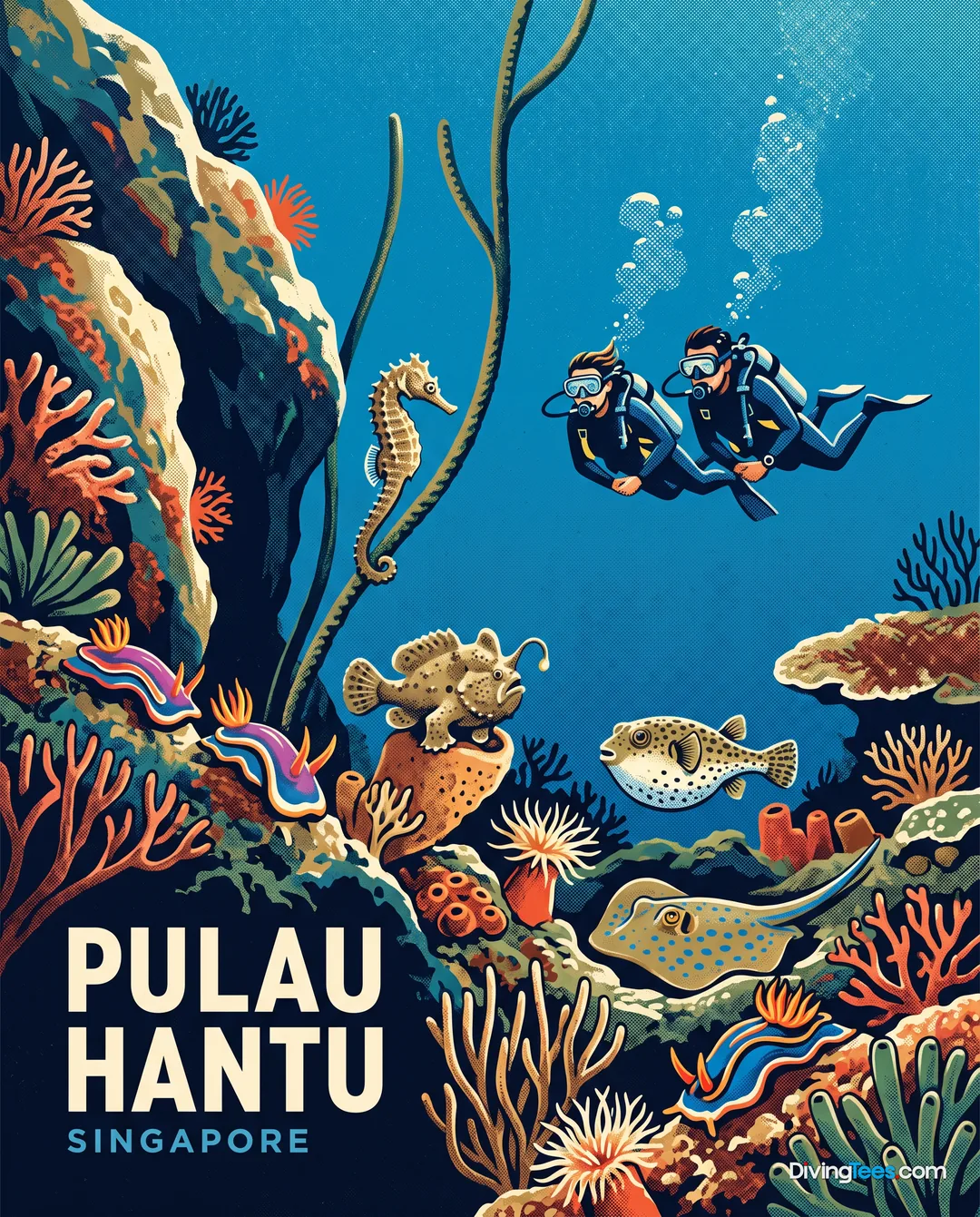
The underwater character is shallow to moderate and close to the city, with coral reef, protected-island and wreck diving rather than long reef routes. Pulau Hantu is the most tangible example: divers follow guidance ropes through typically one-to-two-metre visibility, using careful buoyancy and a slow pace to search the reef for macro life. Currents are variable and can be present, so the day's site choice depends on immediate sea conditions and operator judgement. Most outings are by dive boat, with some shore access, and the crossing to island sites is short rather than expeditionary. Advanced Open Water is useful for divers who want more flexibility, while Nitrox can make sense on repetitive day-boat schedules. The main challenge is not depth but limited visibility, maritime traffic and the need to work within managed access arrangements.
Pulau Hantu is valued for its biodiverse coral reefs and abundant macro fauna rather than for grand reef scenery. The low visibility is part of the setting: creatures adapted to these conditions reward divers who slow down, stay close to the rope and look carefully rather than covering distance. Protected areas such as Sisters' Islands Marine Park are important because marine-life encounters are concentrated where access and conservation are actively managed. The dossier does not identify a dependable seasonal parade of particular species, so the sensible expectation is resident reef and macro life, with the best chances shaped by site choice and conditions. April to June is the most comfortable period for finding calmer water, which makes patient searching easier, although it does not turn Singapore into a clear-water destination.
April to June is the measured window when the sea is calmest, making it the most sensible period for a first diving visit. Singapore's sites are close to busy urban and harbour areas, so wind, weather and maritime conditions can affect whether a boat can use a particular location. The calmer spring-to-early-summer period gives operators more room to arrange island and nearshore outings, while the fixed city base makes it easy to leave spare days for a change of plan. It is better to think in terms of workable boat conditions than guaranteed visibility: Pulau Hantu can remain a low-visibility dive even when the sea is at its most settled.
All certification levels can find suitable diving here, provided they are comfortable in low visibility and with changing current. Pulau Hantu is accessible to newer divers, but one-to-two-metre visibility demands reliable buoyancy, calm finning and confidence staying with a buddy and guide rope. PADI, SSI and BSAC qualifications are all relevant through their equivalent recreational levels. Advanced Open Water is useful for broader site choice, while Nitrox suits divers planning several day-boat dives. The destination is less suitable for anyone expecting effortless, open-water reef navigation.
From London Heathrow, London Gatwick or Manchester, the journey to Singapore normally involves one connection and roughly fourteen to eighteen hours of total travel. Once in the city, diving is reached overland: use a taxi or public transport from central accommodation to the relevant dive centre, marina or ferry terminal. The final leg is a short ferry or dive-boat crossing to an island or offshore site, rather than a domestic flight. The important practical constraint is that Sisters' Islands Marine Park and other managed access may require advance booking, a permit and controlled visitor arrangements. Boat departures also depend on weather and maritime traffic, so a connection that gets a diver into the city is only the first part of the plan; the marina departure and any regulated booking need to line up as well.
Treat Singapore as a series of separate local outings, not as a liveaboard itinerary or a hunt for endless tropical reef mileage. Book managed-site access ahead of time, particularly for Sisters' Islands Marine Park, where permits, visitor controls and no-take rules shape the visit. Keep a weather-flexible day in the schedule rather than making every dive depend on one departure. Bring a proper save-a-dive kit and small spares: Singapore has city dive shops, but a niche replacement may not be immediately convenient. Carrying a DSMB and being comfortable with guidance-rope navigation are sensible for the local conditions, especially at Pulau Hantu. Do not arrive assuming unrestricted shore access or resort-style reef scenery; the most worthwhile diving is selective and often boat-based. For mixed groups, stay near central transport, then let the dive days fit around marina transfers. A no-diving day after the first block works well for Singapore's museums, food and waterfront, rather than trying to pack sightseeing around every departure.
Allow three to five days, with several separate dive outings and enough flexibility for weather or site changes. A central city base works better than planning the whole stay around a marina, particularly when non-divers are travelling too. Dive days can combine a short transfer, a boat crossing and shallow-to-moderate dives; the remaining time belongs easily to museums, food, waterfront districts or coastal nature visits. Keep the final non-diving period clear before flying, as with any repetitive diving schedule.
Singapore’s neighbourhoods make the city unusually easy to read on foot. Chinatown Historic District moves through Kreta Ayer, Telok Ayer, Bukit Pasoh and Tanjong Pagar, where temples, traditional medicine shops and restored shophouses sit beside contemporary bars. Little India brings the smells and sounds of Serangoon Road, with Sri Srinivasa Perumal Temple, sari and gold shops, spices and the market at Tekka Centre. Kampong Glam centres on Sultan Mosque, Arab Street and Haji Lane, where textiles, perfumes and cafés occupy restored shophouses. Food is best explored at hawker centres: Hainanese chicken rice and char kway teow in Chinatown, laksa in Katong, and roti prata in Little India. Try kaya toast with kopi in a kopitiam, or chilli crab at East Coast Seafood Centre. At a hawker centre, reserve a table with a packet of tissues and return your tray afterwards. Temples and mosques require covered shoulders and knees, shoes removed and discretion with cameras.
English works as the service language, but Singapore’s identity is encountered through Chinese, Indian and Malay traditions placed close together. In Chinatown, Little India and Kampong Glam, religious buildings, food stalls and everyday shops remain part of active neighbourhoods rather than isolated museum pieces. Hawker centres have their own etiquette: a table marked with a packet of tissues is taken, shared seating is normal, and trays are returned to collection points. In temples and mosques, visitors cover shoulders and knees, remove shoes and avoid intrusive photography. The practical rhythm is equally local: the MRT and buses connect these quarters efficiently, while ferries from Marina South Pier extend the city into the Southern Islands without requiring a separate base.
Your last day stays dry: no diving in the 18-24 hours before a flight, the perfect window to see the destination from another angle.
 Culture
⏱ 3 h · ★ 5.0 (240 reviews)
from £45$60€54
see on Viator ↗
 Culture
⏱ 4 h · ★ 5.0 (165 reviews)
from £174$233€208
see on Viator ↗
 City
City⏱ 1 h · ★ 5.0 (34 reviews)
from £180$240€215
see on Viator ↗

⏱ 2 h · ★ 5.0 (22 reviews)
from £24$32€29
see on Viator ↗
Ratings and reviews collected by Viator and Tripadvisor.
For Pulau Hantu boat diving, plan your Singapore trip between April and June, which is identified as the country’s diving season. This timing fits an itinerary focused on the south-west coast, while other parts of your visit can include Singapore’s mainland neighbourhoods and southern-island ferry connections.
Singapore offers boat diving around Pulau Hantu and coastal settings such as Labrador Reef, where seagrass and juvenile marine life are associated. Choose an outing according to whether you want an offshore boat experience or an urban coastal visit, rather than assuming one format represents every dive.
In Singapore, Labrador Reef is associated with seagrass and juvenile marine life, while Kusu Island is noted for corals and anemones. The marine park around Sisters’ Islands, St John’s and Pulau Tekukor adds a conservation-focused setting, letting you compare mainland coastal and southern-island reef habitats.
Plan boat diving around Pulau Hantu alongside ferry trips from Marina South Pier to St John’s Island and visits to the southern islands. On land, you can add Chinatown’s hawker centres, Little India’s temples, Kampong Glam’s Sultan Mosque and Arab Street shophouses, or Labrador Nature Reserve’s coastal paths.