Nudibranch
Nudibranchia
The jewels of the reef measure less than five centimetres — and there are more than 3,000 species of them.
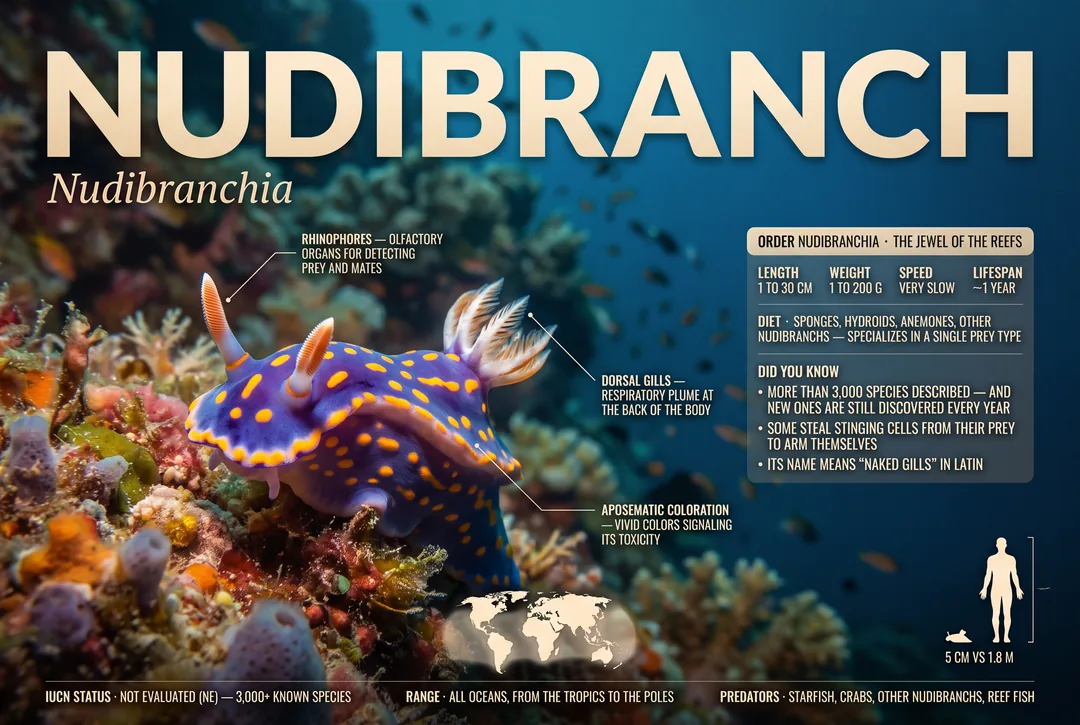
IDENTITY CARD
| Classification | Order Nudibranchia, class Gastropoda |
| Scientific name | Order Nudibranchia (Cuvier, 1817) — more than 3,000 described species |
| Size | From 4 mm (Doto) to 60 cm (Hexabranchus sanguineus), majority between 1 and 5 cm |
| Weight | A few grams |
| Speed | A few metres per hour — gliding locomotion on a muscular foot |
| Lifespan | A few weeks to 1 year depending on the species |
| Depth | Intertidal zone to over 700 m, majority between 1 and 30 m |
| Diet | Specialised carnivore — sponges, hydroids, bryozoans, tunicates, eggs, other nudibranchs |
| IUCN Status | Not Evaluated for the vast majority of species — a few listed as locally endangered |
PORTRAIT
The nudibranch is living proof that beauty needs no size. These gastropod molluscs, cousins of snails but stripped of their shell in adulthood, form one of the most diverse and visually stunning orders in the marine world. More than 3,000 described species — with dozens of new ones every year — in a palette of colours that defies imagination: electric violet, fluorescent orange, neon blue, pink stripes on white, yellow polka dots on black.
The word nudibranch literally means "naked gills" — a reference to the gill plumes that many species carry exposed on their backs, like bouquets of feathers. These animals have traded the mechanical protection of a shell for a formidable chemical arsenal: some sequester the cnidocytes (stinging cells) from their hydroid prey and store them at the tips of their dorsal cerata, primed to discharge against any predator. Others synthesise their own toxins or concentrate toxic compounds extracted from the sponges they feed on. The vivid colouration is a warning: do not eat me, I am toxic. This is aposematism in its most spectacular form.
For the diver, the nudibranch is a perpetual treasure hunt. You must slow down, lie flat on the sand or reef, and scrutinise every square centimetre of sponge and dead coral. The reward: an animal of breathtaking beauty, motionless, just centimetres from your lens.
HOW TO RECOGNIZE IT
Nudibranchs divide into two major morphological groups.
Dorids (Doridacea) carry a retractable gill plume on their backs, near the posterior end. The body is oval, often covered in tubercles. The rhinophores (sensory organs on the head) are usually lamellate, resembling small feathered antennae. Iconic examples: Chromodoris, Hypselodoris, Glossodoris.
Aeolids (Aeolidida) are covered in cerata — elongated dorsal appendages containing extensions of the digestive system and, in species that feed on hydroids, recycled cnidocytes. No distinct gill plume. The body is more elongated, often translucent. Examples: Flabellina, Cratena, Aeolidiella.
Underwater, species-level identification relies on the combination of colour + rhinophore shape + gill/cerata shape + substrate. Local guides and photographic databases (Sea Slug Forum, NudiPixel) are indispensable — no diver knows all 3,000 species. Best practice: photograph the animal from several angles (dorsal, profile, rhinophores) and note the depth, substrate and location.
For subtitles in English: start the video firstthen click the gearat the top right of the video, select “Subtitles/CC”, then “Auto-translate” and choose “English”.
WAY OF LIFE
Nudibranchs are specialised carnivores. Each species (or nearly so) feeds on a specific type of prey: a particular sponge, a genus of hydroid, a bryozoan. This specialisation explains why the best observations occur on muck-dive sites — volcanic sand or silt bottoms covered in encrusting sponges, hydroids and debris.
The radula, a rasping tongue typical of gastropods, is the tool of predation. It scrapes the surface of the sponge or tears polyps from the hydroid with surgical precision. Some species are cannibalistic — Gymnodoris actively hunts other nudibranchs.
Reproduction is simultaneous and reciprocal: all nudibranchs are simultaneous hermaphrodites. During mating, both partners exchange sperm. Each then lays a characteristic egg ribbon — spiral, rosette, sinuous cord — whose shape is often as diagnostic as the animal itself. The eggs hatch into planktonic veliger larvae bearing a tiny shell, which they shed at metamorphosis.
Lifespan is short — a few weeks to a year. Nudibranchs live fast, reproduce once or twice, and die. This brevity, combined with their extreme dietary specialisation, makes certain species highly vulnerable to habitat disturbance.
WHERE TO SEE IT
Nudibranchs are found in every ocean, from the Arctic to the tropics. But the finest observations are concentrated in regions of high marine biodiversity and on macro-oriented dive sites.
Indonesia — Lembeh Strait. The world capital of nudibranch diving. The Lembeh Strait, between Sulawesi and Lembeh Island, is a black volcanic sand bottom strewn with debris — and it is a macro paradise. More than 300 nudibranch species have been recorded here. Local guides are among the best spotters on the planet — they find 5 mm animals on a uniform background in seconds.
Philippines — Anilao. The "Lembeh of the Philippines." Anilao Bay, south of Manila, offers comparable diversity in a more accessible setting. Dive sites (Cathedral, Mainit, Beatrice) are renowned for rare species — Halgerda batangas (a local endemic), multicoloured Nembrotha, Glossodoris in every shade.
Red Sea — Egypt. The reefs of Dahab, Marsa Alam and the Brothers host Mediterranean-tropical and Indo-Pacific species. Chromodoris quadricolor (blue and orange) is the Red Sea's nudibranch emblem. Night dives are the most productive.
Japan — Osezaki, Izu Peninsula. Temperate Japan is an unexpected hotspot. Cold waters (12-22 degrees C) harbour endemic species found nowhere else — Japanese photographers dominate the global nudibranch-hunting community.
Mediterranean — France, Croatia, Spain. The Mediterranean is home to around 300 species. Flabellina affinis (vivid violet) is the most photographed species along the Mediterranean coast. Dive sites on the French Riviera, Costa Brava and Dalmatian coast offer excellent sightings year-round.
OBSERVATION CALENDAR
| Destination | J | F | M | A | M | J | J | A | S | O | N | D |
|---|---|---|---|---|---|---|---|---|---|---|---|---|
| Indonesia (Lembeh) | ||||||||||||
| Philippines (Anilao) | ||||||||||||
| Red Sea (Egypt) | ||||||||||||
| Japan (Izu) | ||||||||||||
| Mediterranean |
Click each button to show/hide
CONSERVATION
Most nudibranchs are not evaluated by the IUCN — the 3,000-plus species, often small, cryptic and difficult to survey, largely escape monitoring programmes. A few species with restricted ranges are considered locally vulnerable.
The threats are indirect but real. Degradation of coral reefs and coastal habitats destroys the sponges and hydroids on which nudibranchs depend. Coral bleaching and ocean acidification alter the composition of benthic communities — and with them, the distribution of specialist nudibranchs.
Plastic and chemical pollution is a growing threat on muck-diving sites, often close to urbanised areas (Lembeh, Anilao). Microplastic accumulation in sediments affects nudibranch prey and, through bioaccumulation, the nudibranchs themselves.
The aquarium trade harvests some colourful species (notably Chromodoris and Nembrotha), but their short lifespan and ultra-specialised diet make them nearly impossible to keep in captivity — most die within weeks, rendering the collection all the more senseless.
Organisations to support:
- Coral Triangle Initiative — protecting the epicentre of marine biodiversity
- Sea Slug Forum — database and collaborative identification
- Project AWARE — marine conservation and seabed clean-ups
- Reef-World Foundation — responsible diving practices (Green Fins)
3 THINGS YOU PROBABLY DON'T KNOW
1. Some steal their prey's weapons. Aeolid nudibranchs that feed on hydroids and anemones can capture the cnidocytes (stinging cells) from their prey without triggering them, transport them intact through their digestive system, and store them — still functional — at the tips of their dorsal cerata. This mechanism, called kleptocnidae, is unique in the animal kingdom — it is as if a soldier disarmed a grenade, carried it through his stomach, and brought it back to the surface of his back, live and ready to fire.
2. Some practise photosynthesis. Several species of sacoglossans (close cousins of nudibranchs) steal chloroplasts from the algae they eat and incorporate them into their own cells — a phenomenon called kleptoplasty. Elysia chlorotica, for instance, can survive for months by photosynthesising like a plant. It is an animal that runs on solar energy.
3. Their chemical arsenal interests medicine. Several chemical compounds extracted from nudibranchs are being studied for anticancer, antiviral and anti-inflammatory properties. Dolastatin 10, originally isolated from Dolabella auricularia (a sea hare), has given rise to a class of anticancer drugs. The reef, seen through the nudibranch, is a pharmacy we have only just begun to catalogue.
PHOTO AND VIDEO TIPS
The nudibranch is the quintessential macro subject: motionless, colourful, richly detailed, and small. It is the perfect training ground for any underwater photographer.
Lens. Macro 60 mm minimum, ideally 100-105 mm for sufficient magnification without crushing the animal under the lens port. Wet diopter add-on lenses (+5, +10) allow further magnification for species smaller than one centimetre. On a compact camera, an add-on macro lens is virtually mandatory.
Focus. Manual or single-point AF. Aim for the rhinophores (the "antennae" on the head) — they are the natural focal point of the image. If the rhinophores are sharp, the photograph works.
Lighting. Strobe or video light at moderate power. Side-raking light brings out the texture of the mantle and the translucency of the cerata. The snoot (a cone that concentrates the flash into a point) is the ultimate nudibranch photography tool — it isolates the subject in a circle of light against a black background, eliminating the often unattractive substrate.
Composition. Get down to the animal's level — not shooting vertically from above. A nudibranch photographed in profile, with sharp rhinophores and a visible gill plume, is infinitely more alive than a bird's-eye shot. Look for specimens on contrasting substrates: colourful sponge, hydroid, dead coral. Wait for an egg-laying event (spiral egg ribbon) for a narrative composition.
Classic mistake. Touching the animal to reposition it. The nudibranch retracts, loses its natural posture, and the photograph looks artificial. Never handle the subject — find a better angle or a better individual.