Seahorse
Hippocampus
The only animal on Earth where the male gets pregnant.
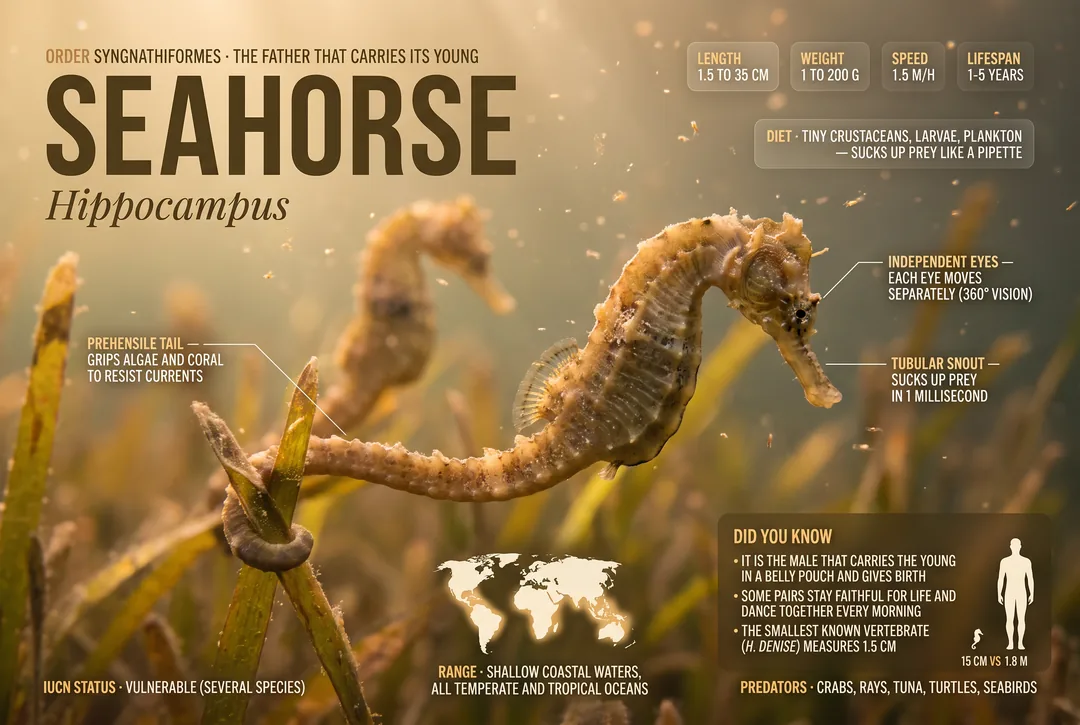
IDENTITY CARD
| Classification | Order Syngnathiformes, family Syngnathidae |
| Scientific name | Hippocampus (Rafinesque, 1810) — 46 recognised species |
| Size | From 1.5 cm (H. denise) to 35 cm (H. abdominalis) depending on species |
| Weight | From under 1 g to approximately 30 g |
| Speed | ~1.5 m/h — the slowest fish in the ocean |
| Lifespan | 1 to 5 years depending on species |
| Depth | 1 to 80 m, most commonly between 5 and 25 m |
| Diet | Carnivore — small crustaceans (copepods, mysids), fish larvae, zooplankton |
| IUCN Status | Vulnerable (VU) for many species — several classified Endangered (EN) |
PORTRAIT
You never spot one first. You have to search, slow down, retrain your eye. And then it is there — clinging to a strand of sea fan or a blade of seagrass, upright as a tiny knight, its tail coiled around a living anchor — and you suddenly understand why the Greeks called it hippokampos, the curved horse of the sea.
The seahorse is a fish. That fact still catches people off guard, because everything about it — the horse-shaped head, the prehensile tail, the vertical swimming posture, the bony armour — sets it apart from anything else that carries fins. Yet it breathes through gills, owns a swim bladder, and beats a dorsal fin up to 35 times per second for propulsion. The result is the slowest fish in the ocean: Hippocampus zosterae, the dwarf seahorse, holds the Guinness record for the slowest swimming ever measured in a fish, at roughly 1.5 metres per hour.
But the seahorse's slowness is not a weakness — it is a strategy. The animal does not chase its prey: it inhales it. Its elongated, tube-shaped snout works like a suction pipette. When a copepod drifts within range, the seahorse triggers one of the fastest strikes in the animal kingdom — under one millisecond — and swallows its target with a success rate above 90%. The contradiction between that apparent sluggishness and that lightning precision is one of the first things that stays with a patient diver.
HOW TO RECOGNIZE IT
The seahorse is unmistakable — provided you find it. Its vertical silhouette is unique among fish: head bent at a right angle to the body, tubular snout, bulging eyes that move independently of each other, a rigid body sheathed in bony plates arranged in rings, and a long prehensile tail with no caudal fin. It is the only fish whose tail carries no fin at all.
Swimming is vertical, powered by rapid vibrations of the dorsal fin and steered by two small, translucent pectoral fins tucked behind the gill covers. The motion is jerky, almost stationary — closer to the hovering of an insect than the gliding of a fish.
Size varies enormously between species. The pygmy seahorse (H. bargibanti), a macro photography icon, measures less than 2 cm and lives exclusively on sea fans of the genus Muricella, mimicking their colour and texture so faithfully that it becomes literally invisible. At the other end of the scale, the big-bellied seahorse (H. abdominalis) reaches 35 cm and is far easier to observe in the temperate waters of Australia and New Zealand.
A local dive guide is often essential for finding them. Seahorses hold territories of just a few square metres and return to the same anchor point day after day. A guide who knows the site can tell you exactly which sea fan, which soft coral, or which patch of seagrass to scan. Without one, you can spend twenty minutes with your nose on the reef and see nothing — and that is entirely normal.
For subtitles in English: start the video firstthen click the gearat the top right of the video, select “Subtitles/CC”, then “Auto-translate” and choose “English”.
WAY OF LIFE
The seahorse is monogamous — or, more precisely, it forms stable pair bonds reinforced by a daily ritual. Every morning, male and female meet, change colour, intertwine their tails, and swim side by side for several minutes before parting for the day. This greeting dance allows the partners to synchronise their reproductive cycles. If one disappears, the survivor remains inactive for days or weeks before seeking a new mate.
But it is reproduction that makes the seahorse unique in the animal kingdom. In no other known species does the male carry the young. The female deposits her eggs into a ventral pouch on the male — the brood pouch — using an ovipositor. The male fertilises the eggs inside the pouch, then incubates them for two to four weeks. The pouch is richly vascularised: it supplies oxygen, regulates salinity, and partially nourishes the embryos. The male even controls the chemical composition of the pouch fluid, gradually shifting it from blood-like to seawater-like — preparing the young for life in open water.
The birth is spectacular. The male contracts in spasms for hours, sometimes an entire night, and expels anywhere from a few dozen to over 1,500 fully formed miniatures of the adult, each one swimming independently from the moment it emerges. There is no parental care after delivery: the juveniles are cast adrift in the plankton, and survival rates are brutally low — less than 1% in most species. The male, meanwhile, can be pregnant again within hours.
The seahorse is an ambush predator. Anchored by its tail to a fixed hold — sea fan, alga, seagrass, rope, even debris — it waits for prey to drift within range of its snout. Its two eyes, capable of independent movement like those of a chameleon, scan two directions at once without the body moving a millimetre. That stillness is what makes its hunting so effective — and what makes watching one so rewarding for a diver with the patience to stay.
WHERE TO SEE IT
The seahorse inhabits every temperate and tropical sea on the planet, from the seagrass meadows of the Mediterranean to the coral reefs of Southeast Asia. It is discreet everywhere, but certain destinations concentrate sightings to the point where seahorses become a dive objective in their own right.
Indonesia — Lembeh Strait. The world's premier muck-diving destination is also seahorse paradise. The volcanic black-sand slopes harbour at least five species, including the pygmy seahorse (H. bargibanti) on sea fans and Pontoh's seahorse (H. pontohi), tiny and translucent. Local guides, specialists in detecting the very small, are among the best in the world. Shallow dives (5-25 m), mild current, variable visibility.
Philippines — Anilao. The Philippine "macro capital" offers remarkable seahorse density on accessible sites. The pygmy seahorse H. bargibanti appears on several sea fans in the area, and H. denise, one of the smallest known seahorses (1.5 cm), is spotted regularly. The sites of Beatrice, Secret Bay, and Basura are classics. Anilao can be dived year-round, with the best visibility from November to May.
Indonesia — Komodo. Komodo National Park, famous for its currents and manta rays, also supports a population of pygmy seahorses on the sea fans of sheltered sites. Macro dives at Batu Bolong, Tatawa Besar, or Siaba combine seahorse hunting with exceptional reef biodiversity.
Red Sea — Egypt. The short-snouted seahorse (H. hippocampus) and the thorny seahorse (H. histrix) inhabit the shallow seagrass beds and reefs of the Gulf of Aqaba and the southern Egyptian coast. Sightings, less frequent than in Southeast Asia, reward the patient diver — particularly in the rubble and sand stations around Dahab and Nuweiba.
Mediterranean — France, Spain, Croatia. Two seahorse species live in the Mediterranean: the long-snouted seahorse (H. guttulatus) and the short-snouted seahorse (H. hippocampus). They are found in Posidonia seagrass beds, lagoons, and harbours. The Thau lagoon (France), the Ria Formosa (Portugal), and the Dalmatian coast (Croatia) are well-known sites. Accessible dives at shallow depth (2-12 m), but observation is delicate — the animal is protected and must never be handled.
United Kingdom — southern coast of England. The short-snouted seahorse (H. hippocampus) and the long-snouted seahorse (H. guttulatus) are present in the Thames estuary, Studland Bay, and Dorset waters. British populations, discovered in the early 2000s, are the subject of active scientific monitoring. Diving requires a drysuit and visibility is often poor — but the thrill of encountering a seahorse in British waters is proportional to the sheer improbability of the meeting.
OBSERVATION CALENDAR
| Destination | J | F | M | A | M | J | J | A | S | O | N | D |
|---|---|---|---|---|---|---|---|---|---|---|---|---|
| Indonesia (Lembeh) | ||||||||||||
| Philippines (Anilao) | ||||||||||||
| Indonesia (Komodo) | ||||||||||||
| Red Sea (Egypt) | ||||||||||||
| Mediterranean |
Click each button to show/hide
CONSERVATION
The genus Hippocampus is among the most threatened of all marine fish. Of the 46 recognised species, around a dozen are classified Vulnerable (VU) or Endangered (EN) on the IUCN Red List, and many others remain listed as Data Deficient (DD).
The primary threat is trade. An estimated 25 million seahorses are taken from the oceans every year, the vast majority destined for traditional Chinese medicine — none of whose claimed properties have been confirmed by modern pharmacology. The remainder feeds the aquarium trade and the dried-curio market.
The second threat is bycatch. Seahorses are caught by the millions in shrimp trawls and bottom nets.
Habitat destruction compounds the picture. Seagrass beds of Posidonia and Zostera are shrinking under coastal development, pollution, and boat anchoring.
Since 2004, all species in the genus Hippocampus have been listed under CITES Appendix II — the first marine fish genus ever subjected to a global trade regulation.
The responsible diver never touches a seahorse, never moves one for a photograph, and limits observation time.
Organisations to support:
3 THINGS YOU PROBABLY DON'T KNOW
1. The male does not merely "carry" the eggs — he nourishes them. The male's brood pouch is not a simple sac. It is lined with blood vessels that supply the embryos with oxygen and nutrients, functioning much like a mammalian placenta. The male controls the salinity of the amniotic fluid, which gradually shifts from blood-like to seawater-like composition.
2. Its eyes work like a chameleon's — but it is colour-blind. Each eye pivots independently of the other. However, the seahorse retina contains only a single type of cone: the animal sees the world in shades of grey, and the spectacular colour changes it produces are intended for its peers, not for itself.
3. It is the only fish with a neck. The cervical vertebrae of the seahorse allow it to flex its head forward and downward — a movement impossible in other fish. This flexion is the key to its hunting technique: it enables a spring-loaded strike with an acceleration that takes less than 0.002 seconds.
PHOTO AND VIDEO TIPS
The seahorse is the quintessential macro subject.
Lens. Dedicated macro: 60 mm or 100/105 mm. For pygmy seahorses, a super-macro lens or a +10 dioptre wet lens is essential.
Light. Flash is mandatory for macro work. Two external strobes mounted on articulated arms. Power at minimum — limit yourself to 5-6 shots per subject. A snoot isolates the subject against a dark background.
Approach. Slow, low, head-on or at three-quarters. Settle at 30-40 cm from the subject, stabilise your buoyancy, and wait.
Classic mistake. Touching the animal or its holdfast to reposition it for the lens. It is a common practice, and an inexcusable one.