Stingray
Dasyatidae — Dasyatis, Hypanus, Pastinachus, Himantura, Taeniura
A disc of silk armed with a dagger: the stingray is the reef's paradox.
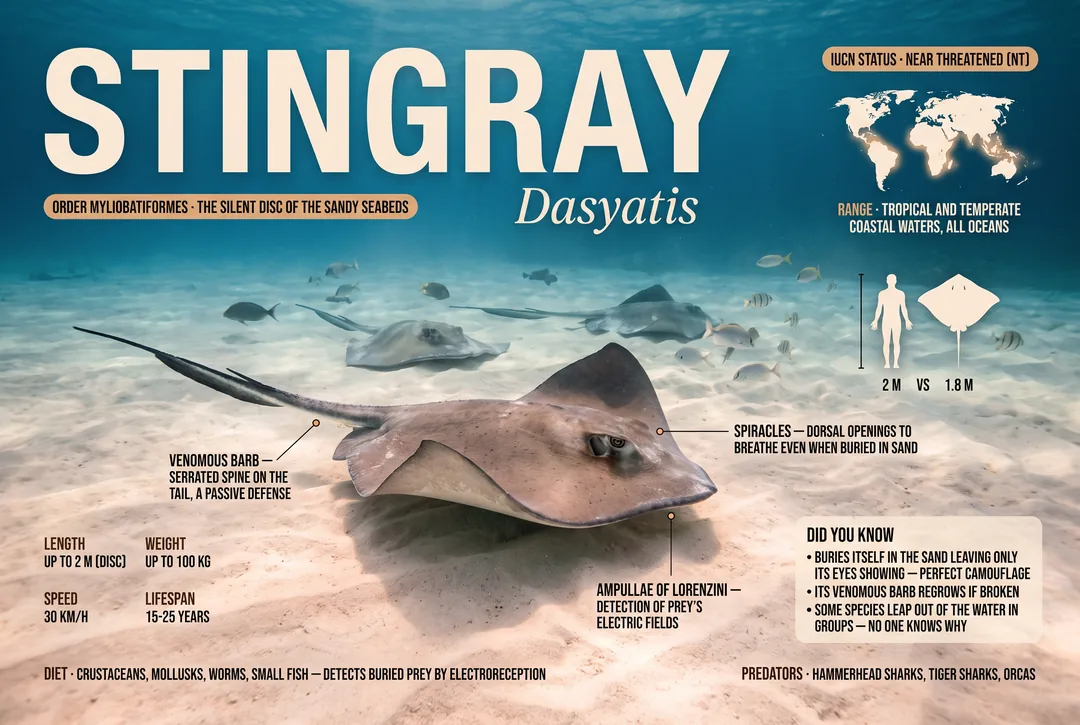
IDENTITY CARD
| Classification | Order Myliobatiformes, family Dasyatidae and allied families |
| Main genera | Dasyatis, Hypanus, Pastinachus, Himantura, Taeniura, Urogymnus |
| Size | From 30 cm (Taeniura lymma) to over 2 m wingspan (Hypanus americanus) |
| Weight | From 1 kg to over 100 kg depending on species |
| Speed | ~8 km/h cruising, brief bursts up to 30 km/h |
| Lifespan | 15 to 25 years (up to 30 years in the largest species) |
| Depth | 0 to 60 m, but most sightings between 1 and 25 m |
| Diet | Benthic carnivore — molluscs, crustaceans, worms, small buried fish |
| IUCN Status | Variable by species — from Least Concern (LC) to Critically Endangered (CR) for several freshwater species |
PORTRAIT
You rarely see one coming. Settled on the sand, its outline blurred, its colour a perfect match for the seabed, a stingray is almost invisible. Then it lifts off — a single beat of those broad pectoral fins, a movement of absolute fluidity — and the diver understands that something extraordinary is swimming alongside: one of the most elegant animals on the reef. A flat, supple disc, undulating like a sheet in the wind.
Beneath that grace lies a weapon. The tail carries one or more venomous barbs — serrated spines measuring 5 to 35 cm, sheathed in a mucus membrane loaded with venom. The animal never uses them to attack: the sting is purely a defensive reflex. The venom produces searing pain. Hundreds of waders step on buried stingrays every year — making it the most common injury involving an elasmobranch anywhere in the world.
On 4 September 2006, Steve Irwin was killed by a short-tail stingray (Bathytoshia brevicaudata) barb that pierced his heart during a filming session off Port Douglas. The incident made the animal known worldwide, but it also triggered a wave of retaliatory killings against rays in Australia. The irony is cruel: Irwin had spent his entire life defending exactly these animals.
HOW TO RECOGNIZE IT
The stingray's body forms a dorso-ventral disc created by the fusion of its pectoral fins with its trunk. Its mouth, nostrils, and five pairs of gill slits sit on the underside, while the eyes and spiracles are positioned on top. The tail is long, thin, and lacks a caudal fin — it carries the barb or barbs instead.
Do not confuse the stingray with the spotted eagle ray (Aetobatus narinari), which has a pointed snout and spotted wings, or with the manta ray, which is vastly larger and lacks a sting.
Key species divers encounter include: the southern stingray (Hypanus americanus), the blue-spotted ribbontail ray (Taeniura lymma), the leopard whipray (Himantura leoparda), the blotched fantail ray (Taeniurops meyeni), and the common stingray (Dasyatis pastinaca).
For subtitles in English: start the video firstthen click the gearat the top right of the video, select “Subtitles/CC”, then “Auto-translate” and choose “English”.
WAY OF LIFE
The stingray is a bottom dweller, spending most of the day buried in sand — a camouflage strategy that doubles as both protection and ambush hunting. Its main predators are sharks, particularly the hammerhead, which has evolved a head shape ideally suited to pinning rays against the seabed.
To find prey hidden beneath the substrate, the stingray relies on electroreception via its ampullae of Lorenzini, detecting the faintest electrical fields generated by buried organisms. It "scans" the bottom, pins its prey beneath its disc, and crushes it using flat dental plates.
Reproduction is aplacental viviparous: litters range from 1 to 13 pups, with a gestation period of 4 to 12 months depending on the species.
WHERE TO SEE IT
Grand Cayman — Stingray City. A shallow sandbar where dozens of southern stingrays gather daily, accessible even to snorkellers. Available year-round, it remains one of the most reliable wildlife encounters in the Caribbean.
Moorea — French Polynesia. The northern lagoon hosts blotched fantail rays alongside blacktip reef sharks — an effortless snorkelling experience in waist-deep turquoise water.
Bora Bora — French Polynesia. The same lagoon magic as Moorea, with rays gliding over white sand inside the barrier reef.
Red Sea — Egypt. The blue-spotted ribbontail ray (Taeniura lymma) is a staple of Red Sea diving from Sharm El Sheikh to Marsa Alam, hiding under coral tables and in sandy overhangs.
Maldives. House reefs and cleaning stations throughout the atolls provide regular encounters with several species, including the blotched fantail ray.
Belize — Hol Chan and Shark Ray Alley. A former fisherman's cleaning station turned into one of Central America's most popular marine encounters, with snorkelling among nurse sharks and stingrays.
OBSERVATION CALENDAR
Click each button to show/hide
CONSERVATION
Conservation status varies widely across the family. Coastal marine species remain relatively abundant, but several freshwater stingrays face critical decline. The giant freshwater stingray (Urogymnus polylepis), which can exceed 600 kg, is classified as Endangered (EN) on the IUCN Red List.
Threats include targeted fishing for meat and shagreen leather, bycatch in commercial nets, and destruction of coastal habitats. Tourist feeding programmes — such as those at Stingray City and Shark Ray Alley — remain controversial: studies show that fed rays exhibit altered behaviour patterns and elevated cortisol levels compared to wild populations.
The "stingray shuffle" — dragging one's feet when wading in sandy shallows — remains the simplest and most effective way to avoid stepping on a buried ray.
Organisations to support:
- Shark Trust — elasmobranch conservation across Europe
- Save Our Seas Foundation — research funding for sharks and rays worldwide
- Manta Trust — research across the ray family
- PADI AWARE — citizen science and marine conservation
3 THINGS YOU PROBABLY DON'T KNOW
1. Its barb regrows — and it can carry several at once. Old and new spines coexist, with some individuals sporting two or three barbs simultaneously. The venom is not in the barb itself but in the mucus sheath that covers it.
2. It "sees" with its belly. The ampullae of Lorenzini on its underside can detect electrical fields as faint as five billionths of a volt per centimetre — the equivalent of sensing a 1.5 V battery from 3,000 km away. A stingray can locate a worm buried under 15 cm of sand, in total darkness.
3. Stingray City was born from an accident. In the 1980s, fishermen began cleaning their catches in the shallow waters off Grand Cayman, and stingrays learned to associate the spot with free food. Today the site draws more than a million visitors a year. The rays recognise the sound of approaching boat engines.
PHOTO AND VIDEO TIPS
Lens. Wide angle is essential — a 10-17 mm fisheye or 16-35 mm in a housing, or a GoPro for action footage. For close-ups of the blue-spotted ribbontail ray (Taeniura lymma), switch to macro.
Light. Strobes or video lights are indispensable to separate the animal from the sand. Side lighting reveals texture and lifts the disc off the monotone substrate.
Approach. Get flat on the bottom, at the same level as the ray — this is the single most important technique. Approach slowly and avoid sudden movements.
Classic mistake. Shooting from above. A top-down image of a stingray is a flat, featureless disc. Portraits from the front, from below, or of the animal in mid-flight produce dramatically better results.