Liveaboards · Micronesia
Thorfinn — A working steel base above Truk Lagoon’s wrecks
What makes this boat unique
- Thorfinn is built around wreck diving in Truk Lagoon, with more than 30 wrecks reachable during a week aboard.
- Two diving tenders allow divers to split into smaller groups and reach different parts of the lagoon.
- The dive setup includes 12-litre tanks, two compressors, DIN adaptors, nitrox for an extra charge, and support for technical diving.
- The boat carries 22 guests in 11 air-conditioned cabins, with a dedicated camera area and separate camera rinse tanks.
The invitation
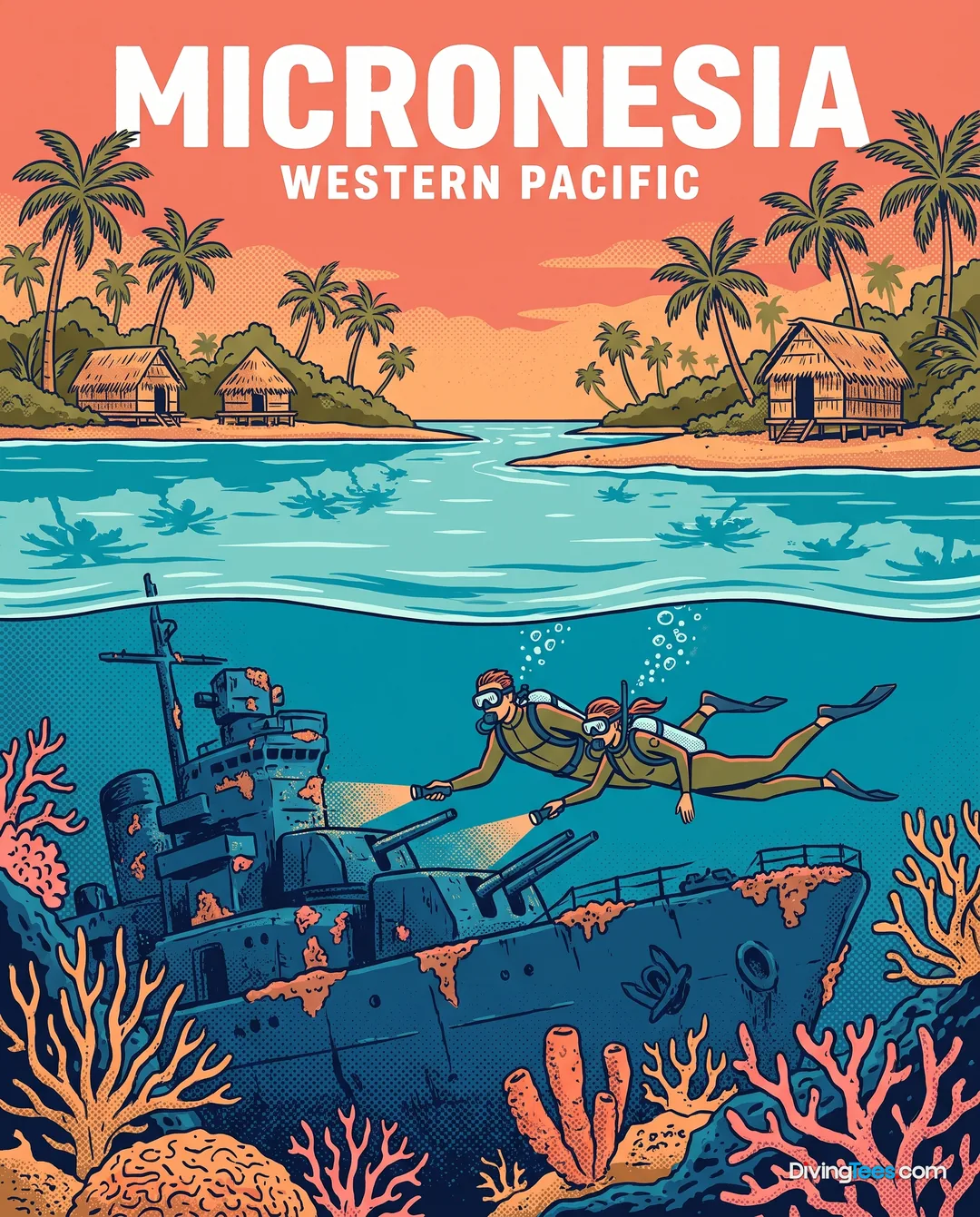
Thorfinn is for divers who come to Truk Lagoon for the wrecks, not for a polished resort at sea. The boat stays above one of the world’s richest concentrations of Second World War shipwrecks, with more than 30 wrecks reachable during a week aboard. That changes the point of the trip: the vessel is a base for repeated descents, equipment work and long looks into steel holds, engine rooms and deck structures. Two tenders help keep the diving flexible and the groups small. A dedicated camera area, charging points and compressed air for camera maintenance matter here because wreck photographers rarely finish a dive when the first image is taken. Thorfinn suits experienced divers who want a serious wreck itinerary, a boat equipped for technical diving and enough space to retreat between dives.
Boarding
Thorfinn presents as a substantial working dive vessel rather than a newly styled yacht. Its steel hull was built in 2005 and renovated in 2008, and the character follows from that: the boat is arranged first around moving divers, tenders and equipment through a demanding wreck-diving itinerary. Once aboard, the useful spaces are easy to identify—the dive deck, camera area, saloon, dining room and open-air places for sitting outside. The large hull gives the operation room to carry two diving tenders and support 22 guests without turning every surface into a gear pile. It is a boat with a job to do. That is exactly why it works as a base for Truk Lagoon.
The atmosphere on board
Thorfinn carries 22 guests, but the diving is not organised as one large procession. Two tenders and a guide ratio of one guide to four or five divers allow the operation to break into smaller groups. That matters in Truk Lagoon, where wrecks reward time and attention more than crowding a single route. Back aboard, the social centre is the saloon and dining area: people can watch television, read from the library, share the day’s images or meet at the bar. The crew works in English and Chuukese. The atmosphere is therefore shaped less by formal entertainment than by the repeated pattern of diving, eating, rinsing cameras and comparing what each group found inside the wrecks.
The sites you’ll dive
The route is the Truk Lagoon Trip, departing from Weno Island and returning to Weno Island over eight days and seven nights. Its subject is the wreck field itself: Thorfinn offers access to more than 30 Second World War wrecks during a week aboard, rather than building the itinerary around a short list of named reefs. The wrecks suit different levels of diver, and the two tenders make it possible to divide groups and work different parts of the lagoon. No verified site descriptions or site-specific depths are available here, so no individual wreck or depth is named. The appeal is the concentration: several days spent moving from one wreck to the next, with enough dives to explore more than a single famous ship.
What you’ll meet underwater
The defining underwater spectacle on this route is not a species list but the wreck field of Truk Lagoon. Divers come to see Second World War ships resting underwater, with the structure itself—decks, holds and machinery—providing the reason to descend. More than 30 wrecks can be explored during a week aboard, but no verified species list is available for this itinerary, so particular animals and cleaning stations are not assigned to individual sites. That makes the trip especially clear in its purpose: it is for divers who want time inside and around historic wrecks, and for photographers who need a proper place to prepare and maintain cameras between descents.
Who puts you in the water
Divers are organised in groups of roughly four or five per guide, with two tenders available to support the operation. The working languages are English and Chuukese. Thorfinn requires at least 50 logged dives and an Advanced Open Water Diver certification or equivalent, which fits the wreck-focused itinerary better than a first liveaboard does. The boat welcomes technical diving, but the available information does not describe courses, instructor qualifications or a specific technical programme. Full boat safety equipment is carried. The practical threshold is clear: guests should arrive with enough experience to manage themselves in current, around wreck structure and during repeated dives from tenders.
The dive deck and the gear
The diving setup is built for wreck divers and photographers. The included tanks are 12 litres, with weights; 15-litre tanks and equipment rental cost extra. Two compressors handle filling: one Bauer Model IK 15.1 II produces 21 cfm to 5,000 psi, and one Bauer/Poseidon P 201 produces 7.5 cfm to 5,000 psi. Nitrox is available for an extra charge, and the boat supports technical diving. DIN adaptors are carried. The dive deck has warm-water showers, rinse facilities, a camera table, a dedicated photography area and separate rinse tanks for underwater cameras. Two tenders support the diving and make smaller-group operations possible. The camera area adds two large worktables, dual-voltage charging points and compressed air for cleaning and maintenance.
Between dives
Between dives, the main saloon is the practical centre of the boat. There is an entertainment system, a bar, a television and a library, so the gap can be spent watching something, reading or simply letting equipment and body dry. The dining area provides another place to sit, while the open-air saloon, sun deck and loungers offer a change from air conditioning. A dedicated camera area with two large tables, dual-voltage charging points and compressed air lets photographers clean and prepare their equipment without taking over the living spaces. Wi-Fi is available. On an afternoon without a dive, those spaces matter more than decoration: they give wet divers somewhere to spread out, work on images or sit quietly.
A day on board
A day is shaped by three dives, with two dives on the final day. The first briefing and equipment preparation lead into the opening descent; after that, meals, rinsing, camera work and rest fill the interval before the next tender departure. The cycle repeats through the day, with the dining room and snacks keeping divers supplied between entries. There is no published timetable to turn into an artificial schedule, and no night dive is listed among the included dives. The final day is shorter underwater, with two dives before the return part of the trip. The rhythm is therefore straightforward: prepare, dive, recover, eat, work on equipment, then prepare again.
What you eat aboard
Meals are served buffet-style, with Western and local food, and dietary restrictions can be accommodated. The chef’s cooking gives the dining room a proper role on a dive trip: divers can eat enough, return for snacks through the day and keep the focus on the next descent rather than on finding food ashore. Tea, coffee, soft drinks, ice water and snacks are included. Alcoholic drinks and spirits are available, while alcoholic and soft drinks are not included by default. The useful detail is the all-day access to snacks. After a dive, nobody has to wait for a formal mealtime before replacing what was spent underwater.
Nights at sea
The cabins are air-conditioned, and all have a TV and DVD player. The five lower-deck cabins numbered 4 to 8 have a double bed and a single bed, with private bathrooms; cabin 3 on the main deck has the same arrangement. Cabins 9 and 10 on the upper deck are brighter, with a double bed and a single upper bed, but share shower and toilet facilities. Cabin 11 has two single bunk-style beds and shared facilities. Thor’s Lair is the largest and most elaborate option, with a king-size bed, adjoining settee, walk-in closet, bar fridge, four view windows and a large private bathroom. The cabins are functional places to dry out and sleep between dives, while the saloon is better suited to staying awake.
Double + Single Bed Cabin (#4-8)
Twin Cabin (#11)
Double + Single Bed Cabin (#9,10)
Thor’s Lair Cabin
Double + Single Bed Cabin (# 3)
What to know before boarding
The trip departs from and returns to Weno Island. A scheduled group transfer between the airport or a local hotel and the boat is included. Guests should plan to arrive the night before, so an airport or hotel transfer can connect with embarkation without turning a flight delay into a boarding problem.
What the boat does for the ocean
Thorfinn uses a solar-powered energy system with 36 panels producing up to 20 kWh, a 40 kW inverter and lithium metal-ion battery storage. The system supports quiet overnight power and reduces reliance on fuel.
- Year built
- 2005
- Year renovated
- 2008
- Length
- 58 m
- Beam
- 10 m
- Maximum number of passengers
- 22
- Number of cabins
- 11
- Engines
- Fredriksstad Mek 4 cyl. double compound steam – 2,500 h.p. @ 140 rpm
- Tenders
- 2 × Yamaha 150's; 2 × Yamaha 60's; 1 × Yamaha 40's
Hello, I'm Marina, DivingDeal.com's AI assistant. I answer in detail about hotels, dive centres and liveaboards.

Thinking about the whole trip and the flights? Talk it over with Edith →
Marina is an AI. Some links are affiliate links: DivingDeal may earn a commission, at no extra cost to you. Bookings are made with the partner.