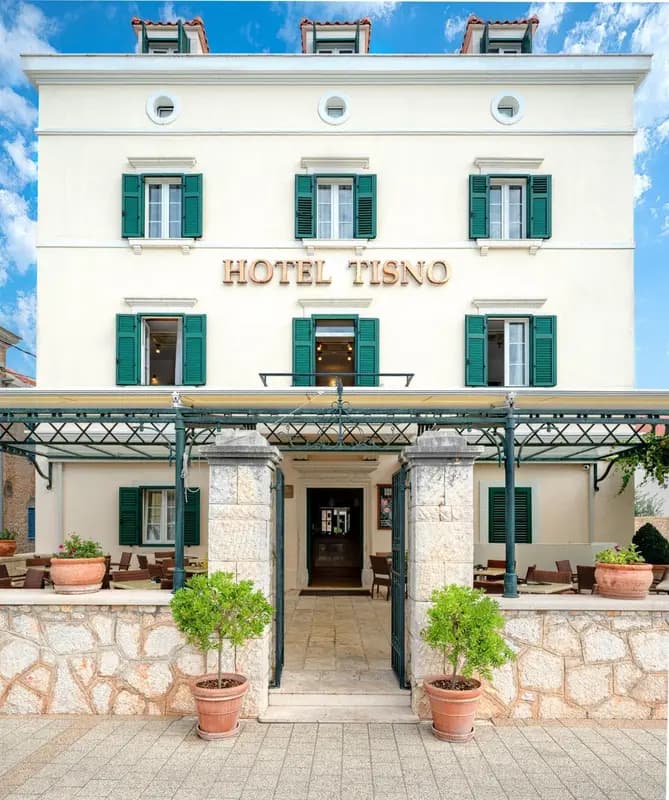
Heritage Hotel Tisno
★★★★
★ 9.7/10 (282 reviews)
less than 1 km away as the crow flies
Dive centre · Tisno · Croatia
4.8185 Google reviewsExplore the wrecks and deep walls of the Kornati National Park from a centre situated just two metres from the water's edge.
For subtitles in English: start the video firstthen click the gearat the top right of the video, select “Subtitles/CC”, then “Auto-translate” and choose “English”.
Tramonto is located in Tisno, positioned directly on the seafront with the water only a few steps from the centre. Since its founding in 2009, it has become a reliable fixture for divers looking to explore the Dalmatian coast, specifically the Murter archipelago and the Kornati National Park.
The centre's location provides immediate access to a diverse range of underwater environments. You can choose between shore dives on local reefs or boat excursions that take you out to the more remote islands and protected marine areas of the national park.
As an SSI-affiliated centre, Tramonto focuses on professional training and continuous development. The facility is designed to handle both the logistics of daily recreational diving and the specific requirements of technical diving programmes.
The centre provides a dedicated classroom for theory, a changing room, and an equipment storage area. The office is situated right on the water, making the transition from the shore to the boats seamless for your dive days.
Tramonto offers a comprehensive curriculum through SSI, catering to everyone from those looking for their first experience to advanced technical divers. The training range includes SSI Try Scuba, Junior Open Water Diver, and the full Open Water Diver course.
For those looking to advance their skills, the centre provides Advanced Open Water Diver, Deep Diver, Navigation, and Night Diver specialties, as well as the Stress & Rescue course. They also facilitate higher-level certifications such as Dive Guide and Master Diver.
Technical training is a core part of the centre's offering, with courses available for Nitrox and Trimix divers, allowing for deeper and more complex explorations of the local wrecks and walls.
The centre operates two boats to accommodate different group sizes and dive types. The Flymar is a larger vessel with a capacity for 14 divers, featuring two large engines, a new navigation system, and dedicated areas for both sun and shade. It is equipped with an emergency oxygen kit and onboard toilets.
For smaller groups or more agile trips, there is an 8-metre speedboat powered by a Honda 250HP engine, which carries up to 8 divers. Both vessels are used to reach the various sites around the archipelago, including the more distant reefs.
The shore-based facility is well-equipped for high-volume diving, supported by a robust compression setup. The centre utilises L&W 450L, Bauer 470L/min, and Bauer Poseidon 210L/min compressors, providing a total capacity of 1130L/min. This ensures reliable gas supply for all divers, including those requiring Nitrox or Trimix.
A full range of rental kit is available on-site, including wetsuits, BCDs, regulators, computers, torches, masks, and fins. For those requiring more specialised configurations, the centre stocks 15L cylinders and S80 stage tanks.
The Junkers JU 87 Štuka is a significant wreck for advanced divers, located at a depth of 28 metres. This WWII aircraft remains in good condition, with the fuselage, wings, and tail largely intact.
Kaprije offers a diverse range of environments, from shallow areas at 5 metres to a reef wall that drops to 40 metres. The site is known for its sponge-rich caves and the opportunity for a 'blue water jump' along the wall.
Bacvica provides three distinct diving experiences near the entrance to the Kornati National Park. You can explore a shallow western wall at 18 metres, a deeper southern wall reaching 40 metres covered in red gorgonians, or the Borko fishing boat wreck on the northern side.
Panitula, located in the heart of the Kornati National Park, features a dramatic wall that descends from the surface to 80 metres. The site is characterised by deep penetrations into the island that create cave-like environments.
And some of the dive sites the centre runs.
The marine life in this region is diverse, particularly along the deep walls and wrecks. You will find various species of fish, including amberjack, dentex, and wrasse, often patrolling the rocky structures. On the deeper walls, red gorgonians provide a vibrant backdrop for observing groupers, moray eels, and scorpionfish.
Macro life and smaller inhabitants are abundant throughout the archipelago. Divers frequently encounter octopuses, lobsters, and various species of sea urchins. If you look closely among the sponges and corals, you may spot seahorses or different types of crabs.
The rocky reefs and caves are also home to catsharks and southern stingrays. In the deeper sections, particularly around the wrecks, you may see eels and larger predatory fish moving through the structure.
The area is accessible year-round, with the marine environment remaining active through the seasons. In the winter, a decrease in algae blooms can lead to improved visibility in the water.
While the sea is generally manageable, the sites in the Kornati National Park can vary in character depending on the location, from sheltered reefs to more exposed outer walls.
Hello, I'm Marina, DivingDeal.com's AI assistant. I answer in detail about hotels, dive centres and liveaboards.

Thinking about the whole trip and the flights? Talk it over with Edith →
Marina is an AI. Some links are affiliate links: DivingDeal may earn a commission, at no extra cost to you. Bookings are made with the partner.