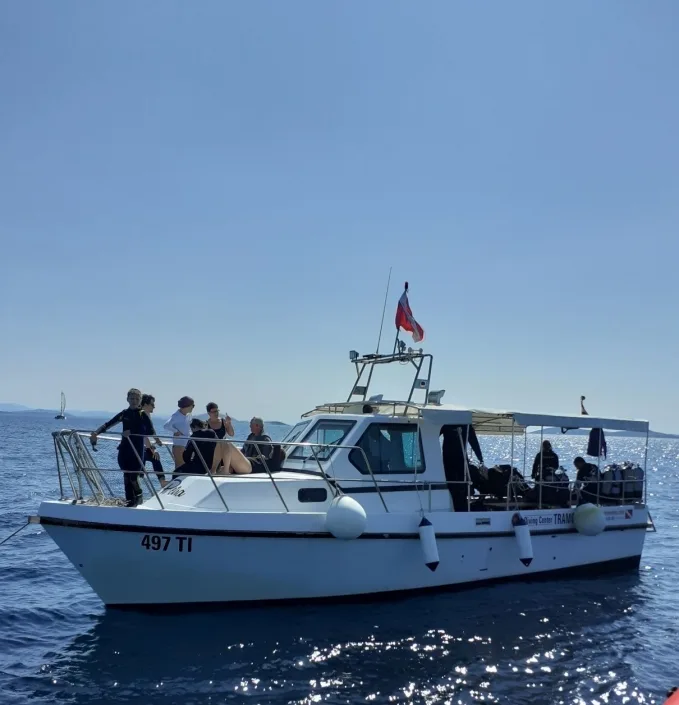

Tramonto
Google 4.8/5 (194 reviews)
Croatia · Mediterranean
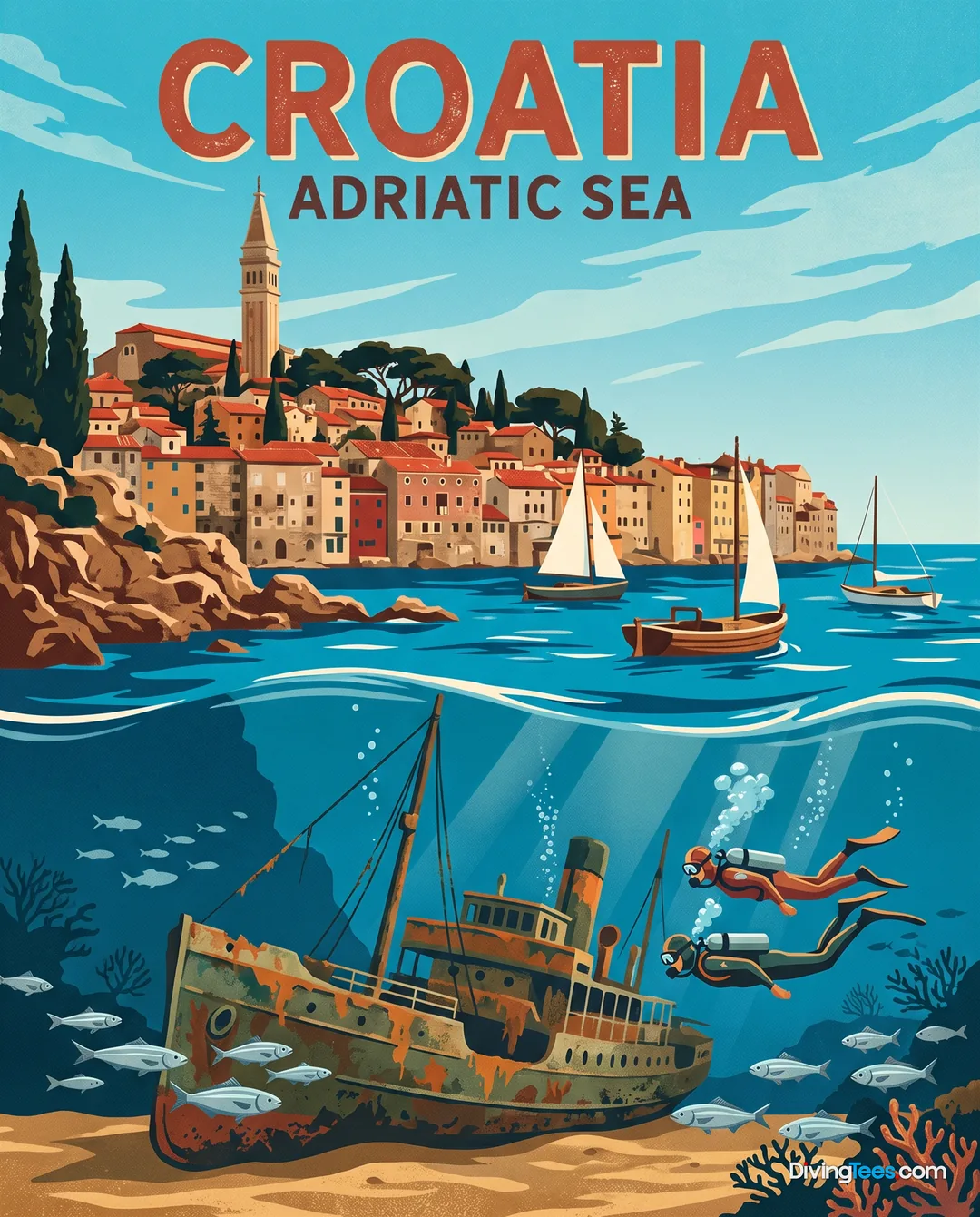
Underwater trails in Saint-André Bay, fissured reefs in the Murter Channel and the deep Junkers Ju 87 wreck define Tisno’s diving.
For subtitles in English: start the video firstthen click the gearat the top right of the video, select “Subtitles/CC”, then “Auto-translate” and choose “English”.
The Saint-André Bay underwater trail gives Tisno an unusually simple introduction, while boats take divers from the waterfront into the Murter Channel, towards neighbouring islands and the Kornati archipelago. Underwater, the menu runs from shallow rock and educational markers to fissures, caves, walls and wrecks around 60 metres. It is a practical base for a five- to seven-day stay, with enough range for new divers, experienced recreational divers and technical teams sharing the same Croatian village.
Tisno diving is mainly boat-based. Close to the island, expect rocky channels, fissures, caves and walls, with formations described at roughly 20 to 40 metres. Further trips open out towards island sites and the Kornati archipelago, so a day on the water can involve more travelling than a local Murter Channel outing. Currents are variable rather than a fixed feature of every dive, and the site briefing matters before committing to a wall or channel. The water is generally clear during the season, although the useful expectation is good Adriatic visibility rather than a guaranteed figure. Saint-André Bay offers the gentlest contrast, with a shallow underwater trail and straightforward orientation. At the other end, the Junkers Ju 87 and other deep wrecks demand planned profiles, appropriate gas and a disciplined ascent with a proper safety stop.
Marine life around Tisno is encountered against rock, cracks, caves and the underwater trail rather than around a published list of headline animals. The Saint-André Bay trail is intended for observing and identifying the fauna and flora of the Murter Channel, giving a slower, more attentive dive than a deep wreck excursion. On the natural reefs, the interest lies in checking the shelter of fissures and walls as the boat-diving route moves between the channel and the islands. May to October is the practical wildlife season because it is the local diving season. June to September generally offers the clearest conditions, while the quieter shoulder months make close observation easier around Saint-André Bay.
The local diving season runs chiefly from May to October. May, June, September and October are the sensible choices for divers who would rather share the channel and boat sites with fewer holiday crowds. July and August bring the busiest tourist period and the greatest likelihood of traffic on the water. Visibility is generally clearest from June through September, which suits wall, cave and wreck diving, but the quieter edges of the season have their own advantage at the shallow Saint-André trail. Allow for the Tisno bridge when planning road transfers in high summer, as boat movements can temporarily interrupt the road.
Tisno suits all levels, provided the trip is matched to the site. Beginners can start with an easier local outing or the Saint-André Bay trail, while experienced recreational divers can move on to channel walls, caves and deeper rock. The Junkers Ju 87 and similar wreck profiles require Advanced Open Water or an equivalent qualification, with relevant experience. Technical divers should confirm the centre’s requirements for certification, gases and equipment configuration before reserving a deep outing.
From London Heathrow, London Gatwick or Manchester, the usual route is by air to Split or Zadar, followed by a road transfer to Tisno. Travellers arriving through Zagreb can continue by road, with the drive from Zagreb taking roughly three and a half to four hours. From Split, allow around one and a half to two hours by road. Tisno is connected to the mainland by road and its mobile bridge, so no ferry is needed. The bridge can be raised for passing boats, which makes a little spare time worthwhile on transfer days. Once in Tisno, waterfront centres may be walkable from nearby accommodation, while farther stays on Murter Island call for a car or taxi.
Do not arrive assuming that every dive is from the shore. Local operations work mainly from boats, and the Saint-André trail still needs its practical entry point checked before you rely on it for an independent dive. Ask which sector a trip visits, the Murter Channel, nearby islands or the Kornati, because travel time and diving character change accordingly. Reserve a separate, properly specified outing for the Junkers Ju 87 or another deep wreck, and check the required experience and equipment configuration rather than treating it like the shallow trail. Keep road plans loose around the Tisno bridge. If the itinerary includes the Kornati, check the rules applying to the national park, rather than assuming they are the same as around Murter. Natura 2000 status around Murter signals ecological importance, but it should not be read as a blanket no-anchoring or no-taking rule everywhere.
Tisno works best as a land-based diving holiday. Five to seven days allows the Saint-André trail, several boat days in the Murter Channel and a separate excursion towards the Kornati, with extra time if deep wrecks are the main aim. Staying near the waterfront can make morning departures walkable; accommodation farther around Murter Island is more practical with a car or taxi. Non-divers have beaches, coastal villages, kayaking, walking, cycling and boat trips to fill the surface intervals.
Hello, I'm Marina, DivingDeal.com's AI assistant. I guide you through destinations, areas and countries.
Thinking about the whole trip and the flights? Talk it over with Edith →
Marina is an AI. Some links are affiliate links: DivingDeal may earn a commission, at no extra cost to you. Bookings are made with the partner.
For diving in Tisno, the local season runs from May to October. May, June, September and October are quieter choices, while July and August are busier on the water. Visibility is generally clearest from June through September, although the shoulder months suit calmer observation at the Saint-André underwater trail.
Tisno suits different experience levels when you match the site to your training. Beginners can start with an easier local outing or the Saint-André Bay trail. Experienced recreational divers can explore channel walls, caves and deeper rock. The Junkers Ju 87 and similar wrecks require Advanced Open Water or equivalent experience.
Diving in Tisno includes the shallow Saint-André Bay underwater trail, with markers for observing and identifying local fauna and flora. Boat trips reach Murter Channel fissures, caves, rocky walls and formations around twenty to forty metres. Further outings visit islands and the Kornati archipelago, while the Junkers Ju 87 lies around sixty metres.
Plan Tisno as a land-based diving holiday, with several boat days in the Murter Channel and a separate outing towards the Kornati or a deep wreck. Stay near the waterfront for easier departures, or arrange a car or taxi farther around Murter Island. Allow spare time for the mobile bridge and check park rules for Kornati trips.