Leafy Seadragon
Phycodurus eques
A masterpiece of camouflage that moves on invisible fins.
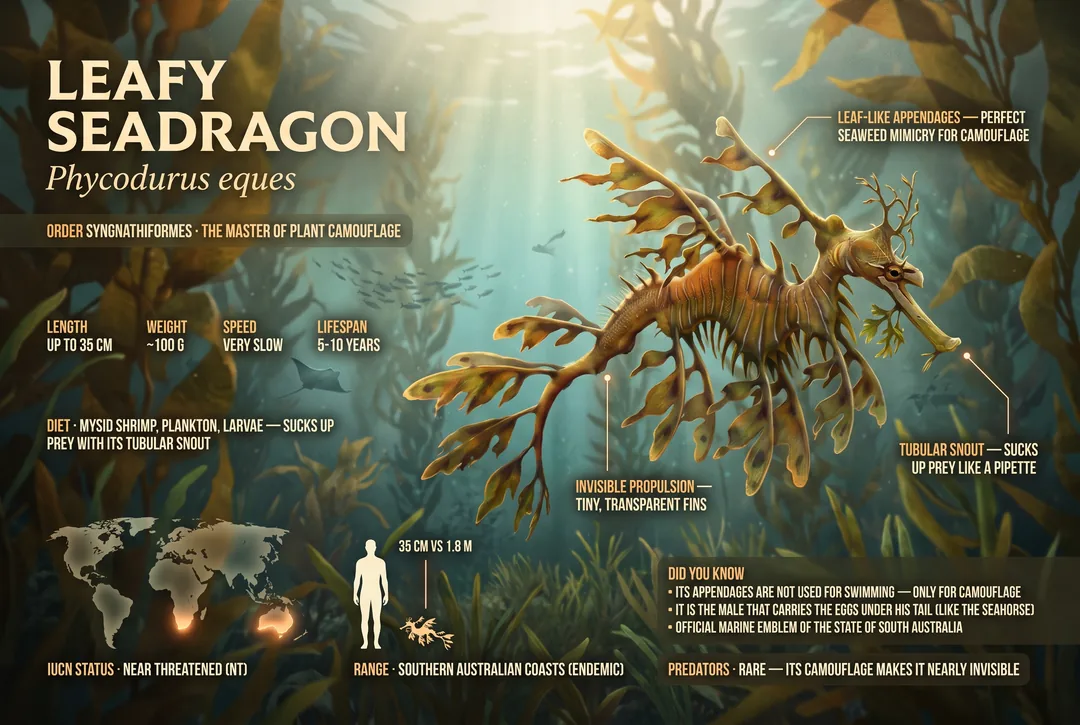
IDENTITY CARD
| Classification | Order Syngnathiformes, family Syngnathidae |
| Scientific name | Phycodurus eques |
| Size | Up to 35 cm (including leaf-shaped appendages) |
| Weight | A few grams |
| Speed | ~150 m/h — one of the slowest fish in the ocean |
| Lifespan | 5 to 10 years (estimates in the wild) |
| Depth | 3 to 30 m, usually 8-20 m |
| Diet | Mysids (opossum shrimp), small planktonic crustaceans, fish larvae — aspirated through a tubular snout |
| IUCN Status | Least Concern (LC) — but endemic to southern Australia with a very restricted range |
PORTRAIT
It takes several minutes to spot one. Not because the animal is far away — it may be less than a metre from your mask — but because it looks exactly like the seaweed it floats beside. The leafy seadragon is a fish that decided to become a plant, and very nearly succeeded. Phycodurus eques carries translucent, vein-patterned lobes across its entire body — head, spine, flanks, tail — that sway in the current precisely like fronds of brown algae. The camouflage is so complete that a diver can scan a seagrass bed for long seconds before realizing, with a jolt of recognition, that one of those strands of kelp has an eye.
The spectacular appendages serve a single purpose: disguise. They contain no muscle and play no role whatsoever in propulsion. Movement comes instead from two tiny, near-transparent fins — a dorsal fin along the crest of the neck and a pair of pectorals on each side of the head — that beat at high frequency, like hummingbird wings played in slow motion. The result is a ghostly, drifting glide so slow that the illusion of being seaweed holds even while the animal is in motion. At 150 metres per hour, the leafy seadragon moves roughly 400 times more slowly than a walking human.
For a diver, finding one is a quiet triumph — a reward for patience, observation, and the willingness to look past what the eye expects to see. There is no drama, no speed, no size. Just a tiny, impossibly ornate creature floating at the edge of visibility in the green temperate waters of southern Australia, daring you to tell it apart from the kelp.
HOW TO RECOGNIZE IT
The leafy seadragon's body colour ranges from yellow-brown to olive green, sometimes marked with pink or purple bands. The leaf-shaped appendages are most developed on the head, back, and tail, giving the animal an outline that is almost impossible to parse as a fish at first glance. Each lobe is translucent and veined, mimicking the structure of kelp fronds down to the finest detail.
Do not confuse it with the weedy seadragon (Phyllopteryx taeniolatus), the only other species in its immediate family. The weedy seadragon has shorter, less elaborate appendages, a more slender body, and is often red or orange with yellow rings. The leafy seadragon is rarer, harder to spot, and more heavily ornamented — its appendages are longer, more branched, and more convincingly plant-like.
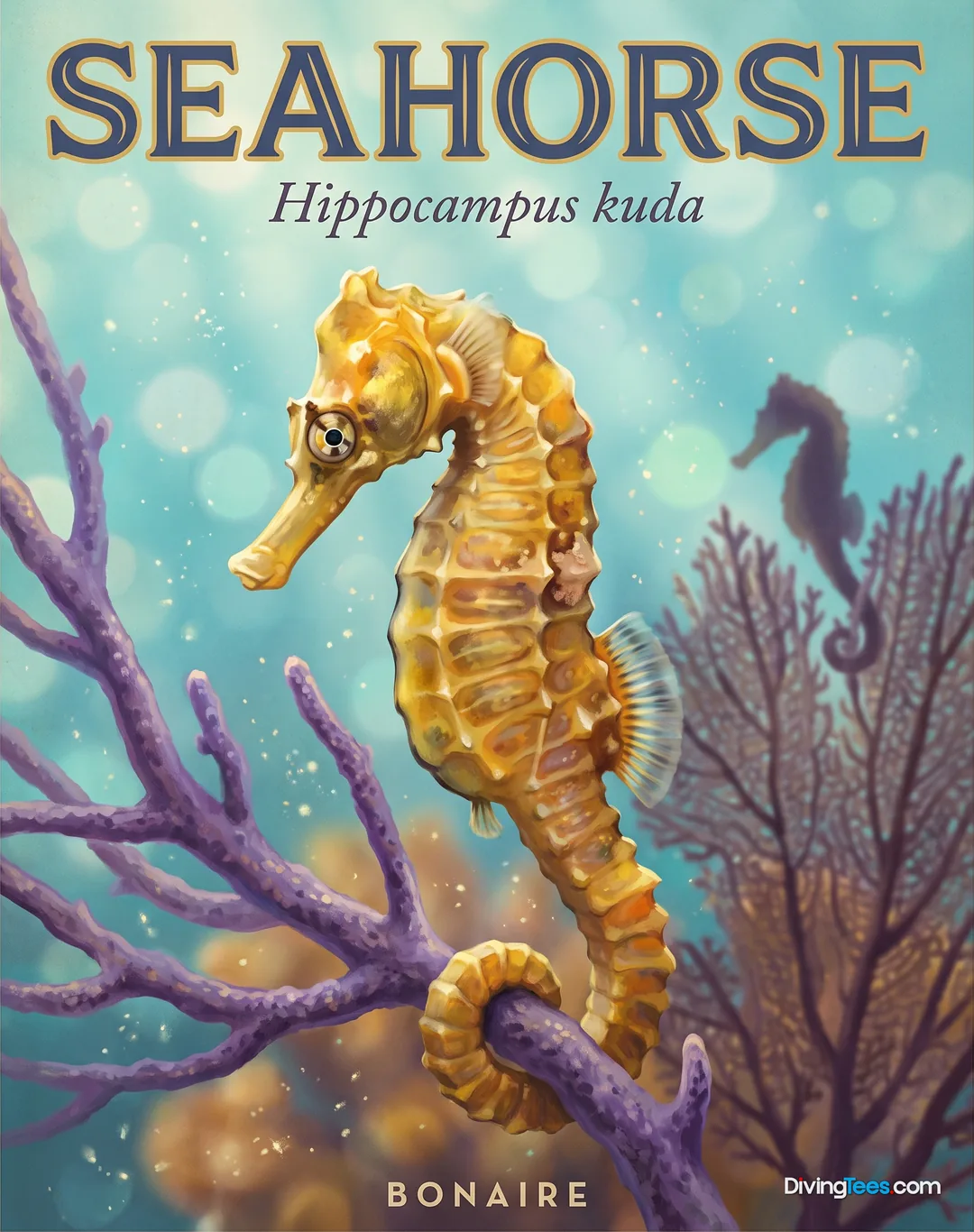
Both species are related to seahorses and pipefish and share their rigid, armour-plated body structure and tubular snout.
For subtitles in English: start the video firstthen click the gearat the top right of the video, select “Subtitles/CC”, then “Auto-translate” and choose “English”.
WAY OF LIFE
The leafy seadragon is a sedentary animal, rarely straying more than a few hundred metres from the patch of temperate seagrass and rocky reef where it settled as a juvenile. Its depth range spans 3 to 30 metres, though most sightings occur between 8 and 20 metres — the heart of the kelp forest and seagrass zone along southern Australia's coast.
Feeding is a miniature act of precision. The tubular snout functions as a pipette, creating a rapid suction that aspirates mysids and other tiny crustaceans one by one. A single leafy seadragon may consume thousands of mysids per day, hovering among the seagrass with imperceptible adjustments of its transparent fins, picking off prey that never sees it coming.
As with seahorses, the male carries the eggs. The female deposits 100 to 300 pink eggs onto a spongy brood patch on the underside of the male's tail. Incubation lasts 4 to 8 weeks, during which the eggs progress through a colour change from pink to purple to silver-grey. The juveniles emerge at roughly 20 millimetres, fully formed, already bearing their first leaf-shaped appendages. Breeding season runs from October to March — the austral spring and summer.
WHERE TO SEE IT
The leafy seadragon is endemic to southern Australia. It exists nowhere else on Earth.
The leafy seadragon is a resident: you can see it all year round at Rapid Bay and on Kangaroo Island. October to February is the breeding season, when the males carry the eggs.
Rapid Bay, South Australia. The single most famous leafy seadragon site in the world. A shore dive off the old jetty, in 6 to 12 metres of water, through beds of Posidonia seagrass that shelter a resident population. Local guides know individual animals by their appendage patterns. November to February offers the best chance of seeing egg-bearing males, though the population is present year-round.
Victor Harbor and Granite Island, South Australia. Along the Fleurieu Peninsula coast, divers find leafy seadragons in the same temperate seagrass habitats. Similar conditions and seasonality to Rapid Bay.
Kangaroo Island, South Australia. The island's north coast, particularly around Kingscote and Emu Bay, supports populations in kelp and seagrass beds. Summer months offer the best visibility and diving conditions.
Esperance, Western Australia. Near the eastern limit of the species' range, the Recherche Archipelago offers encounters in cooler water (10-18 degrees C) among dense kelp forests — a wilder, more remote experience than the South Australian sites.
CONSERVATION
The leafy seadragon is classified as Least Concern by the IUCN, but that status belies a precarious reality: the species is restricted to a narrow strip of southern Australian coastline and exists nowhere else. Its entire global population occupies a range measured in hundreds of kilometres, not thousands.
Legal protection has been in place since 1991, when collection was banned after years of exploitation for the aquarium trade and traditional medicine. The leafy seadragon has been the official marine emblem of South Australia since 1982 — a recognition of both its uniqueness and its vulnerability.
Current threats are quiet but persistent. Degradation of seagrass and kelp habitats — through agricultural runoff, coastal pollution, and rising water temperatures — erodes the very environment on which the species depends for food, shelter, and camouflage. Bycatch in fishing nets takes an unknown toll. Illegal collection continues at a low level. And at popular dive sites, overcrowding can disturb resident populations, particularly during the breeding season when males are carrying eggs. Climate change is pushing kelp forests southward along the Australian coast, potentially shrinking the seadragon's already restricted habitat.
Organisations to support:
- Dragon Search — citizen science programme tracking individual leafy seadragons across South Australia
- Marine Life Society of South Australia — local marine conservation
- Reef Life Survey — global reef monitoring including southern Australian temperate reefs
3 THINGS YOU PROBABLY DON'T KNOW
1. The leaves do not help it swim — not even slightly. The spectacular appendages are purely passive ornaments. They contain no muscle tissue, no articulation, no connection to the animal's locomotion. All propulsion comes from two near-invisible fins that beat roughly ten times per second — a dorsal fin along the neck and pectorals beside the head. The leafy lobes are dead weight, carried solely for the sake of disguise.
2. Its camouflage makes it vulnerable to storms. The very appendages that protect the seadragon from predators increase its hydrodynamic drag enormously. During storms and heavy swells, individuals are torn from their seagrass beds and washed ashore. The first naturalists to study the species worked almost exclusively from beached specimens — they had never seen one alive underwater.
3. Every individual is identifiable. Each leafy seadragon carries a unique pattern of appendages, body marks, and colouration — a natural fingerprint. The Dragon Search citizen science programme has used photo-identification for over 20 years, building one of the longest-running datasets on any marine fish. Some individuals have been tracked across their entire adult lives, revisited year after year on the same patch of reef.
PHOTO AND VIDEO TIPS
Lens. Macro or semi-macro is essential. A 60 mm lens offers a wider field of view and more habitat context; a 100-105 mm macro provides tighter detail on the leaf appendages and the tiny transparent fins. Forget wide-angle — this is an animal measured in centimetres.
Light. The green, temperate waters of southern Australia swallow colour rapidly. External lighting — strobes or continuous video lights — is non-negotiable. Position lights laterally to reveal the texture and translucency of the leaf appendages, which glow beautifully when backlit.
Approach. Move slowly and deliberately. Do not touch the bottom — silt disturbance in these seagrass beds ruins visibility instantly and can take minutes to clear. Fin gently, hover with precision, and be patient. The animal moves at 150 metres per hour; you have time.
Classic mistake. Isolating the subject against a clean green background. This misses the entire point. The leafy seadragon's genius is its camouflage — the way it disappears into its habitat. The most powerful photographs show it in the seagrass, at the edge of recognition, forcing the viewer's eye to search for it. Compose so that the boundary between plant and animal is ambiguous. Let the image do what the animal does: hide in plain sight.