Blue-ringed Octopus
Hapalochlaena
It fits in the palm of a hand, weighs less than a golf ball — and carries enough venom to kill twenty-six adult humans in minutes.
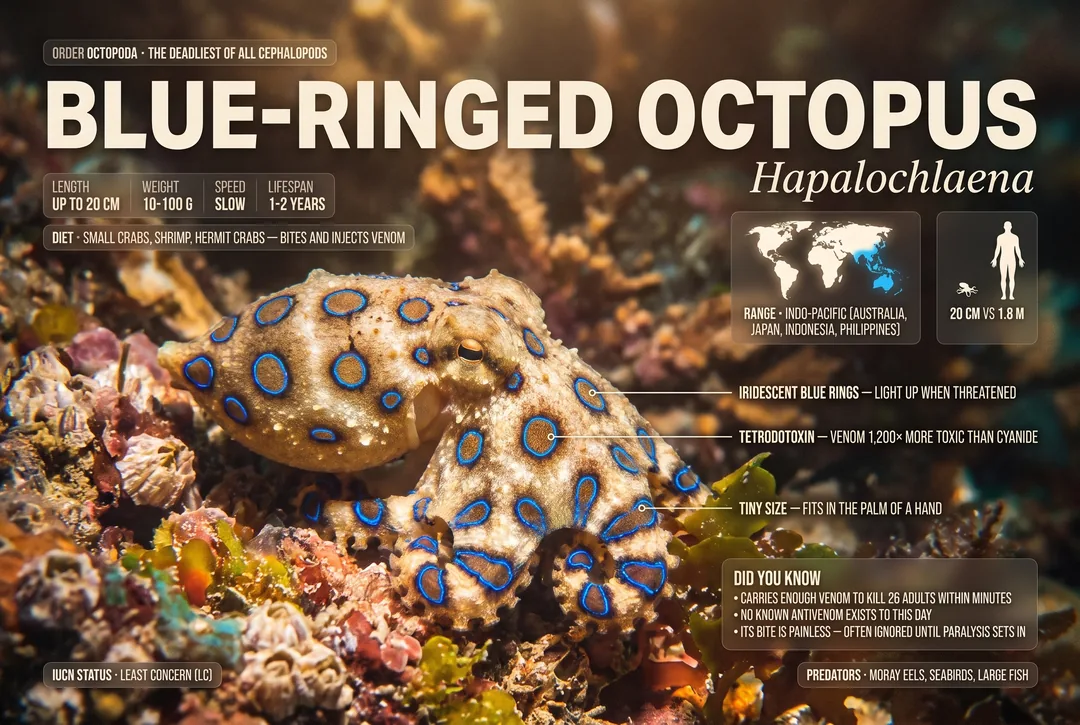
IDENTITY CARD
| Classification | Order Octopoda, family Octopodidae |
| Scientific name | Genus Hapalochlaena (Robson, 1929) — 4 recognized species |
| Size | 12 to 20 cm arm span (mantle: 4 to 6 cm) |
| Weight | 10 to 100 g depending on the species |
| Lifespan | 1 to 2 years — like most small cephalopods, it dies after its first reproduction |
| Depth | Intertidal zone to 50 m, most commonly between 0 and 20 m |
| Diet | Predator — small crabs, shrimp, gastropods, occasionally small fish, immobilized by a venomous bite |
| IUCN Status | Least Concern (LC) for assessed species |
PORTRAIT
There are underwater animals people seek because they are large. The blue-ringed octopus is sought precisely because it is minuscule — and because its reputation precedes it. Hapalochlaena is one of the most venomous animals on the planet, all categories combined. A single individual the size of a golf ball carries enough tetrodotoxin (TTX) to kill twenty-six adult humans. There is no antidote.
Tetrodotoxin is the same neurotoxin found in the pufferfish — 1,200 times more potent than cyanide. Produced by symbiotic bacteria of the genus Vibrio housed in the animal's salivary glands, it blocks the sodium channels of nerve cells and causes progressive muscle paralysis. The victim remains conscious but can neither move nor breathe. Without immediate artificial ventilation, the outcome is fatal within minutes.
And yet, the blue-ringed octopus is not aggressive. It flees human contact, hides in empty shells and crevices in the reef, and bites only if seized or crushed by accident. Serious incidents — a handful per decade — occur almost exclusively in tide pools, when a beachgoer picks up an occupied shell without knowing it. In diving, the risk is virtually nil for anyone who observes without touching.
HOW TO RECOGNIZE IT
At rest, the blue-ringed octopus is nearly invisible. Its skin tends toward beige, brown, or dull yellow, marked with faint patterns that blend it into the substrate — sand, coral rubble, empty shells. Nothing distinguishes it from the dozens of other small octopuses on the reef.
Everything changes when it feels threatened. In a fraction of a second, 50 to 60 iridescent rings appear across the body and arms, shifting from dull to an intense electric blue. This is not a pigment-based coloration but a mechanism of chromatophores and iridophores: cells beneath the skin that reflect light to produce a metallic blue visible even in low light. The signal is unequivocal — pure aposematism: do not touch.
The four species in the genus are difficult to distinguish from one another without genetic analysis. The most widespread, Hapalochlaena maculosa, bears relatively large, well-defined rings. H. lunulata, the most frequently photographed, displays smaller and more numerous rings. H. fasciata and H. nierstraszi, described more recently, remain poorly known.
For subtitles in English: start the video firstthen click the gearat the top right of the video, select “Subtitles/CC”, then “Auto-translate” and choose “English”.
WAY OF LIFE
The blue-ringed octopus is a crepuscular and nocturnal hunter. It spends the day hidden in a coral hole, an empty shell, or beneath a rock, emerging at dusk to hunt. Its technique is devastatingly efficient: it approaches a small crab or shrimp, seizes it with its arms, and delivers a precise bite with its horny beak. The TTX-laden saliva paralyzes the prey in seconds. The animal can then feed at leisure, sheltered in its den.
The life cycle is brief. Like most octopods, Hapalochlaena is semelparous: it reproduces only once, then dies. The female broods approximately 50 eggs under her arms for about two months, ceasing to feed for the entire incubation. The young hatch as planktonic paralarvae, drift for several weeks in the current, then settle on the bottom to begin their benthic life. The mother, exhausted, dies shortly after hatching.
The preferred habitat is the maze of empty shells, coral debris, and rocky rubble that divers call muck — those seemingly drab bottoms where microscopic life proliferates at staggering density. Rocky tide pools are the other hunting ground, particularly in Australia, where encounters outside the water are most frequent.
WHERE TO SEE IT
The blue-ringed octopus is endemic to the Indo-Pacific, from southern Japan to Australia, from Indonesia to the Philippines. It is a discreet, small, and nocturnal animal — every sighting is an event.
Australia — Great Barrier Reef and Sydney tide pools. Australia is the heart of the genus's range. Hapalochlaena maculosa, the type species, inhabits the southern and eastern coasts, including the tide pools of the Sydney and Melbourne areas — it is also where most accidents occur. On the Great Barrier Reef, underwater encounters are rare but documented, usually on shallow coral flats.
Indonesia — Lembeh and Bali. The Lembeh Strait (North Sulawesi) is the world capital of muck diving — and one of the places where the probability of encountering a blue-ringed octopus is highest. Local guides know the daytime resting sites and locate the animal with a regularity that astonishes visitors. In Bali, macro sites such as Seraya and Tulamben offer comparable sightings, especially on night dives.
Philippines — Anilao. Anilao Bay (Batangas), south of Manila, is the other world capital of macro. The volcanic rubble and black sand bottoms shelter a population of Hapalochlaena lunulata that guides find regularly, by day and by night.
Japan — Izu Peninsula. The warm temperate waters of the Izu Peninsula, two hours from Tokyo, mark the northern limit of the range. Japanese divers, whose patience and observational precision are legendary, regularly photograph H. lunulata in algae forests and shallow rocky bottoms.
OBSERVATION CALENDAR
| Destination | J | F | M | A | M | J | J | A | S | O | N | D |
|---|---|---|---|---|---|---|---|---|---|---|---|---|
| Australia (Sydney, southern coasts) | ||||||||||||
| Australia (Great Barrier Reef) | ||||||||||||
| Indonesia (Lembeh) | ||||||||||||
| Indonesia (Bali) | ||||||||||||
| Philippines (Anilao) | ||||||||||||
| Japan (Izu) |
Click each button to show/hide
CONSERVATION
The blue-ringed octopuses are not threatened. The species assessed by the IUCN are classified as Least Concern (LC). Their short life cycle, reasonable fecundity, and coastal habitat — coral reefs, intertidal zones, rubble bottoms — make them dependent on the general health of coastal ecosystems, but no specific pressure weighs on the genus.
Indirect threats are nonetheless real. Destruction of coastal habitats — urbanization, pollution, sedimentation — reduces hunting and spawning grounds. Warming waters could alter the range: specimens have been observed in recent years in areas where the genus was previously unknown, such as the coasts of southern India. Finally, the exotic aquarium trade occasionally removes individuals from the wild, a practice dangerous to the keeper as much as to the species.
The responsible diver never touches a blue-ringed octopus, never moves it for a photograph, and does not illuminate a resting individual for more than a few seconds. These animals are minuscule, fragile, and stressed by the slightest contact.
Organizations to follow:
- The Cephalopod Page — the reference scientific resource on cephalopod biology
- Australian Marine Conservation Society — conservation of Australian marine ecosystems
- CephRes — Association for Cephalopod Research — cephalopod research and awareness
3 THINGS YOU PROBABLY DON'T KNOW
1. Its venom is manufactured by bacteria, not by the octopus itself. The tetrodotoxin is not synthesized by the octopus. It is produced by colonies of symbiotic bacteria of the genera Vibrio and Pseudoalteromonas, housed in its salivary glands. Without these bacteria, the animal would be as harmless as any other small octopus. The same mechanism exists in the pufferfish, certain newts, and some tropical frogs — TTX is a universal poison, not the invention of a single group.
2. Its bite is painless — that is what makes it dangerous. The beak of the blue-ringed octopus is minuscule and its bite so gentle that most victims do not feel it. The first symptoms — numbness of the lips, muscle weakness, difficulty breathing — appear 5 to 25 minutes later. By that point, the victim is often far from any help. This is why accidents, although extremely rare (two to three documented deaths in recorded history), are so grave: no one knows they have been bitten.
3. The rings are not blue at rest — they become blue. The blue color is not permanent. At rest and at ease, the animal is brown-beige, nearly invisible. The rings appear in under one-third of a second, through contraction of muscles surrounding reflective cells (iridophores) beneath the skin. The blue flash is a last-resort warning — the animal equivalent of a danger sign. If you see the rings, the octopus considers itself in imminent danger.
PHOTO AND VIDEO TIPS
The blue-ringed octopus is the holy grail of underwater macro photography. Its rarity, its tiny size, and the chromatic spectacle of its rings make it a subject coveted by every muck photographer.
Lens. Macro is mandatory: 60 mm or 100 mm in a mirrorless or SLR housing, or a wet macro lens on a compact. The subject rarely exceeds 6 cm of mantle — a wide angle would be pointless. A supplementary diopter allows filling the frame with the entire animal and its rings.
Light. Low-power flash or focus light, positioned to avoid reflections off the iridophores. The blue rings naturally produce a metallic gleam that can saturate a sensor if the light is frontal and too strong. Sidelighting at 45 degrees from the subject brings out the rings while preserving the detail of the skin.
Approach. Slow, low, with no sudden movements. If the blue rings appear, the animal feels threatened — back away immediately and wait for it to return to calm. The best images show the animal at rest or hunting, rings subdued, in its natural environment — not a portrait of chromatic stress.
Classic mistake. Wanting at all costs to trigger the blue ring flash. Some divers nudge or touch the animal to provoke the reaction. This is both dangerous (risk of bite) and contrary to all photographic ethics. The rings at rest, barely visible, yield images rarer and more honest than the threat portrait — and demonstrate far superior command of the subject.