Clownfish
Amphiprion ocellaris
The anemone's tiny tenant that changes sex to seize power.
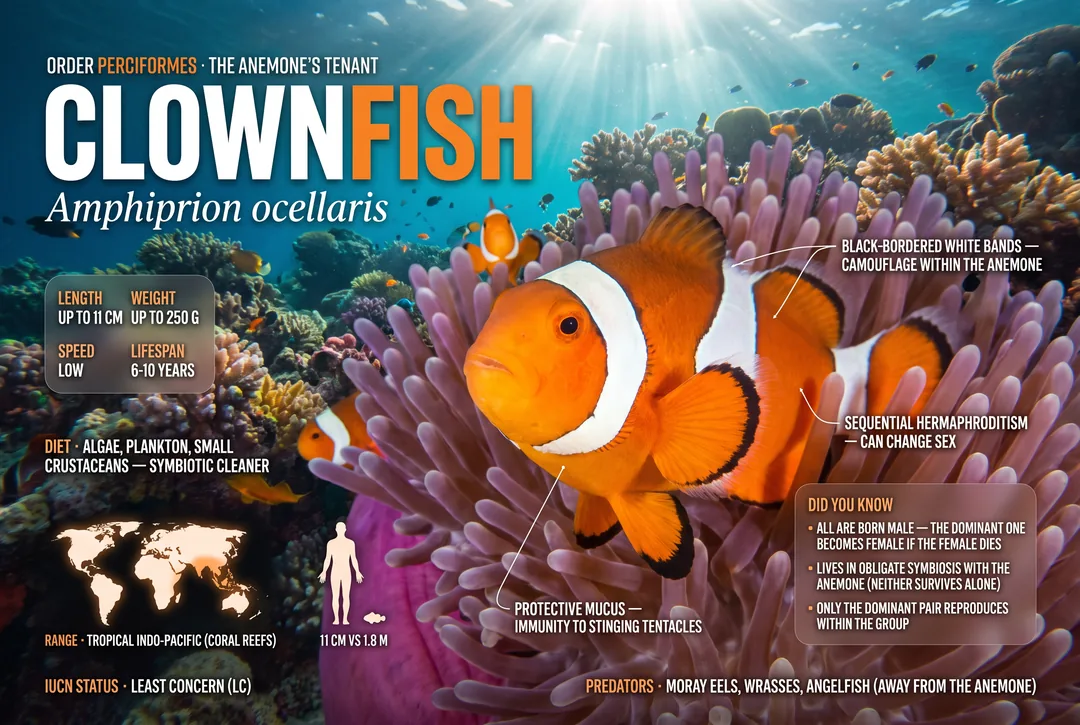
IDENTITY CARD
| Classification | Order Perciformes, family Pomacentridae |
| Scientific name | Amphiprion ocellaris (Cuvier, 1830) |
| Size | Up to 11 cm |
| Weight | ~50 g |
| Speed | Short, darting bursts |
| Lifespan | 6-10 years in the wild, up to 20 years in captivity |
| Depth | 1 to 15 m, rarely deeper |
| Diet | Omnivore — zooplankton, algae, small invertebrates, scraps from its anemone's meals |
| IUCN Status | Least Concern (LC) |
PORTRAIT
Before Finding Nemo, the clownfish was a reef insider's secret. Divers knew it, snorkellers searched for it, biologists studied it for its extraordinary relationship with the anemone. After 2003, it became the most recognised marine animal on the planet — and one of the most coveted targets of the aquarium trade.
Amphiprion ocellaris is one of 30 known clownfish species, and the most iconic: three white bands edged in black across a vivid orange body. But what makes this animal truly remarkable is not its colour — it is its life.
The clownfish lives in a mutualistic symbiosis with certain species of sea anemone. The anemone, armed with stinging cnidocytes capable of paralysing a small fish, is deadly to most reef inhabitants. The clownfish is immune. Its skin mucus, chemically modified, prevents the stinging cells from firing. It lives, sleeps, breeds, and raises its young in the very heart of the tentacles — a home no one else can occupy. In return for this refuge, the clownfish feeds its host: it lures prey toward the tentacles, cleans the anemone's parasites, and ventilates it through constant movement. Without the clownfish, the anemone survives — but less well. Without the anemone, the clownfish does not survive at all.
HOW TO RECOGNIZE IT
The three-band clownfish (A. ocellaris) is the species everyone pictures: vivid orange body, three vertical white bands (head, midsection, base of the tail), each band outlined in a fine black border. The fins are rounded and black-edged.
Underwater, confusion is possible with Amphiprion percula, the true three-band clownfish, which looks nearly identical but has thicker black banding. The distinction is trivial for divers — both species share the same behaviour and occupy the same anemones in separate geographical ranges.
The 30 clownfish species vary considerably in colour: A. clarkii is yellow and brown, A. frenatus is deep red with a single band, Premnas biaculeatus (the maroon clownfish) is burgundy with three white or gold bands. All share the same symbiotic way of life.
The most reliable sign for spotting a clownfish is to look for the anemone. No anemone, no clown. The reverse is not true — some anemones live without a tenant.
For subtitles in English: start the video firstthen click the gearat the top right of the video, select “Subtitles/CC”, then “Auto-translate” and choose “English”.
WAY OF LIFE
Clownfish society is a strict matriarchy, governed by a spectacular biological mechanism: sex change.
Within each anemone lives a hierarchical group: the dominant female (the largest), a reproductive male (the second-largest), and several non-reproductive juveniles. When the female dies, the male changes sex — becoming female within a few weeks, growing in size, and taking charge. The largest juvenile then becomes the new reproductive male. This process is irreversible: the clownfish is a protandrous hermaphrodite — born male, it can become female, never the reverse.
Reproduction takes place on a hard substrate, carefully cleaned by the male, always in the immediate vicinity of the anemone. The clutch (300 to 700 eggs) is guarded and ventilated by the father for 7 to 10 days until hatching. The larvae are pelagic: they drift in open water for 8 to 12 days before finding a reef — and a vacant anemone. This is the most dangerous moment of their lives: larval mortality exceeds 99%.
The clownfish is sedentary in the extreme. An individual can spend its entire life — 10 years — in the same anemone, never straying more than a few metres. Its territory is its host.
WHERE TO SEE IT
The clownfish is one of the easiest marine animals to find on a tropical reef. Just look for an anemone — and the encounter is guaranteed.
Indonesia — Bunaken, Raja Ampat, Lembeh. Indonesia is home to the greatest diversity of clownfish in the world. At Bunaken (Sulawesi), anemone-covered walls harbour A. ocellaris, A. clarkii, and A. perideraion. Raja Ampat offers exceptional density. Lembeh Strait, a macro paradise, allows close-up observations against a backdrop of volcanic sand.
Maldives. Maldivian reefs are home primarily to A. clarkii and A. nigripes (endemic to the Indian Ocean). Nearly every dive delivers encounters — anemones are everywhere on the thilas and walls.
Red Sea — Egypt. Amphiprion bicinctus, the Red Sea two-band clownfish, is endemic to this region. It can be found on most reefs between 3 and 15 m — Ras Mohammed, Tiran, and the reefs of Dahab and Marsa Alam are teeming with them.
Philippines — Anilao, Malapascua, Apo Reef. The Philippines lie at the heart of the Coral Triangle and offer a diversity of clownfish comparable to Indonesia. Anilao is a world-class macro site where photographers routinely find 5-6 species on a single dive.
Thailand — Similans, Koh Tao. The sites of Koh Bon and Richelieu Rock (Similan Islands) harbour spectacular anemone fields. Koh Tao, accessible and shallow, is ideal for first encounters while snorkelling.
Australia — Great Barrier Reef. The original filming location for Finding Nemo. A. percula is common here, inhabiting the vast anemone fields of the outer reefs.
OBSERVATION CALENDAR
| Destination | J | F | M | A | M | J | J | A | S | O | N | D |
|---|---|---|---|---|---|---|---|---|---|---|---|---|
| Indonesia (Bunaken) | ||||||||||||
| Maldives | ||||||||||||
| Red Sea (Egypt) | ||||||||||||
| Philippines (Anilao) | ||||||||||||
| Thailand (Similans) | ||||||||||||
| Australia (GBR) |
Click each button to show/hide
CONSERVATION
Amphiprion ocellaris is listed as Least Concern (LC) on the IUCN Red List. The species is not globally threatened, but local populations face two major pressures.
The first is the aquarium trade. After the release of Finding Nemo, worldwide demand for clownfish exploded. Millions of individuals are harvested each year from Southeast Asian reefs, often using cyanide — a poison that stuns the fish for easy capture but destroys the coral and the anemone in the process. Captive breeding (A. ocellaris reproduces readily in aquariums) has partially reduced the pressure on wild populations, but wild collection persists.
The second threat is coral bleaching. Anemones, like corals, harbour zooxanthellae and are vulnerable to warming waters. No anemone, no clownfish. The mass bleaching events of 2016-2017 wiped out entire anemone populations on some reefs — and their tenants with them.
Organisations to support:
- Coral Triangle Initiative — protecting the Coral Triangle, epicentre of clownfish diversity
- Reef-World Foundation — Green Fins programme against destructive practices
- PADI AWARE — participatory marine conservation
- Saving Nemo Conservation Fund — dedicated specifically to clownfish
3 THINGS YOU PROBABLY DON'T KNOW
1. Nemo was born male — and would have become female. In real life, after the death of his mother, Nemo's father (Marlin) would have turned female and taken control of the anemone. Protandrous hermaphroditism is the rule across all clownfish species without exception. Pixar deemed this biological detail too complex for a family film.
2. It can hear the anemone. Research has shown that clownfish larvae, after their pelagic phase, are able to detect the "sound" of reefs from kilometres away and orient themselves toward anemones using sound. For a clownfish larva, the reef is an acoustic beacon in the vastness of the ocean.
3. Its mucus is a chemical key. The clownfish's immunity to its anemone's cnidocytes is not innate — it is acquired. During the first contact, the fish delicately brushes the tentacles for several hours, gradually acclimating its mucus. This modified mucus prevents the stinging cells from firing. If a clownfish is placed in a different anemone species without acclimation, it will be stung like any other fish.
PHOTO AND VIDEO TIPS
The clownfish is the quintessential macro subject: small, colourful, territorial (it won't flee), and expressive. A beginner can achieve a spectacular shot on their very first dive.
Lens. Macro 60 mm or 100-105 mm. The 60 mm offers a wider angle that includes the entire anemone; the 100 mm allows tight portraits of the face. With a compact camera or GoPro, macro mode or a clip-on macro lens gives good results at 10-20 cm.
Depth of field. Stop down (f/11-f/16) to keep both the eyes and the fins sharp. The fish is small and restless — a shallow depth of field (f/2.8) yields beautiful bokeh but a high rejection rate.
Flash. Two strobes at 45 degrees from the axis, moderate power. The anemone and the fish are highly reflective — direct flash produces white-hot highlights. Side lighting brings out the texture of the tentacles and the orange-on-white contrast of the fish.
Behaviour. The clownfish is aggressive and territorial. It charges the lens, bites the dome port, positions itself face-on to the camera. This is an advantage: it comes to you. Stay still, macro at the ready, and wait for it to approach head-on — the "wide-open mouth" frontal-attack shot is the signature image.
Classic mistake. Touching the anemone to make the fish move. The anemone retracts, the fish panics, and the photo is ruined. Never touch the living substrate — patience and stillness are the reef photographer's only tools.