Lion's Mane Jellyfish
Cyanea capillata
The largest jellyfish in the world can trail tentacles 30 metres long — longer than a blue whale — and turns the cold waters of the North Atlantic into floating forests.
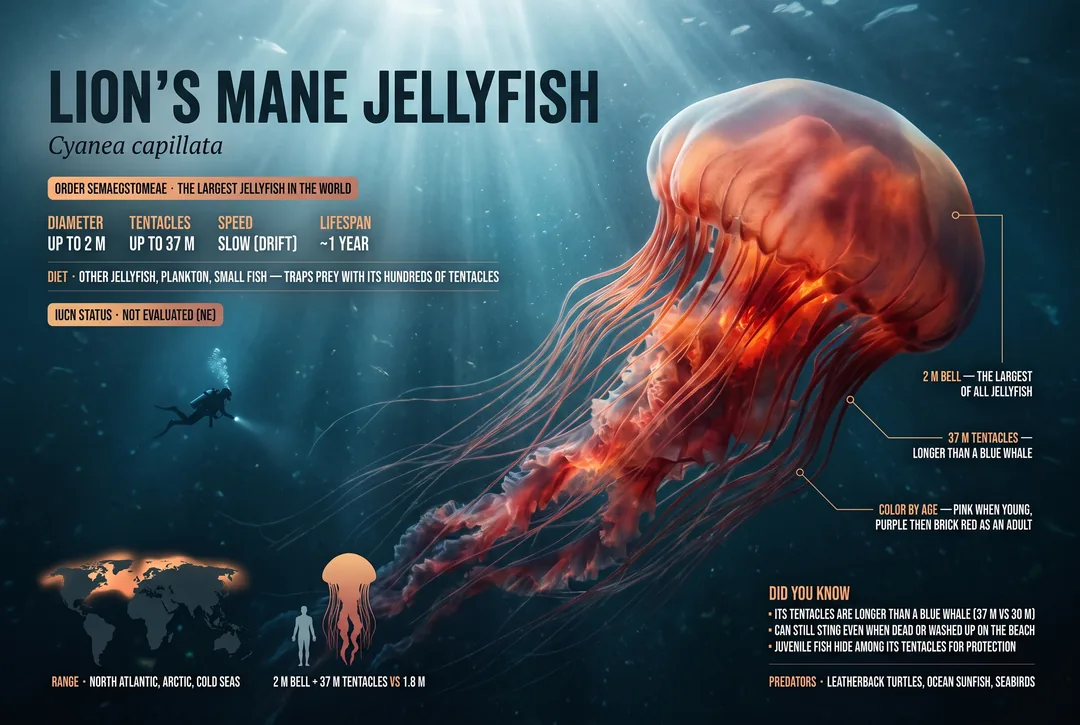
IDENTITY CARD
| Classification | Phylum Cnidaria, class Scyphozoa, family Cyaneidae |
| Scientific name | Cyanea capillata (Linnaeus, 1758) |
| Size | Bell: 50 cm to 2 m diameter (record: 2.3 m). Tentacles: up to 30 m |
| Weight | Up to 150 kg (large specimens) |
| Speed | Slow — ~8 km/h by pulsation, mostly a drifter (currents and tides) |
| Lifespan | ~1 year (full cycle polyp to medusa) |
| Depth | Surface to 20 m, mainly in the top 5 metres |
| Diet | Carnivore — zooplankton, small jellyfish, juvenile fish, ctenophores |
| IUCN Status | Not Evaluated (NE) |
PORTRAIT
The lion's mane jellyfish is the largest gelatinous animal on the planet. Its bell can reach 2.3 metres in diameter — the size of a round table for eight — and its tentacles stretch for 30 metres, longer than the largest animal ever measured, the blue whale. The common name comes from the mass of tentacles that hang beneath the bell like a floating mane, dense, tangled, ranging from red-orange to dark brown.
Cyanea capillata is a cold and temperate water species. It is found in the North Atlantic, the North Sea, the Baltic, the North Pacific, and around southern Australia. The colder the water, the larger the individuals — the 2-metre giants live in the icy waters of Norway, Scotland, and Canada, while specimens from warmer temperate waters rarely exceed 50 cm. This inverse relationship between temperature and size is a biological phenomenon known as Bergmann's rule.
For the diver, the lion's mane jellyfish is a spectacular encounter that demands respect. The sting is painful — rarely dangerous for a healthy adult, but unpleasant and potentially serious in cases of extensive contact (tentacles wrapped around an arm or leg). Cold-water divers (Norway, Scotland, British Columbia) encounter it regularly in summer and autumn, when the large jellyfish drift toward the coast.
HOW TO RECOGNIZE IT
The lion's mane jellyfish is recognised first by its size — no other jellyfish in the North Atlantic approaches 1-2 metres in diameter. The bell is a flattened dome with 8 scalloped lobes on the margin. Colour varies with age and size: juveniles are pink to pale yellow, medium adults are golden orange, and large specimens turn deep crimson then dark brown.
The tentacles are arranged in 8 groups, each containing 70 to 150 filaments — 800 to 1,200 tentacles in all. They are fine, sticky, and virtually invisible in turbid water. It is this extended network that makes the jellyfish dangerous for swimmers: you can pass through the tentacles without having seen the bell, 20 metres away.
Beneath the bell, four long, frilled oral arms hang from the centre — thicker than the tentacles, they transport captured food to the mouth. The bell surface is smooth and slightly translucent — filtered sunlight shining through it creates an effect like liquid amber.
Do not confuse with the compass jellyfish (Chrysaora hysoscella), which is smaller (30-40 cm) with characteristic brown radial markings on the bell. The lion's mane is uniformly coloured, without pattern.
For subtitles in English: start the video firstthen click the gearat the top right of the video, select “Subtitles/CC”, then “Auto-translate” and choose “English”.
WAY OF LIFE
The lion's mane jellyfish lives about a year — rarely more. Its life cycle alternates between two forms: the polyp (attached to the bottom, microscopic, in winter) and the medusa (pelagic, visible, in summer). In spring, the polyp divides by strobilation into tiny jellyfish of a few millimetres (ephyrae) that grow through the summer by feeding on zooplankton.
Hunting is passive and devastatingly effective. The jellyfish drifts with the currents, its tentacles deployed as a curtain tens of metres wide. Any organism that touches a tentacle triggers the cnidocytes — stinging cells that inject paralysing venom in milliseconds. The prey is then drawn toward the mouth by the oral arms. The diet includes zooplankton, ctenophores, small jellyfish (including younger conspecifics), fish larvae, and juvenile fish.
Reproduction is sexual. Males release sperm into the water, which is captured by the oral arms of females. Fertilised eggs develop into planulae — swimming larvae that settle on the bottom and become polyps. A single polyp can produce, through strobilation, dozens of jellyfish.
The lion's mane is a floating ecosystem. Beneath its bell, sheltered from the tentacles, live communities of juvenile fish (whiting, cod), shrimp, and amphipods that benefit from the jellyfish's protection without being stung — a commensalism that the observant diver can spot by looking under the bell.
WHERE TO SEE IT
Norway — northern fjords. The fjords of northern Norway (Tromso, Lofoten, Bodo) are the best place in the world to observe giant specimens. The cold waters (4-10 C) produce the largest jellyfish — individuals of 1 to 2 metres are regular in late summer. Drysuit diving in Norwegian fjords, with the lion's mane backlit by the midnight sun, is an unforgettable experience.
Scotland — west coast, Oban, Skye. Scottish waters harbour dense populations of Cyanea capillata between July and October. Dive sites around Oban, the Isle of Skye, and the Outer Hebrides offer frequent encounters. The jellyfish drift in the tidal currents of sea lochs and accumulate in sheltered bays.
British Columbia — Canada. The northeast Pacific waters around Vancouver Island and the Gulf Islands harbour populations of Pacific Cyanea capillata. Dives in tidal currents (Race Rocks, Browning Wall) offer spectacular sightings between August and November.
North Sea — Netherlands, Denmark. In late summer, lion's mane jellyfish regularly wash up on North Sea beaches. For divers, the coastal sites of the Netherlands (Zeeland) and Denmark offer sightings by snorkelling or shallow diving.
OBSERVATION CALENDAR
| Destination | J | F | M | A | M | J | J | A | S | O | N | D |
|---|---|---|---|---|---|---|---|---|---|---|---|---|
| Norway (fjords) | ||||||||||||
| Scotland (west coast) | ||||||||||||
| British Columbia | ||||||||||||
| North Sea |
Click each button to show/hide
The lion's mane is a seasonal jellyfish. The large medusae appear in early summer and reach maximum size in late summer (August--September), before dying with the first autumn cold. The overwintering polyps are invisible to the naked eye.
CONSERVATION
Cyanea capillata is not evaluated by the IUCN — like most jellyfish, it has neither a protection status nor a dedicated monitoring programme. The species is not threatened in the classical sense: jellyfish are survivors that have existed for more than 500 million years and have lived through every mass extinction.
The contemporary paradox is that jellyfish, as a group, are expanding. Overfishing reduces competition (fish eat the same zooplankton), warming extends the growing season, coastal eutrophication increases planktonic productivity, and the disappearance of predators (sea turtles, ocean sunfish) reduces mortality. Jellyfish blooms are a symptom of the degradation of marine ecosystems — not a sign of good health.
The impact of these blooms is considerable: jellyfish clog the water intakes of power plants and desalination plants, destroy fishing nets, decimate caged salmon farms, and drive swimmers from beaches. The lion's mane, with its 30-metre tentacles, is the most problematic species in the North Atlantic.
Organisations to support:
- Global Ocean Monitoring and Observing (GOOS) — ocean ecosystem surveillance
- JellyWatch — citizen science tracking of jellyfish blooms
- Marine Conservation Society (UK) — cold-water marine conservation
- Ocean Conservancy — ocean protection
3 THINGS YOU PROBABLY DON'T KNOW
1. Its tentacles are longer than a blue whale. The record measured for Cyanea capillata is a specimen washed ashore at Nahant Bay, Massachusetts, in 1870, with a bell 2.1 m in diameter and tentacles of 36.6 metres. That is longer than the largest animal ever measured (a blue whale of 33.6 m). This measurement is sometimes contested (tentacles, being elastic, can be stretched), but even conservative estimates place the largest individuals beyond 20 m — making it the longest animal on the planet after colonial siphonophores.
2. It shelters a fish nursery under its bell. Juveniles of several fish species (whiting, cod, dab) deliberately settle beneath the lion's mane's bell, swimming among its oral arms without being stung. The fish benefit from the protection of the curtain of stinging tentacles, and the jellyfish may gain some parasite cleaning in return. This commensalism, first observed by Scottish marine biologists, explains why large jellyfish are never "alone" — an observant diver will always spot small silvery fish tucked in the folds of the bell.
3. Sherlock Holmes solved a case thanks to it. In The Adventure of the Lion's Mane (1926), Arthur Conan Doyle made Cyanea capillata the "killer" of his plot — a swimming instructor is found dead on a Sussex beach, covered in whip-like marks, and Sherlock Holmes identifies the giant jellyfish as the cause of death. It is one of the rare cases narrated by Holmes himself (not Watson), and Conan Doyle's anatomical description of the jellyfish, written by a physician, is remarkably accurate.
PHOTO AND VIDEO TIPS
The lion's mane jellyfish is a spectacular dive subject — but one that demands precautions that tropical subjects do not.
Protection. In cold water, a drysuit protects the body. Hands and face remain exposed — thick gloves and hood are essential. Detached tentacles (invisible, drifting) sting just as effectively as attached ones. Never swim above a lion's mane — the tentacles are below you and invisible.
Lens. Wide angle — fisheye 10-17 mm or rectilinear 14-24 mm. The bell alone can measure 1-2 m and the tentacles extend for metres — a tight framing does not do the animal justice. The signature image is the view from below: the bell backlit by the sun, the tentacles hanging like a curtain toward the depths, and the small fish sheltering under the bell.
Lighting. Flash at moderate power. The bell is translucent — a harsh frontal light makes it opaque and flat. Dual strobes at 45 degrees reveal the texture and colours (orange, red, amber) without crushing the transparency. In pure natural light, the backlight through the bell creates a spectacular stained-glass effect — if visibility permits.
Approach. Approach slowly from the side, never from above (invisible tentacles). Stay at least 1-2 m from the tentacles — currents can shift them abruptly toward you. The bell pulsations are slow and photogenic — wait for the moment when the bell is fully deployed, translucent, with the oral arms visible.