Blue Whale
Balaenoptera musculus
The largest animal ever to have lived on Earth is not a fossil — it still swims in our oceans.
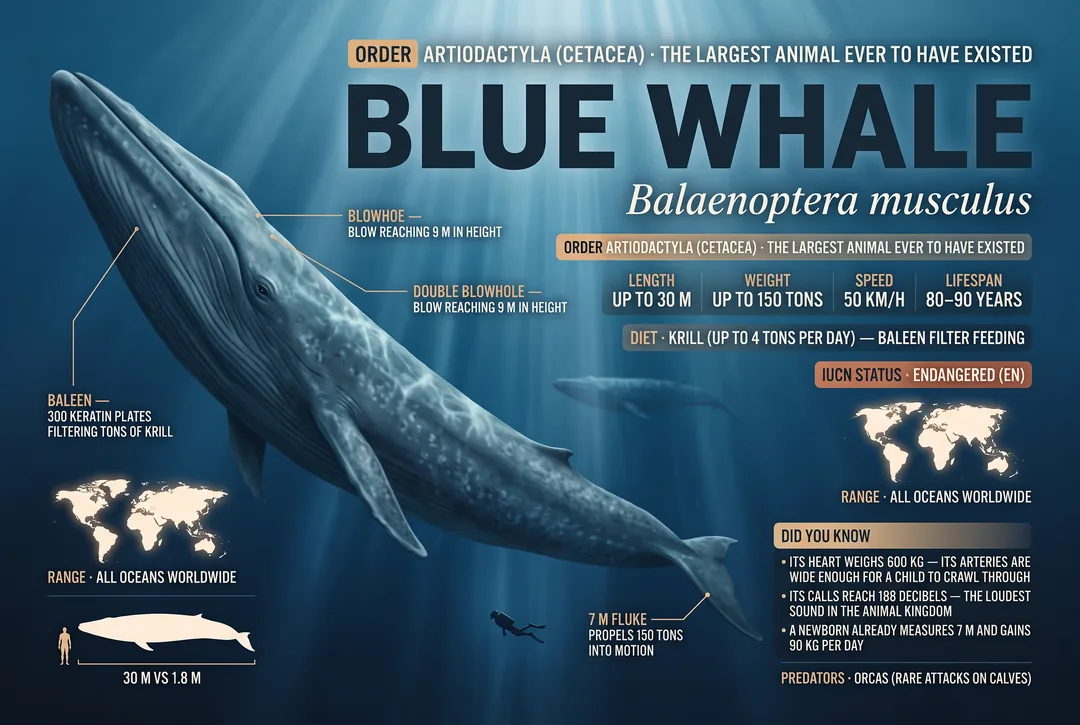
IDENTITY CARD
| Classification | Order Artiodactyla (infraorder Cetacea), suborder Mysticeti, family Balaenopteridae |
| Scientific name | Balaenoptera musculus (Linnaeus, 1758) |
| Size | Up to 30 m (adult average: 24-27 m) |
| Weight | Up to 190 tonnes |
| Speed | Up to 50 km/h in bursts (cruising: 5-20 km/h) |
| Lifespan | 80-90 years (some individuals estimated beyond 100 years) |
| Depth | Surface to approximately 500 m; most feeding dives between 100 and 200 m |
| Diet | Filter feeder — almost exclusively krill, up to 4 tonnes per day during feeding season |
| IUCN Status | Endangered (EN) — global population reduced to 10,000-25,000 individuals after 20th-century industrial whaling |
PORTRAIT
Nothing prepares you for the encounter. From a boat, out at sea, you first spot the blow — a vertical column of vapor rising nine meters into the air, visible from kilometers away before the back even breaks the surface. Then the back itself, interminable, rolls at the waterline for long seconds, blue-grey and mottled like a storm sky, before the dorsal fin — tiny, almost comical on an animal of this scale — closes the scene. You have not seen the whole animal. You never see the whole animal. That is the problem, and that is the beauty of it: Balaenoptera musculus is simply too large to fit within a single gaze.
No animal, at any point in the history of life on Earth, has ever achieved such mass — not even the largest dinosaurs. A heart weighing nearly 180 kg, the size of a small car, beats inside its chest at a rate that can drop to two pulses per minute during deep dives. Its tongue alone can weigh as much as an elephant. And yet this continent of an animal feeds on the smallest link in the marine food chain: krill, a few centimeters of crustacean, engulfed in mouthfuls of tens of tonnes of seawater at a time.
The blue whale does not hunt in the way one might use that word for a shark or a sperm whale. It charges through swarms of krill with its mouth wide open, the pleated throat distending like an accordion, then closes its jaw and forces the water out through its baleen plates, retaining only the prey. A single lunge lasts a handful of seconds and can yield the energy equivalent of half a day's fasting. It is one of the most powerful movements in the animal kingdom, and one of the most rarely witnessed — most encounters are limited to the blow, the back, and the fluke lifting before a deep dive.
HOW TO RECOGNIZE IT
At sea, the blue whale is recognized first by its blow: a single, slender, vertical column reaching 9 to 12 meters in height — the tallest blow of any cetacean. The body, fusiform and extremely elongated, displays a blue-grey mottled skin with lighter patches, a pattern unique to each individual that allows researchers to track populations through photo-identification, much like the whale shark.
The head is broad and flat, shaped like a wide-open U when viewed from above, bisected by a central ridge (the splashguard) that protects the two blowholes during surfacing. The throat bears 55 to 88 ventral pleats — folds that expand like a bellows during lunge feeding. The dorsal fin, minuscule and set far back on the body, appears only briefly after the blow, never at the same time. This is a useful marker for distinguishing it from the fin whale, whose dorsal fin is taller and appears almost simultaneously with the blow.
The tail, broad and powerful, lifts above the water only before deep dives — a moment every observer watches for, as it signals several minutes of absence from the surface. The pectoral fins are slender and relatively short, in stark contrast to the immense flippers of the humpback whale.
For subtitles in English: start the video firstthen click the gearat the top right of the video, select “Subtitles/CC”, then “Auto-translate” and choose “English”.
WAY OF LIFE
The blue whale is a long-range migrant, following a fairly strict seasonal rhythm: cold, productive waters in summer (Antarctica, Iceland, the Gulf of St. Lawrence, California), tropical and subtropical waters in winter for breeding (Gulf of California, Sri Lanka, certain Atlantic tropical populations). Some populations, such as the one off Sri Lanka, appear to have abandoned part of this migration and remain resident year-round, taking advantage of a narrow continental shelf where krill is available throughout the year.
The animal is generally solitary or seen in pairs, occasionally in loose aggregations on dense krill-feeding grounds — never the large social gatherings observed in other marine species. Communication relies on vocalizations among the most powerful in the animal kingdom, reaching 188 decibels — louder than a jet engine at takeoff — and audible, under favorable oceanic conditions, across several hundred kilometers. Most of these sounds are infrasound, below the threshold of human hearing.
Reproduction remains secretive and rarely observed directly. Gestation lasts approximately 10 to 12 months and produces a single calf, born already 7 meters long and weighing roughly 2.5 to 3 tonnes — the size of an adult in many other whale species. Fed on milk extraordinarily rich in fat (35 to 50 %), it gains up to 90 kg per day during its first six to eight months before weaning. A female gives birth every two to three years.
WHERE TO SEE IT
Blue whale observation is almost always done from a boat — encounters while diving, whether on scuba or snorkeling, remain exceptional, tightly regulated, and never guaranteed. This is a whale-watching experience before it is a dive, but it ranks among the most sought-after marine encounters in the world.
Sri Lanka — Mirissa. One of the rare places on Earth where the blue whale can be observed year-round, thanks to a narrow continental shelf off the island's southern coast. The best window remains December to April, when the sea is calmest. Trips depart from Mirissa and Dondra Head, often in the company of sperm whales and dolphins.
Azores. The archipelago is a migratory waypoint rather than a residential site: blue whales pass through from May to October, with a peak in May-June, en route to northern feeding grounds. Shore-based lookouts (vigias), inherited from the old whaling era, now guide observation boats with remarkable efficiency.
Iceland. Faxafloi Bay (off Reykjavik) and Husavik in the north offer sightings from June to August, at the height of the feeding season in waters rich with krill and capelin.
Mexico — Baja California and the Gulf of California. The Loreto area and the Ballenas Channel, between Baja California and Isla Angel de la Guarda, rank among the highest winter-density zones for blue whales in the world, from January to March — some of the same waters that also host whale sharks in season.
Antarctica. The Southern Ocean, particularly around the Antarctic Peninsula and the Weddell Sea, is a major summer feeding ground for the southern subspecies (Balaenoptera musculus intermedia), the largest of all. Window: December to March, aboard polar expedition cruises.
United States — Monterey Bay, California. The offshore waters of Monterey and the National Marine Sanctuary attract blue whales in summer and autumn (July to October), drawn by krill blooms along the continental slope — often alongside humpback whales and fin whales.
OBSERVATION CALENDAR
| Destination | J | F | M | A | M | J | J | A | S | O | N | D |
|---|---|---|---|---|---|---|---|---|---|---|---|---|
| Sri Lanka (Mirissa) | ||||||||||||
| Azores | ||||||||||||
| Iceland | ||||||||||||
| Mexico (Baja/Gulf of California) | ||||||||||||
| Antarctica | ||||||||||||
| California (Monterey Bay) |
Click each button to show/hide
CONSERVATION
Balaenoptera musculus is classified as Endangered (EN) on the IUCN Red List. The species paid the ultimate price of 20th-century industrial whaling: from an estimated global population of 350,000 individuals before 1900, it was driven down to a few hundred by the 1960s. The moratorium enacted by the International Whaling Commission in 1966 for this species, then extended to all great whales in 1986, allowed the beginnings of a recovery — the current population is estimated between 10,000 and 25,000 individuals depending on the subspecies, still far from pre-whaling levels.
Current threats are different but very real: collisions with large commercial vessels, which often share the same corridors as migratory routes; accidental captures in fishing nets and lines; oceanic noise pollution, which disrupts the species' long-distance communication; and ocean warming, which is altering the distribution of the krill on which it depends almost exclusively. The species is listed on Appendix I of CITES and under the Convention on Migratory Species (CMS).
Responsible travelers choose a whale-watching operator that respects regulatory distances (typically a 100-meter minimum), cuts its engine on approach, and never pursues an animal that is trying to move away.
Organizations to support:
- WWF — Blue Whale — global great-whale conservation program
- NOAA Fisheries — Ocean Giants — scientific monitoring and regulations in U.S. waters
- Oceanswell — Sri Lankan research dedicated to Indian Ocean blue whales, founded by biologist Asha de Vos
- Whale and Dolphin Conservation (WDC) — international advocacy against whaling and for habitat protection
3 THINGS YOU PROBABLY DON'T KNOW
1. Its heart weighs as much as a small car. An adult blue whale's heart weighs nearly 180 kg and is the size of a compact car. During deep dives, its heart rate can drop to just two beats per minute — one of the slowest rates ever recorded in a mammal.
2. Its tongue weighs as much as an elephant. The blue whale's tongue alone can weigh more than 2.5 tonnes — the equivalent of an adult Asian elephant. It serves to push seawater out of the mouth through the baleen plates after each lunge-feeding gulp.
3. It is the loudest animal on the planet. Some blue whale calls reach 188 decibels, louder than a jet aircraft heard at close range during takeoff. Most of these sounds are infrasound, inaudible to the human ear, yet capable of traveling hundreds of kilometers through the deep ocean.
PHOTO AND VIDEO TIPS
Photographing a blue whale is an exercise in patience and discretion more than pure technique — the essence of the encounter plays out at the surface, from a boat, in a few seconds before each deep dive.
Lens. A telephoto lens (100-400 mm on a camera body) is essential for capturing the blow and the back at a safe distance. For the fluke lifting before a dive — the most coveted shot — a 200-300 mm range offers a good balance between framing and responsiveness.
Anticipation. The blow precedes the back by a few seconds; the back precedes the fluke by several breaths. Observing the animal's rhythm (typically 3 to 5 closely spaced blows before a deep dive) lets you prepare for the tail shot, rather than missing it by reacting too late.
Light. Work with the sun behind you to reveal the mottled skin pattern. Low-angle light at the start or end of the day accentuates the relief of the swell and provides context for the animal's scale.
Snorkeling. In the rare cases where guided snorkeling is offered (some operators in Sri Lanka), a wide-angle lens (14-16 mm or fisheye) is necessary — visibility and mandated safety distances make any close-up framing illusory. Never swim toward the animal or cut across its path.
Common mistake. Trying at all costs to capture the entire animal. At this scale, it is almost always impossible and rarely the most compelling image: a vertical blow silhouetted against the horizon, or a fluke raised against the sky, often tells the story better than a wide, blurry framing.