Blue Dragon
Glaucus atlanticus
Three centimetres of stolen venom, adrift between sky and sea.
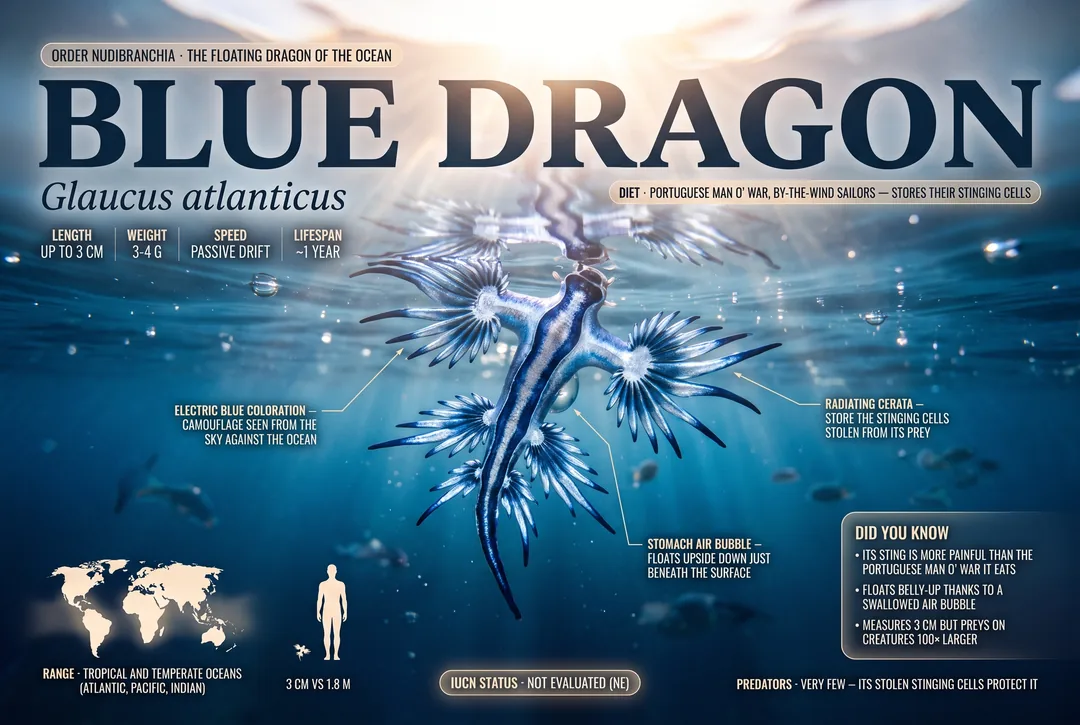
IDENTITY CARD
| Classification | Order Nudibranchia, family Glaucidae |
| Scientific name | Glaucus atlanticus (Forster, 1777) |
| Size | 2 to 3 cm (reported maximum: 5 cm) |
| Weight | A few grams |
| Habitat | Pelagic surface-dweller — floats upside down on the surface tension film |
| Diet | Specialist carnivore — Portuguese man o' war (Physalia physalis), by-the-wind sailors, blue buttons |
| Lifespan | Estimated at less than one year |
| IUCN Status | Not Evaluated (NE) |
PORTRAIT
You will not encounter it on a dive. You find it one morning on the sand, stranded between two tide lines, and you crouch down wondering whether it is a toy, a piece of plastic, or a living creature. It is a living creature — and one of the most extraordinary in the ocean.
Glaucus atlanticus, the blue dragon, is a nudibranch of three centimetres that spends its entire life at the ocean surface, floating upside down, buoyed by a bubble of air swallowed and stored in its stomach. Its silver belly faces the sky; its blue-streaked back faces the abyss: a textbook case of counter-shading, the same principle used by tuna, sharks, and penguins. Seen from above, it blends into the glitter of the surface. Seen from below, it vanishes into the blue.
The blue dragon does not choose its course. Like the Portuguese man o' war on which it feeds, it belongs to the neuston — the community of organisms that live on the very film of the water, at the mercy of currents and wind. It is a reluctant nomad, sometimes carried by storms in their thousands to beaches, where swimmers discover it with a mixture of wonder and imprudence.
HOW TO RECOGNIZE IT
The blue dragon is instantly recognisable. Its flattened body, shaped like an elongated diamond, carries three pairs of lateral appendages — the cerata — fanned out like clawed fingers. The overall effect evokes a science-fiction creature more than a mollusc.
The ventral surface (facing upward when the animal floats) is a brilliant silver-blue. The dorsal surface (facing the depths) is a darker grey-blue, sometimes streaked with fine lines. This chromatic inversion is the key to its camouflage: the pale belly merges with skylight from above, the dark back merges with the dark water column below.
The size is tiny. A 3 cm adult fits on a thumbnail. The largest reported specimens reach 5 cm, but that is exceptional. It should not be confused with Glaucus marginatus, its even smaller cousin (under 1 cm), which carries a single pair of cerata instead of three.
For subtitles in English: start the video firstthen click the gearat the top right of the video, select “Subtitles/CC”, then “Auto-translate” and choose “English”.
WAY OF LIFE
The blue dragon is a predator, and its prey is far larger and far more dangerous than itself. It feeds primarily on Portuguese men o' war — those infamous siphonophores whose tentacles carry thousands of cnidocytes capable of inflicting severe stings on humans. The blue dragon is unfazed. It climbs onto the man o' war, tears its tissue with its radula, and devours the stinging tentacles.
And here is where the animal becomes remarkable. The stinging cells of the man o' war — the nematocysts — are not digested. They are sorted, transported intact to the tips of the cerata, and stored in specialised sacs called cnidosacs. The blue dragon recycles its prey's weaponry. Worse still: it concentrates it. The man o' war's nematocysts are spread across several metres of tentacles; in the blue dragon, they are compressed into three centimetres of cerata. The blue dragon's sting is often more painful than the man o' war's own.
It also preys on by-the-wind sailors (Velella velella) and blue buttons (Porpita porpita), other surface-drifting organisms. The blue dragon is hermaphroditic: each individual carries both sexes and mating is reciprocal. Eggs, laid in strings, drift at the surface or are deposited on prey remains.
WHERE TO SEE IT
The blue dragon is not part of the underwater encounter repertoire. It lives on the surface, drifts with the currents, and when you see it, it is almost always stranded on a beach. It is not an animal you seek — it is an animal you find.
It is present in all tropical and subtropical waters worldwide: Atlantic, Pacific, Indian Ocean. Its exact distribution is poorly known, precisely because it is tiny, pelagic, and impossible to census at sea. What we know about are the strandings — and certain coastlines receive them regularly:
Eastern Australia. Beaches in Queensland and New South Wales (Gold Coast, Byron Bay, Sydney) receive regular strandings, sometimes massive, when easterly winds push the neuston shoreward. These are the most documented observations in the world.
South Africa. KwaZulu-Natal and the Eastern Cape coast report seasonal strandings, often associated with arrivals of Portuguese men o' war.
Canary Islands. Tenerife, Fuerteventura, and Lanzarote, exposed to the trade winds and the Canary Current, receive specimens in late summer and autumn.
Brazil. Beaches of the northeast (Bahia, Ceara) and the southeast (Rio de Janeiro, Santa Catarina) report strandings, often after storms.
Gulf of Mexico and Caribbean. Texas and Florida record sporadic strandings. Specimens have been found in the West Indies.
Mozambique and East African coast. Occasional observations are reported along the Mozambique Channel, consistent with the Agulhas Current.
OBSERVATION CALENDAR
The blue dragon is not encountered like a whale shark or a manta ray. Strandings depend on prevailing winds, seasonal currents, and the upstream presence of Portuguese men o' war — its food source and involuntary compass. The calendar below indicates the periods when sightings are most frequently reported:
| Region | J | F | M | A | M | J | J | A | S | O | N | D |
|---|---|---|---|---|---|---|---|---|---|---|---|---|
| Australia (Queensland / NSW) | ||||||||||||
| South Africa (KZN) | ||||||||||||
| Canary Islands | ||||||||||||
| Brazil (Northeast) | ||||||||||||
| Gulf of Mexico (Texas / Florida) |
Click each button to show/hide
This calendar is indicative. Neustonic strandings are erratic by nature and depend on weather conditions that cannot be predicted long-term.
CONSERVATION
Glaucus atlanticus has never been evaluated by the IUCN. Its status is "Not Evaluated" (NE) — which means neither that it is safe nor that it is threatened, but simply that the data needed to make that determination do not exist.
The species is not targeted by any fishery and has no commercial value. Its main threats are indirect:
- Plastic pollution. The blue dragon drifts at the surface, exactly where microplastics and floating debris accumulate. Ingestion of plastic and entanglement in debris are plausible risks, though unquantified.
- Climate change. Shifts in wind patterns and surface currents could alter the distribution of the neuston — men o' war, by-the-wind sailors, and their predators, including the blue dragon. Ocean acidification, which weakens mollusc shells, could also affect it.
- Collection by individuals. The animal's spectacular beauty makes it a target for shell collectors and aquarium enthusiasts. It does not survive in captivity — it needs the open-ocean neuston.
If you find one stranded: do not touch with bare hands. Even dead or desiccated, the blue dragon retains active nematocysts in its cerata. The sting is comparable to that of a Portuguese man o' war — a sharp burn, radiating pain, welt-like redness. It is generally not dangerous, but it is very unpleasant. If stung, rinse with seawater (never freshwater, which bursts remaining nematocysts), remove visible fragments, and consult a doctor if pain persists.
3 THINGS YOU PROBABLY DON'T KNOW
1. It floats thanks to a swallowed air bubble. The blue dragon does not swim — it floats. To stay at the surface, it swallows an air bubble that it stores in a pouch within its stomach. This bubble makes it lighter than water and forces it to float belly-up, back toward the depths. If it loses its bubble, it sinks. Its entire morphology — its inverted camouflage, its flattened silhouette — is a consequence of this upside-down existence.
2. Its venom is stolen — and improved. The blue dragon produces no venom of its own. Every nematocyst it carries has been harvested intact from a man o' war's tentacles, transported through its digestive tract, and stored in the cnidosacs of its cerata. But it does not simply recycle: by concentrating into three centimetres the nematocysts spread across several metres of tentacles, it densifies the arsenal. The dose per square centimetre is far higher in the blue dragon than in the man o' war — hence the more intense sting.
3. It is a cannibal. When men o' war are scarce, the blue dragon does not hesitate to devour its own kind. Two individuals placed in the same container in captivity regularly end up eating each other. It is a coherent strategy: each neighbour carries the same stored nematocysts, making every conspecific a concentrate of the weaponry it seeks.
PHOTO AND VIDEO TIPS
The blue dragon is not an underwater subject. You will photograph it on the beach, in the trough of a wave, or in a few millimetres of water — and that is the entire challenge.
Lens. Macro is mandatory. The animal is 3 cm long and all the detail is in the cerata — the branching appendages, the blue gradient, the translucent edges. A 60-100 mm macro lens on a DSLR or mirrorless body is ideal. On a smartphone, a clip-on macro lens gives decent results provided the phone is stabilised.
Support. Place the animal in a small volume of water — an overturned shell, a cap, a spoon filled with seawater — to photograph it against a clean background. The water reveals the cerata, which collapse in air. A dark background (black rock, slate) makes the silver-blue glow pop. Never place the animal on dry sand: it dehydrates within minutes.
Light. Natural, diffuse light with no direct flash. A slightly overcast sky is ideal: no harsh reflections on the water, no hard shadows on the cerata. In bright sunshine, shade the subject with your body.
Handling. Never touch with bare hands — use soft tweezers, a plastic spoon, or a wet leaf. The animal is fragile and its cerata carry active nematocysts. Return the animal to the water after photographing.