Golden Jellyfish
Mastigias papua etpisoni
Millions of stingless jellyfish, steered by the sun through a lake cut off from the ocean for 12,000 years.
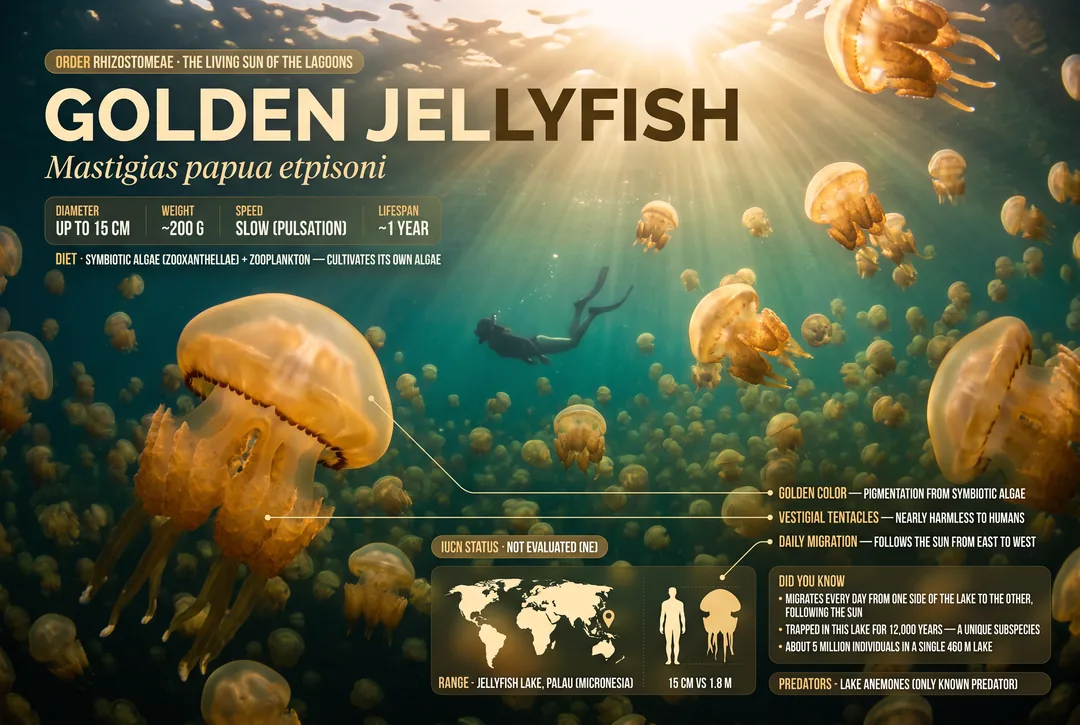
IDENTITY CARD
| Classification | Order Rhizostomeae, family Mastigiidae |
| Scientific name | Mastigias papua etpisoni (Dawson, 2005) — subspecies endemic to Jellyfish Lake, Palau |
| Size | 8 to 15 cm diameter (bell) |
| Weight | A few dozen grams |
| Lifespan | About 4 months (fast cycle, continuous reproduction) |
| Depth | Surface to 15 m — daily migration in top 5 metres |
| Diet | Mixotroph — photosynthesis via symbiotic zooxanthellae + zooplankton capture |
| IUCN Status | Not Evaluated (NE) — subspecies endemic to a single lake |
PORTRAIT
There is a lake inside a limestone island in Palau where you can swim among five million jellyfish — and not one of them can sting you. Ongeim'l Tketau, known to the world as Jellyfish Lake, is one of the most extraordinary natural sites on Earth. The creature that inhabits it resembles nothing found in the open ocean, and the experience of drifting through its pulsing, golden clouds belongs to no other dive site, anywhere.
Mastigias papua etpisoni is a subspecies of the spotted jellyfish (Mastigias papua). It diverged from its marine ancestor roughly 12,000 years ago, when rising seas at the close of the last glaciation flooded a karst depression and sealed it off from the Pacific. Without significant predators — sea anemones clinging to the lake walls are its only real threat — the golden jellyfish progressively lost its sting. Cnidocytes still exist in the tissue, but they are far too weak for a human to feel.
Its translucent, golden-brown bell pulses roughly once per second. Eight short, branched oral arms hang below. Zooxanthellae — symbiotic unicellular algae — live embedded in these arms and in the bell itself, providing most of the jellyfish's energy through photosynthesis. The animal barely hunts anymore. It farms.
HOW TO RECOGNIZE IT
The golden jellyfish is immediately distinguished from its marine cousin Mastigias papua by its smaller size (8-15 cm versus 15-25 cm), the near absence of spots on its bell, and its reduced oral arms. Colour ranges from translucent gold to deep orange-brown depending on the density of zooxanthellae in the tissue — individuals with more algae glow a richer amber.
In practice, identification is never in doubt. The golden jellyfish is the only species encountered by the millions in a saltwater lake. There is nothing else like it on the planet, and the setting alone — a landlocked marine lake rimmed by jungle — eliminates any confusion.
For subtitles in English: start the video firstthen click the gearat the top right of the video, select “Subtitles/CC”, then “Auto-translate” and choose “English”.
WAY OF LIFE
The golden jellyfish lives by the clock of the sun. Each morning, the entire population migrates horizontally eastward, following the light — a behaviour driven by positive phototaxis. The swarm halts at the shadow line cast by the mangroves on the eastern shore, then reverses course as the sun moves west. The purpose is precise: to maximise sunlight exposure for the zooxanthellae, which produce up to 90 % of the animal's energy through photosynthesis.
At night, the migration turns vertical. The jellyfish descend to a nutrient-rich layer around 10 metres, where their symbiotic algae absorb nitrogen and phosphorus — the fertiliser they need to keep photosynthesising during the day.
The lake is sharply stratified. The upper layer is oxygenated and safe; below roughly 15 metres, a permanent anoxic layer saturated with hydrogen sulfide makes the water toxic to any aerobic organism. This is why scuba diving is forbidden in Jellyfish Lake — a diver descending with bubbles could disturb the stratification. Only snorkelling is permitted.
Reproduction follows both sexual and asexual pathways. Adults release planula larvae, which settle as polyps on the lake floor. These polyps reproduce by strobilation, budding off tiny medusae — the jellyfish visible at the surface. The cycle is fast: an individual lives about four months, but the population regenerates continuously.
WHERE TO SEE IT
Palau — Jellyfish Lake (Ongeim'l Tketau). The definitive site. Nestled among the Rock Islands, a UNESCO World Heritage area, Jellyfish Lake holds between five and ten million golden jellyfish. Access requires a special permit from the Koror State Government. Snorkelling only — no scuba, no fins with hard tips. The lake was closed from 2016 to January 2019 after an El Nino event collapsed the population to a few hundred individuals. It has since reopened, and the jellyfish are back in force.
Indonesia — Raja Ampat (Misool lakes). Several marine lakes scattered across the Misool archipelago harbour non-stinging Mastigias jellyfish, genetically distinct from the Palau population. Access is more adventurous — remote anchorages, jungle trails over sharp limestone — but the reward is an encounter far from the crowds.
Indonesia — Kakaban Island (Derawan, East Kalimantan). The largest marine lake in Indonesia. Four species of non-stinging jellyfish coexist here, including Mastigias and box jellyfish that have similarly lost their sting. The island is uninhabited; the lake is reached by a short trail from the jetty.
OBSERVATION CALENDAR
| Destination | J | F | M | A | M | J | J | A | S | O | N | D |
|---|---|---|---|---|---|---|---|---|---|---|---|---|
| Palau (Jellyfish Lake) | ||||||||||||
| Raja Ampat (Misool) | ||||||||||||
| Kakaban (Derawan) |
Click each button to show/hide
CONSERVATION
The golden jellyfish is not evaluated by the IUCN — a subspecies endemic to a single 460-metre-long lake falls outside most monitoring frameworks. That obscurity makes its vulnerability all the more acute: the entire world population of M. p. etpisoni lives in one body of water.
The 2016 El Nino demonstrated what that means. Elevated sea temperatures warmed the lake, the zooxanthellae were expelled, and the jellyfish population crashed from millions to mere hundreds. It was a coral bleaching event in miniature — the same mechanism, the same symbiosis broken by heat. But the polyps survived. Fixed to the lake floor, invisible, they endured, and within two years the medusa population had rebounded to pre-collapse levels. Cnidarian resilience at its most striking.
The primary threats are climate change — which will make El Nino events more frequent and more severe — and tourism pressure. Chemical sunscreen leaching into the water, careless fin kicks disturbing the polyps, and sheer volume of visitors all stress a closed ecosystem with no outlet and no flushing. Since reopening in 2019, Palau has imposed stricter rules: reef-safe sunscreen only, limited daily permits, and mandatory briefings.
Organisations to support:
- Coral Reef Research Foundation — long-term monitoring of Jellyfish Lake
- Palau International Coral Reef Center — research and conservation in Palau
- The Nature Conservancy — Palau — marine protected area management
- Conservation International — Raja Ampat — protecting Indonesia's marine lakes
3 THINGS YOU PROBABLY DON'T KNOW
1. It is not really an animal — it is a greenhouse. The golden jellyfish derives roughly 90 % of its energy from photosynthesis carried out by its symbiotic zooxanthellae. Its entire daily migration — east in the morning, west in the afternoon, down at night — is a solar-positioning strategy. The jellyfish is less a predator than a mobile greenhouse, orienting its living panels toward the light.
2. There are roughly 60 jellyfish lakes in the Pacific — and each is its own experiment. Marine lakes dot the limestone islands of Palau, Raja Ampat, Kakaban, and the Caroline Islands. Each was sealed from the ocean at a different time, and each population evolved independently — losing its sting, shifting its diet, changing its size. It is adaptive radiation on a miniature scale, like Darwin's finches but in saltwater basins.
3. The population can collapse and rebound in two years. When the medusae died during the 2016 El Nino, the species did not vanish — the polyps, the invisible and sessile stage of the life cycle, survived on the lake floor. Once conditions improved, they regenerated the entire visible population through strobilation. The jellyfish you see pulsing at the surface is only half the organism. The other half is anchored in the dark, waiting.
PHOTO AND VIDEO TIPS
The golden jellyfish presents a paradox: individually small and translucent, collectively spectacular. The challenge is capturing both scales.
Wide angle for the swarm. A rectilinear wide-angle lens (10-17 mm on a crop sensor, 16-35 mm on full frame) is essential for conveying the density of the encounter. Position yourself within the cloud and shoot upward — the jellyfish silhouetted against the surface light, with sun rays filtering through the canopy above the lake, produce the most striking images.
Macro for the individual. A second dive (or a second camera) with a macro lens reveals the extraordinary detail of the bell — the branching oral arms, the embedded zooxanthellae, the rhythmic contraction. A 60 mm macro at close focus fills the frame with a single animal against a blurred golden backdrop of its neighbours.
Light. Mid-morning, when the jellyfish migrate east and are backlit by the rising sun, offers the best natural lighting. No flash is needed for wide-angle shots — the ambient light inside the lake is generous and warm. For macro work, a gentle video light brings out the translucency of the bell without startling the animals.
Behaviour. Minimal horizontal finning — let the jellyfish come to you. Never grab or reposition a jellyfish. Use only mineral, reef-safe sunscreen (chemical sunscreens leach into the closed lake system). Move slowly, breathe calmly, and let the swarm envelop you.