Green Sea Turtle
Chelonia mydas
It carries the name of a color you will never see on its shell.
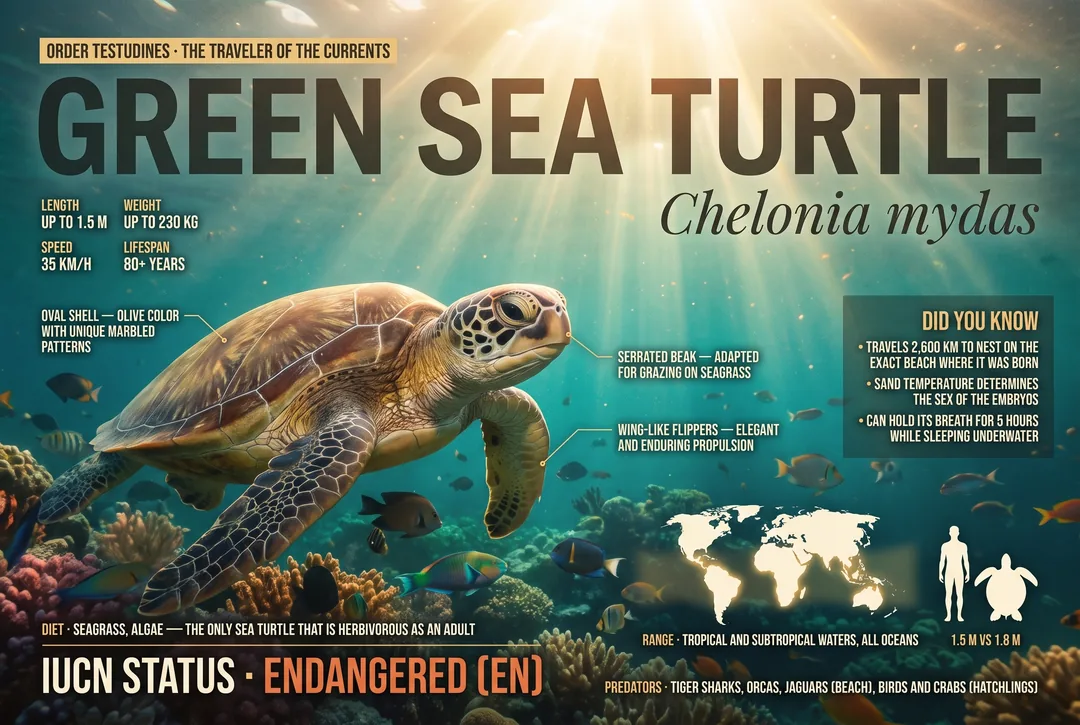
IDENTITY CARD
| Classification | Order Testudines, family Cheloniidae |
| Scientific name | Chelonia mydas (Linnaeus, 1758) |
| Size | Up to 1.5 m in carapace length |
| Weight | Up to 230 kg |
| Speed | ~35 km/h in bursts (rarely sustained) |
| Lifespan | 60 to 80 years |
| Depth | Surface to 40 m as a rule, occasional dives beyond 100 m |
| Diet | Adults almost exclusively herbivorous — algae and seagrass; juveniles omnivorous |
| IUCN Status | Endangered (EN) |
PORTRAIT
She glides through the blue with a nonchalance that fools no one: beneath that apparent slowness lies one of the ocean's most enduring travelers, capable of crossing entire basins to return and nest on the exact beach where she was born. The green sea turtle is often a beginning diver's first encounter with something truly large — and often the one that stays etched in memory the longest.
Her name has nothing to do with her shell, which ranges from brown to olive to mottled depending on the population. It comes from the color of her subcutaneous fat, tinted green by a lifelong diet of algae and seagrass. She is the only sea turtle species that is strictly herbivorous as an adult — a diet that makes her, in her own quiet way, the lawnmower of tropical seagrass beds, an ecological role as discreet as it is essential to the health of the seafloor.
You find her resting on a patch of dead coral, head turned into the current, or rising to the surface for a breath before descending again in an unhurried glide. She superbly ignores divers who keep their distance, and flees without a backward glance those who approach too fast. Chelonia mydas has nothing to prove: she has been swimming on this planet for over 100 million years, long before anyone thought to photograph her.
HOW TO RECOGNIZE IT
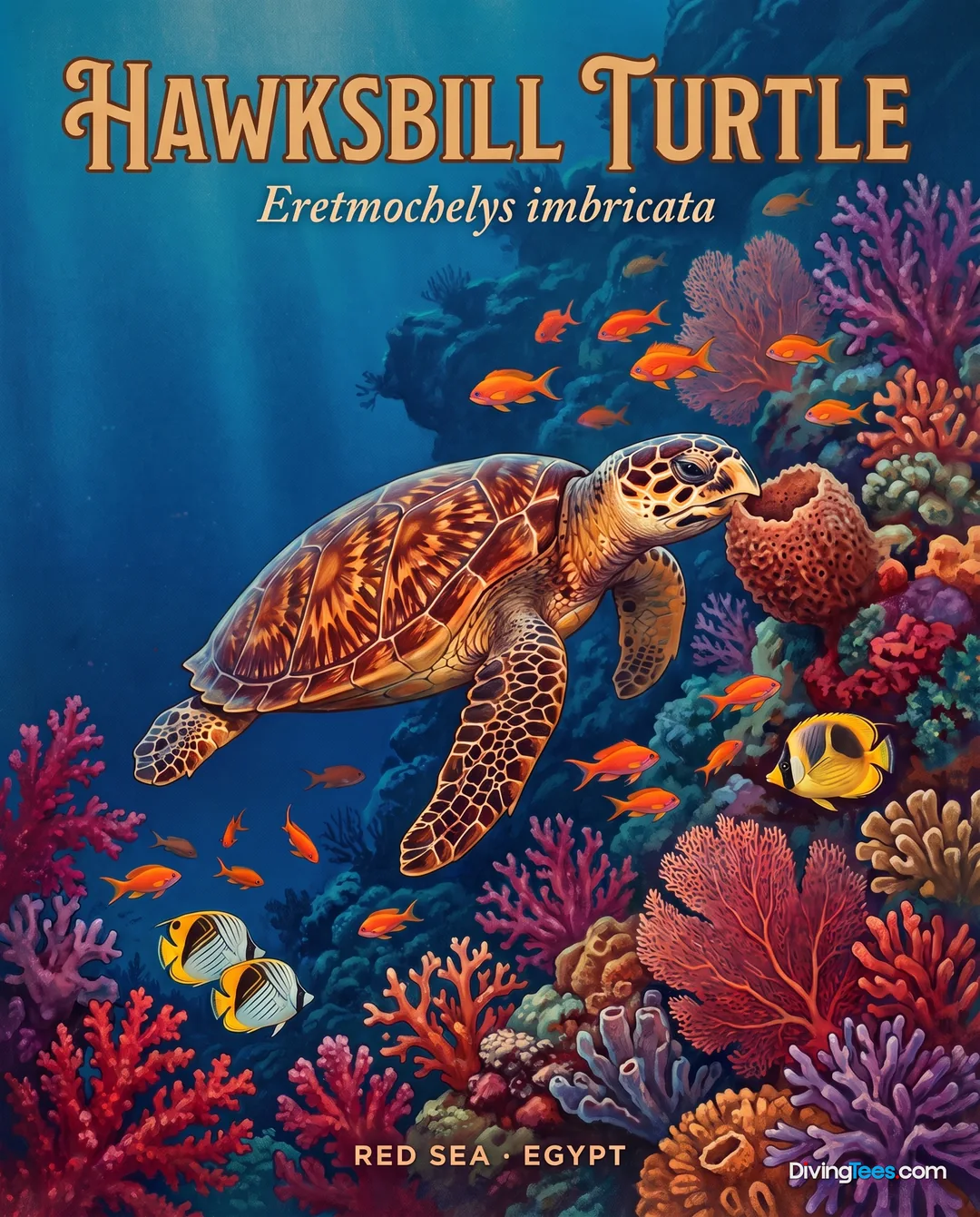
The green sea turtle is distinguished first by her head, relatively small and rounded, with a single pair of prefrontal scales between the eyes — the most reliable marker to avoid confusing her with the hawksbill, which has two pairs and a more hooked beak. Her carapace is smooth, shaped as a broad flattened dome, composed of five non-overlapping central scutes — another clear difference from the hawksbill, whose scutes overlap like roof tiles.
Coloration varies enormously between populations: brown, olive, nearly black in the eastern Pacific, sometimes marbled with radiating patterns. The front flippers are long and paddle-shaped, each bearing a single visible claw. Underwater, it is often the size and the regular dome of the carapace that allow identification before you even see the head — a giant, living boulder resting on the reef.
For subtitles in English: start the video firstthen click the gearat the top right of the video, select “Subtitles/CC”, then “Auto-translate” and choose “English”.
WAY OF LIFE
The green sea turtle leads a double life: oceanic during her early years, then faithful to a coastal feeding territory once adult, where she spends hours grazing on seagrass beds and resting at cleaning stations frequented by cleaner fish. She can remain motionless beneath a rocky overhang for long stretches between trips to the surface to breathe.
The most spectacular aspect of her life cycle remains her natal philopatry: the adult female returns to nest on the very beach where she hatched, decades earlier, after traveling sometimes thousands of kilometers to find it. The navigational mechanism relies largely on a sensitivity to the Earth's magnetic field, imprinted at the moment of hatching.
Nesting takes place at night. The female hauls herself ashore, digs a nest in the sand with her rear flippers, and deposits an average of about one hundred eggs, repeating the process over several clutches in the same season. The sex of the hatchlings depends on sand temperature during incubation — the warmer the sand, the higher the proportion of females, a mechanism that now alarms biologists in the face of climate change. The hatchlings that survive the crossing of the beach spend their early years in offshore Sargassum rafts, a phase nicknamed the "lost years" because it remains so poorly documented.
WHERE TO SEE IT
The green sea turtle is cosmopolitan across tropical and subtropical waters. Here are the destinations where encounters are most reliable:
Maldives. Present across virtually every atoll, the green sea turtle is one of the most consistent encounters of the year here. Shallow seagrass beds near resorts and the fringing reefs of Baa Atoll and Ari Atoll rank among the best observation posts, often during the shallow safety stop at the end of a dive.
Red Sea — Egypt. Marsa Alam is one of the world's premier green turtle destinations. The site of Abu Dabbab, with its vast shallow seagrass bed, hosts a resident population observable nearly year-round, both on scuba and while snorkeling from the beach. Elephmarsa and Marsa Shouna offer similar encounters further south.
Great Barrier Reef — Australia. The entire reef system, from Cairns to Lady Elliot Island, supports abundant populations. Lady Elliot Island in particular is renowned for its density of green sea turtles, visible on snorkel or scuba year-round.
Galapagos. The waters around the islands host a sub-population of green sea turtles recognized for their dark coloration, sometimes referred to as the "black" form. They are encountered in numbers around Santa Cruz and Isabela, often feeding on algae-covered bottoms.
Malaysia — Sipadan (Borneo). Sipadan is world-famous for the density of its green and hawksbill turtles, to the point of inspiring its nickname "Turtle Tomb" for an underwater cave sheltering ancient skeletons. Barracuda Point and South Point offer near-guaranteed encounters.
Hawaii. The green sea turtle, locally known as honu, is as much a cultural symbol as a common diving encounter. The reefs of the Big Island and Oahu, particularly around resting sites like Turtle Pinnacle, provide reliable year-round observations.
Oman. The sultanate's coastline, particularly around Ras Al Jinz and Masirah Island, ranks among the most important green turtle nesting sites in the western Indian Ocean, with in-water sightings year-round.
Costa Rica — Tortuguero. On the Caribbean coast, Tortuguero beach is one of the most closely monitored nesting sites in the world for the green sea turtle, with active tracking programs from July to October. Diving encounters occur more frequently on the country's Pacific coast.
OBSERVATION CALENDAR
| Destination | J | F | M | A | M | J | J | A | S | O | N | D |
|---|---|---|---|---|---|---|---|---|---|---|---|---|
| Maldives | ||||||||||||
| Red Sea (Marsa Alam) | ||||||||||||
| Great Barrier Reef (Australia) | ||||||||||||
| Galapagos | ||||||||||||
| Malaysia (Sipadan) | ||||||||||||
| Hawaii | ||||||||||||
| Oman (nesting) | ||||||||||||
| Costa Rica (Tortuguero, nesting) |
Click each button to show/hide
CONSERVATION
Chelonia mydas is classified as Endangered (EN) on the IUCN Red List, with certain regional sub-populations listed as critically endangered. The species is included in Appendix I of CITES, which prohibits all international trade, and is protected under the Convention on Migratory Species (CMS).
Threats remain numerous: historical and still-ongoing harvesting of meat and eggs in some regions, accidental capture in fishing nets, degradation and artificial lighting of nesting beaches, plastic ingested when mistaken for jellyfish, and above all climate change — which, by altering nest incubation temperatures, is already skewing the sex ratio of hatchlings heavily toward females at several major sites.
The responsible diver keeps a respectful distance, never touches a resting turtle or chases one through the water, and avoids direct, prolonged lighting of the face. On nesting beaches, no white light or flash should ever be used near a laying female or emerging hatchlings.
Organizations to support:
- Sea Turtle Conservancy — long-running population monitoring at Tortuguero, Costa Rica
- Olive Ridley Project — sea turtle research and rescue in the Indian Ocean, particularly the Maldives
- WWF — Marine Turtle Program — nesting site protection and anti-poaching efforts
- PADI AWARE — citizen science program, sighting reporting
3 THINGS YOU PROBABLY DON'T KNOW
1. Her name comes from her fat, not her shell. The green sea turtle owes her name to the greenish tint of her subcutaneous fat, once prized for making the famous "turtle soup." Her shell, however, is brown, olive, or nearly black depending on the population — never green.
2. She changes her diet as she grows. Juveniles are omnivorous, feeding on small invertebrates and jellyfish in open water. As they mature, they switch to an almost exclusively herbivorous diet once settled near the coast — a dietary transition rare among marine reptiles, making her the only truly vegetarian adult sea turtle.
3. She can hold her breath for several hours. At rest, tucked beneath an overhang or wedged into a reef crevice, a green sea turtle can slow her metabolism to the point of remaining submerged for several hours without surfacing to breathe — a physiological feat far removed from the few minutes you might assume when watching her swim actively near the surface.
PHOTO AND VIDEO TIPS
The green sea turtle is a generous subject: whether resting on the bottom or gliding through open water, she gives you ample time to compose a frame, provided you never rush her.
Lens. Wide angle is recommended for full-scene shots in open water: a 10-17 mm fisheye or 14 mm rectilinear in a housing. A compact camera or GoPro with its native field of view works perfectly well for resting scenes, where the working distance is shorter.
Light. At the typical encounter depths (0-20 m), natural light is sufficient for wide shots. A flash or moderate video lights, however, will reveal the texture of the head scales and the true coloration of the carapace, often richer than what the eye perceives at depth.
Approach. Approach from the side and slightly below, never head-on or from above. A resting turtle that lifts her head or begins to swim is signaling she is disturbed — that is the cue to back off, not to push closer. The best images come from patience: stay motionless a few meters away and let the animal resume her activity.
Classic mistake. Pursuing a turtle that is moving away. A disturbed green sea turtle can accelerate to speeds no diver can match, and persistence only ruins the encounter for everyone. Better to let the scene come to you: position yourself along her likely path and wait, rather than chase.