Immortal Jellyfish
Turritopsis dohrnii
It fits inside a thimble — and it has solved death.
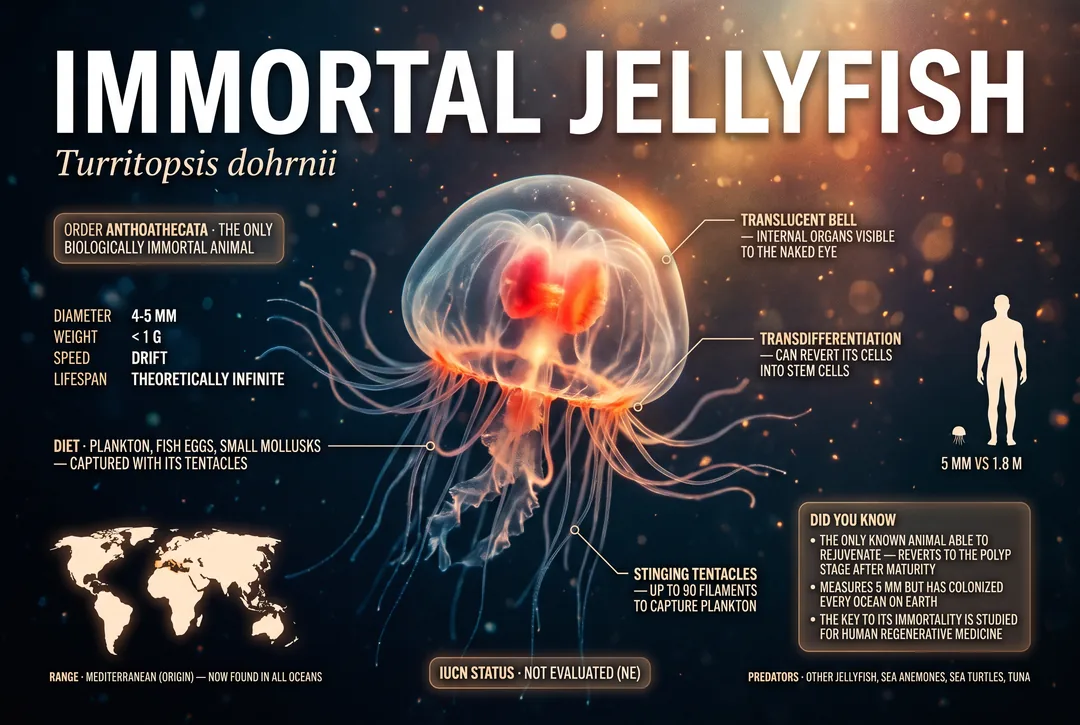
IDENTITY CARD
| Classification | Class Hydrozoa, family Oceaniidae |
| Scientific name | Turritopsis dohrnii (Weismann, 1883) |
| Size | 4.5 mm bell diameter — up to 10 mm in the Mediterranean |
| Weight | A fraction of a gram — essentially water |
| Speed | A few centimetres per second — propelled by bell pulsation |
| Lifespan | Biologically immortal — can reset its life cycle indefinitely |
| Depth | Surface to 200 m, most commonly in shallow coastal waters |
| Diet | Carnivore — plankton, fish eggs, small molluscs, larvae, other jellyfish |
| IUCN Status | Not Evaluated (NE) — too small and too poorly known for population monitoring |
PORTRAIT
Some animals fascinate by their size, their power, or their beauty. Turritopsis dohrnii fascinates by performing a trick that no other living creature has mastered: it ages in reverse. When disease, injury, or stress strikes, this 4.5 mm jellyfish — transparent, nearly invisible — does what no organism should be able to do: it regresses to the polyp stage, its juvenile form, and begins life again from the start.
The mechanism is called transdifferentiation. Specialised cells reprogram themselves into unspecialised stem cells, then re-differentiate to form a new polyp. It is as though a butterfly reverted to a caterpillar, then became a butterfly once more. Biological death by ageing does not exist for this species.
Do not expect to see one on a dive. At 4.5 mm, it is smaller than a fingernail. Transparent, pelagic, solitary, it escapes every gaze without a microscope. One of the most spectacular biological phenomena on Earth plays out inside an organism that could be mistaken for a bubble of water.
HOW TO RECOGNIZE IT
The bell measures 4.5 mm in the Caribbean and up to 10 mm in the Mediterranean, shaped like a thimble — taller than it is wide. The walls are transparent to translucent, sometimes faintly yellowish.
The most reliable identifying feature is the bright red to red-orange stomach, visible through the transparent bell at its centre.
Tentacle count changes with maturity: 8 in a young adult, increasing to 80-90 in a fully mature individual. In its polyp stage, the animal is a minuscule tube fixed to a substrate, invisible without a magnifying lens.
For subtitles in English: start the video firstthen click the gearat the top right of the video, select “Subtitles/CC”, then “Auto-translate” and choose “English”.
WAY OF LIFE
Turritopsis dohrnii follows the standard hydrozoan life cycle — with one extraordinary addition.
The normal sequence runs: sessile polyp, budding, free-swimming ephyra, adult medusa (sexual reproduction). But when stressed, the adult medusa reverses: it reabsorbs its tentacles, its bell collapses, it settles on the substrate, and transdifferentiation converts it back into a polyp. This is not classical regeneration — it is a complete reversion to an earlier developmental stage.
As a medusa, it is a modest pelagic predator, drifting with currents and capturing plankton with its cnidocytes.
Immortal, but not invulnerable: predation, disease, and environmental accidents kill the vast majority of individuals before they ever trigger the reversal. Immortality is a biological potential, not a guarantee.
WHERE TO SEE IT
This is not an animal one "observes while diving." At 4.5 mm and transparent, it is effectively invisible in open water.
Mediterranean — the species' native range. First described near Naples in 1883, and the reversal phenomenon was identified in 1988 off the Italian coast. Found throughout the western Mediterranean: Sicily, Croatia, Spain, and southern France.
Japan — Shirahama. Shin Kubota, a researcher at Kyoto University's Seto Marine Biological Laboratory, has maintained laboratory colonies for years, becoming the world's foremost authority on the species.
Caribbean — Panama, Florida, Belize. The species arrived via ballast water in cargo ships and has since become pan-oceanic in distribution.
OBSERVATION CALENDAR
| Destination | J | F | M | A | M | J | J | A | S | O | N | D |
|---|---|---|---|---|---|---|---|---|---|---|---|---|
| Mediterranean | ||||||||||||
| Japan | ||||||||||||
| Caribbean |
Click each button to show/hide
Note: this calendar is theoretical. Observation during a dive is extremely improbable.
CONSERVATION
Turritopsis dohrnii has not been evaluated by the IUCN and appears on no protection lists. Paradoxically, its range is expanding: transport in ships' ballast water has carried it across every ocean basin. The species is now considered pan-oceanic.
No ecological threat from the species has been documented. It is too small and too sparse to form blooms.
The systemic threats it faces are the same ones affecting all marine invertebrates: ocean acidification, warming waters, and chemical pollution in coastal habitats.
3 THINGS YOU PROBABLY DON'T KNOW
1. It is not the only "immortal" — but it is the only one that actively reverses its life cycle. The freshwater hydra exhibits negligible senescence — it does not appear to age. But Turritopsis dohrnii goes further: it does not merely avoid ageing, it actively rejuvenates. The distinction is between "not growing old" and "growing young again."
2. Its genome interests cancer researchers. Transdifferentiation — the reprogramming of specialised cells — is directly relevant to oncology and regenerative medicine. In 2022, the University of Oviedo sequenced the complete genome of T. dohrnii and identified genetic variants linked to DNA replication, cellular repair, and telomere maintenance.
3. One man has kept it alive in a laboratory for years. Shin Kubota, at the Seto Marine Biological Laboratory in Shirahama, Japan, has devoted his career to maintaining and studying Turritopsis dohrnii colonies. He feeds the tiny medusae individually, one by one, with a pipette loaded with brine shrimp eggs.
PHOTO AND VIDEO TIPS
Lens. Dedicated macro — 60 mm or 105 mm — with extension tubes. A super-macro rig is needed for subjects smaller than 5 mm.
Light. Lateral lighting with a snoot or fibre-optic guide angled at 45 degrees. The goal is an absolute black background that makes the translucent bell and red stomach glow.
Approach. Blackwater diving offers the best chance — a night dive in open water, with a light suspended beneath the boat to attract plankton and the animals that feed on it.
In a research aquarium. A sheet of black card behind the tank eliminates reflections and produces the clean, dark backdrop this subject demands.