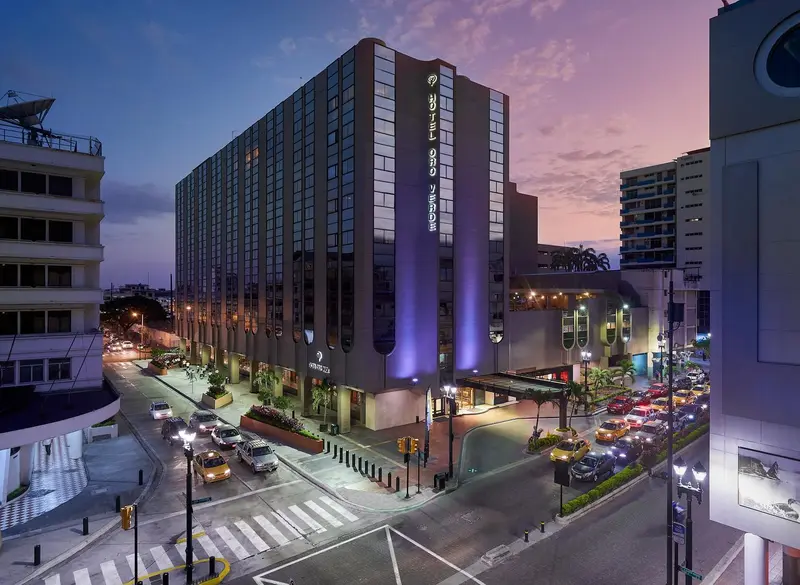
Oro Verde Guayaquil
★★★★★
Google 4.7/5 (8,423 reviews)
Ecuador · Americas
Rocky reefs, small wrecks, turtles and seasonal giant manta rays await along Ecuador’s coast, reached from Guayaquil by road rather than from the city waterfront.
For subtitles in English: start the video firstthen click the gearat the top right of the video, select “Subtitles/CC”, then “Auto-translate” and choose “English”.
Ayangue’s rocky reefs, El Pelado and Puerto López are the real starting points for diving here, not Guayaquil’s urban waterfront. The city works as an arrival and transfer base, linking several coastal areas with different characters. Ayangue offers shorter outings and approachable sites, while Puerto López opens the way to Isla de la Plata and Parque Nacional Machalilla. Between dives, Guayaquil supplies urban and cultural interest, but a proper diving stay belongs on the coast.
Expect boat diving over rocky bottoms, with small wrecks and submerged structures adding interest to the natural relief. Around Ayangue, some sites are shallow and a few points can be reached from shore, while short boat runs lead to El Pelado and nearby reefs. Salango and Isla de la Plata make longer outings from the coastal villages. Currents are variable, so the same trip can feel straightforward on one day and more demanding on another, without turning the area into a specialist current destination. In the dry season, visibility can exceed 15 to 20 metres, although coastal conditions and run-off can alter what you see. Isla de la Plata is a boat excursion rather than a quick local dive, and should be treated as a full outing with its own sea-time and weather margin.
Turtles, rays, octopuses, lobsters, reef sharks and tropical fish are part of the underwater picture around the Ecuadorian coast. Rocky habitats and submerged structures give the smaller life somewhere to settle, while the open-water character of Isla de la Plata brings the possibility of larger encounters. Giant manta rays and humpback whales are associated particularly with Puerto López and Isla de la Plata from June to September. They are seasonal possibilities, not animals to book on the assumption of a guaranteed sighting. A local reef dive around Ayangue or Salango is therefore a different proposition from an island trip: the former centres on rock, fish and invertebrates, the latter adds the chance of passing pelagic wildlife.
June to September is the period to favour if giant manta rays or humpback whales are central to the plan, especially around Puerto López and Isla de la Plata. It also falls within the dry season, when visibility can rise beyond 15 to 20 metres, though coastal run-off still matters. There is no single month that rules out every sector, so the choice depends on the balance you want between local reefs and seasonal wildlife. Build the itinerary around one coastal base rather than trying to cross back to Guayaquil after every dive. Keep a spare day for Isla de la Plata, because the longer boat journey is more exposed to changing conditions than a local outing.
This coast suits beginners as well as experienced recreational divers, with Ayangue specifically described as approachable for both. Standard recreational training from PADI, SSI or BSAC is the relevant starting point, rather than a specialist qualification. Variable currents mean that new divers should be comfortable with a controlled descent, ascent and safety stop before choosing a more exposed boat outing. Experienced divers will find more to manage in the planning and conditions than in a requirement for technical depth or advanced certification.
From London Heathrow, London Gatwick or Manchester, Guayaquil is the air arrival point for this mainland diving itinerary. The structural constraint comes afterwards: the documented sites are reached by road, with roughly two to two and a half hours to Ayangue and about three hours to Puerto López, depending on traffic and the precise coastal destination. No domestic flight or ferry is needed for these areas. Once on the coast, diving normally starts from the village itself, so allow for a short walk, local taxi or pre-arranged transfer to the harbour or meeting point. For Isla de la Plata, stay in Puerto López rather than building the island trip around a daily road journey from Guayaquil.
The first thing to check is what “Guayaquil diving” actually means on the booking: the launch may be in Ayangue, Salinas or Puerto López, not in the city. Ask whether the day is aimed at local reefs, El Pelado, Salango or Isla de la Plata, because the navigation time and shape of the outing are different. Use Ayangue when you want shorter boat runs, shallow sites or a gentler first day. Use Puerto López for the island and Machalilla, and leave a buffer day for Isla de la Plata. Do not plan that island trip as a quick extension from Ayangue or Salinas, and do not confuse it with the Galápagos. Wildlife claims need sensible expectations too: turtles, rays, mantas and whales are possibilities, not guarantees. Most importantly, avoid alternating Guayaquil and the coast every day. The road transfers will take time from the diving and make the itinerary unnecessarily tiring.
A five- to seven-day stay works well when split between a coastal base around Ayangue or Salinas and Puerto López. Ayangue keeps local reefs and El Pelado close, while Puerto López combines local diving with Isla de la Plata, Machalilla and seasonal pelagic excursions. Guayaquil is best used before or after the coastal section, with time for the historic centre, Malecón and urban sights. On non-diving days, choose beaches, wildlife trips, Salango or protected landscapes rather than returning repeatedly to the city.
Hello, I'm Marina, DivingDeal.com's AI assistant. I guide you through destinations, areas and countries.
Thinking about the whole trip and the flights? Talk it over with Edith →
Marina is an AI. Some links are affiliate links: DivingDeal may earn a commission, at no extra cost to you. Bookings are made with the partner.
Choose June to September if giant manta rays or humpback whales are central to your plans, particularly around Puerto López and Isla de la Plata. This period also falls within the dry season, when visibility can exceed 15 to 20 metres. Coastal run-off and conditions can still affect visibility and outings.
Guayaquil’s coastal diving suits beginners and experienced recreational divers. Ayangue offers approachable sites, including shallow areas and some shore-access points. Standard recreational training from PADI, SSI or BSAC is appropriate. Because currents vary, you should be comfortable with controlled descents, ascents and safety stops before choosing more exposed boat outings.
Around Guayaquil’s coastal diving areas, you may see rocky reefs, small wrecks, submerged structures, turtles, rays, octopuses, lobsters, reef sharks and tropical fish. Puerto López and Isla de la Plata add the possibility of giant manta rays and humpback whales from June to September, although wildlife sightings are not guaranteed.
Use Guayaquil as an arrival and transfer base, then stay on the coast rather than returning after every dive. Ayangue suits shorter outings and El Pelado, while Puerto López provides access to Isla de la Plata and Machalilla. Allow road-transfer time, keep a spare day for the island trip, and use Guayaquil before or after coastal diving.