
Accademia Blu Diving Center
Google 4.7/5 (50 reviews)
Italy · Mediterranean
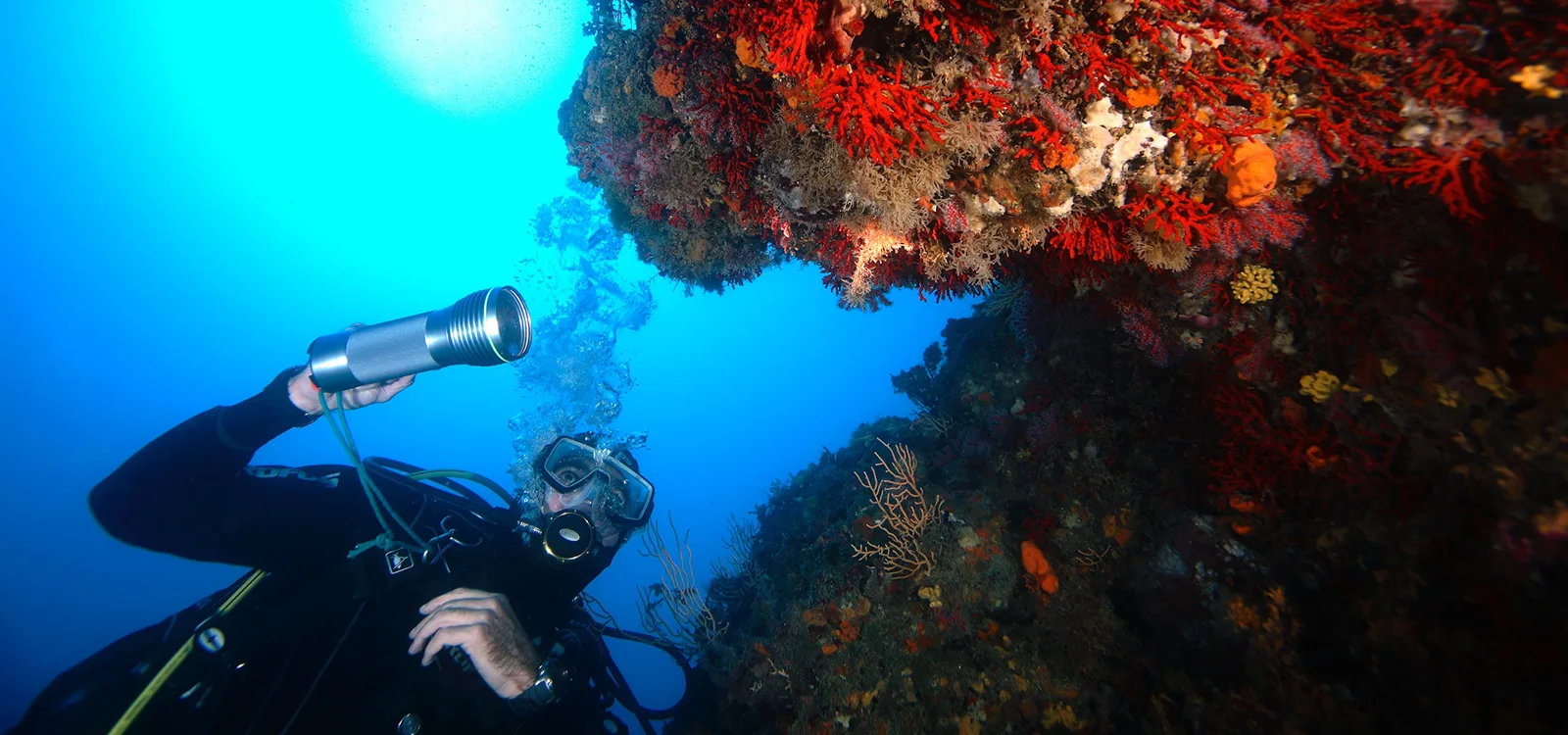
Red coral, white gorgonians, Posidonia meadows and the rocky caverns of Antignano meet boat dives over the protected Meloria shoals.
For subtitles in English: start the video firstthen click the gearat the top right of the video, select “Subtitles/CC”, then “Auto-translate” and choose “English”.
At Antignano, the Grotta del Conger leads into the rocky, close-in character of Livorno’s coastal diving, with pinnacles and cavities rather than a sandy training ground. Further offshore, the Secche della Meloria bring boat diving over protected shoals, where walls, Posidonia meadows, red coral and gorgonians give the dives a different scale. This is a shore-based Tuscan trip, not a liveaboard destination, and it works well for divers who want several kinds of Mediterranean terrain without committing to an island itinerary.
Livorno’s diving moves between coastal rock and offshore relief. Around Antignano, expect pinnacles, cavities and sites such as the Grotta del Conger, reached from the shoreline sector south of the city. The Meloria outings are by boat, over shoals shaped by walls and rocky features, with Posidonia and coralligenous communities adding texture to the route. Currents are variable, so a site that looks straightforward on paper may require more disciplined buoyancy and attention to the guide’s plan. Some outings are suitable for newer divers, while deeper walls, exposed shoals and wrecks demand more experience. Visibility also changes with wind, swell, location and coastal run-off, so do not build the trip around a fixed expectation. A lamp is useful for the caverns, and the final shape of a dive may be a wall, cavity, shoal or wreck rather than a standard reef circuit.
The Meloria shoals are the place to look for red coral, white gorgonians, sponges, nudibranchs and fish moving around coralligenous rock. Posidonia meadows bring a softer, greener contrast to the walls and cavities. On the coastal sites, keep an eye in and around the rock for octopus, conger eels, scorpionfish and grouper. These are Mediterranean encounters rather than a seasonal parade of headline species, and the list is best understood as the resident character of the ground. What appears on a particular dive will depend on the site, conditions and careful observation. Livorno can be dived throughout the year, so marine life is part of the destination’s appeal in every season, not a reason to restrict the trip to a narrow wildlife window.
Diving is possible throughout the year, but May, June, September and October are the most practical months for a balanced trip. Spring and autumn can bring more wind, swell and current disruption, while high summer generally brings more people to the easy coastal sites. The shoulder months reduce that pressure without closing off the local diving, and they leave room to move a Meloria boat trip when the sea is less cooperative. Keep the more exposed outing flexible, then use Antignano as the fall-back when conditions make the shoals unattractive.
Livorno suits mixed groups because some coastal dives are offered at different levels, while the terrain gives experienced divers plenty to consider. Beginners should start with an appropriate Antignano site and avoid assuming that every cavity, wall or wreck is equally simple. An Advanced qualification is useful for deeper walls and demanding relief. A Wreck qualification is appropriate when a wreck dive includes penetration or other wreck-specific demands. Experience with variable current and boat diving will make the Meloria outings more comfortable.
From London Heathrow, Gatwick or Manchester, plan the journey into Italy, then continue to Livorno by road or rail. The city is connected to the Italian transport network, but the dive base is spread along the coast rather than concentrated around one arrival point. Once in Livorno, the coastal sector can be reached by car, taxi or local transport, depending on the centre and site. Antignano is not necessarily a walk from a city-centre hotel. The Secche della Meloria require a boat from the Livorno coast, so a ferry to a Tuscan island is neither a shortcut nor a requirement for this destination. Allow extra time when your accommodation and departure point are in different parts of the city.
Ask for the exact Meloria sector before booking: the protected area is zoned, diving is permitted in zone C and parts of zone B with authorisation, and zone A is closed to diving. Confirm that the operator is handling the required permission, rather than turning up and hoping the paperwork sorts itself out. Keep a coastal Antignano dive as a back-up, because wind and swell can affect the boat trip more severely than the shore sites. Choose accommodation by departure point, not just by the historic centre, and arrange the road connection in advance. If a cavity is planned, take a suitable torch or establish whether one is supplied. Ask whether the dive is a wall, shoal, cave or wreck, then match it to your qualification and experience. Do not quietly treat Livorno as a substitute for Elba or Pianosa, which involve separate island logistics. Leave a land day at the end rather than forcing the final dive into a departure day.
A three- to five-day stay gives the weather some room and lets you combine an Antignano coastal dive with a Meloria boat outing. Stay near the relevant coastal departure point if diving is the priority, or use the city as a base and allow for taxi, car or local-transport time. Keep a day for Livorno’s waterfront, historic canals and harbour architecture, with the southern coast and wider Tuscany available for non-diving excursions.
Hello, I'm Marina, DivingDeal.com's AI assistant. I guide you through destinations, areas and countries.
Thinking about the whole trip and the flights? Talk it over with Edith →
Marina is an AI. Some links are affiliate links: DivingDeal may earn a commission, at no extra cost to you. Bookings are made with the partner.
You can dive in Livorno throughout the year, while May, June, September and October are practical months for a balanced trip. Spring and autumn may bring wind, swell and current disruption. High summer can be busier at easy coastal sites. Keep a Meloria boat outing flexible and use Antignano when conditions are less suitable.
Livorno suits mixed groups because some coastal dives are offered at different levels. Beginners should choose an appropriate Antignano site and not assume every cavity, wall or wreck is simple. An Advanced qualification helps with deeper walls and demanding relief, while wreck-specific training is appropriate for penetration or other wreck demands.
In Livorno, you can explore Antignano’s rocky pinnacles, cavities and Grotta del Conger, or boat-dive the Meloria shoals. Red coral, white gorgonians, sponges, nudibranchs, coralligenous communities and Posidonia meadows add variety. Look around the rocks for octopus, conger eels, scorpionfish and grouper, with sightings depending on conditions and observation.
Plan a shore-based Livorno trip around your coastal departure point, not only the historic centre. Arrange road, taxi or local transport connections, and confirm that your operator has permission for the permitted Meloria zones. Combine an Antignano dive with a Meloria boat outing, keep the boat day flexible, and leave time for weather changes.