Ocean Sunfish
Mola mola
The heaviest bony fish on Earth looks like a mistake of nature — and that is its strength.
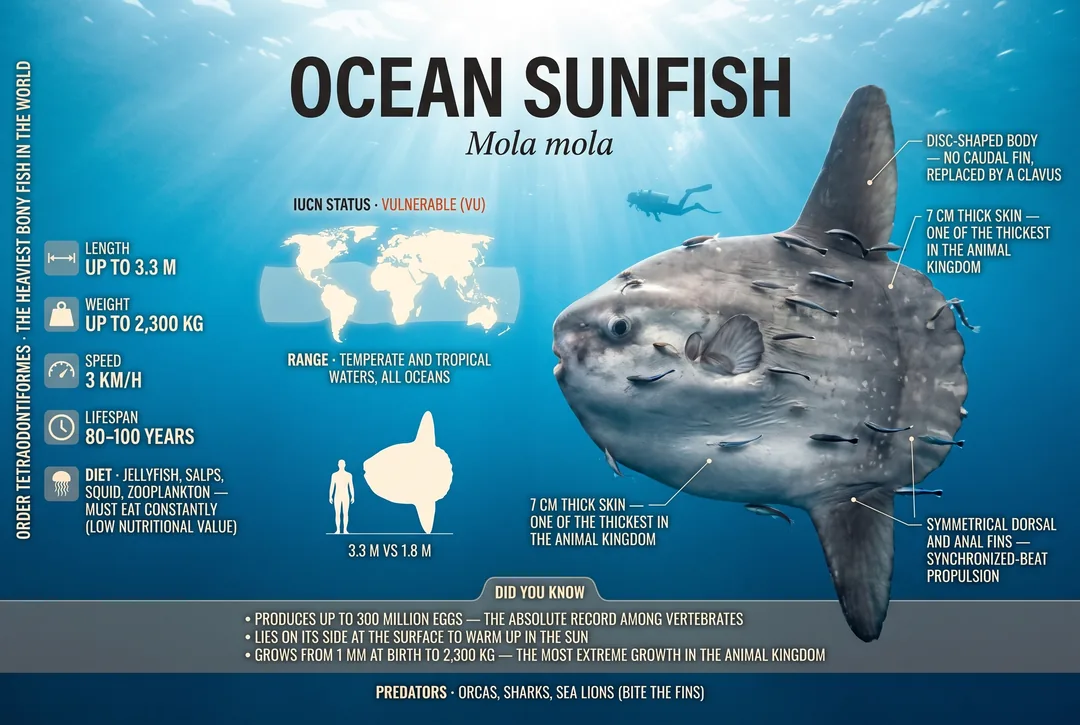
IDENTITY CARD
| Classification | Order Tetraodontiformes, family Molidae |
| Scientific name | Mola mola (Linnaeus, 1758) |
| Size | Up to 3.3 m long, 4.2 m fin-to-fin (dorsal to anal) |
| Weight | Up to 2.3 tonnes — record: 2,744 kg |
| Speed | ~3 km/h cruising |
| Lifespan | 80-100 years (estimates; limited in situ data) |
| Depth | Surface to 800 m; most commonly 0-200 m |
| Diet | Jellyfish, siphonophores, ctenophores, salps, small fish, larvae, squid |
| IUCN Status | Vulnerable (VU) — population declining |
PORTRAIT
You see it coming from a distance and you do not understand what you are looking at. A flat, near-circular form drifting between two waters like a disc tilted on its side. No proper tail. Two enormously tall fins — dorsal and anal — beating in unison, slowly, like wings. And a round, placid eye that fixes you with sovereign indifference. The ocean sunfish is the only marine animal capable of leaving a diver bewildered before it has even begun to inspire wonder.
Mola mola is the heaviest bony fish alive. An adult routinely exceeds one tonne; the authenticated record, caught off Japan in 1996, weighed 2,300 kg for 2.72 m in length. The scientific name comes from the Latin mola — millstone — a nod to its round, flattened silhouette. The French call it poisson-lune, the moonfish, evoking the same pale disc; in English, ocean sunfish, because it likes to lie at the surface and bask in the sun.
Its body resembles nothing else in the fish world. The rear end appears to have been cut clean off: no caudal fin in the classical sense, but a rigid fold called the clavus, formed by the fusion of dorsal and anal fin rays. It is this structure that gives the ocean sunfish its look of a head without a body — a thick oval, almost comical when seen head-on, yet perfectly adapted to its pelagic way of life.
HOW TO RECOGNIZE IT
The ocean sunfish cannot be confused with anything. Its silhouette is unique in the marine world: a laterally compressed disc, truncated at the rear, with symmetrical dorsal and anal fins that project far beyond the body. Seen head-on, it is remarkably narrow — a thick pancake, a few dozen centimetres wide for a diameter of over two metres.
The skin is grey to light brown, sometimes mottled with white or silver, and of a remarkable texture: thick, rough, covered in dermal denticles and a layer of mucus. It can reach 7.5 cm in thickness on the flanks — a natural armour that even sharks struggle to penetrate.
The beak is short and powerful: the teeth are fused into two plates, one upper and one lower, forming a parrot-like bill that cannot close completely. It is this beak that allows it to crush the toughest jellyfish and the small crustaceans in its diet.
Underwater, size and slowness strike first. A 2 m adult is the height of a road sign laid horizontal, drifting toward you in slow motion. It does not flee. It does not hurry. It passes.
For subtitles in English: start the video firstthen click the gearat the top right of the video, select “Subtitles/CC”, then “Auto-translate” and choose “English”.
WAY OF LIFE
The ocean sunfish leads a vertical double life. By day it dives into cold, deep water — down to 600 or 800 metres — to hunt jellyfish, siphonophores and the gelatinous zooplankton that make up the bulk of its diet. Then it rises to the surface and lies on its side, flank exposed to the sun, to warm up. This thermoregulation behaviour is vital: without it, the deep dives would chill the body to the point of metabolic shutdown.
It is also at the surface that the celebrated cleaning sessions play out. The ocean sunfish is a prime host for parasites — up to 54 different species have been counted on a single individual. To rid itself of them, it presents itself at reef cleaning stations where cleaner wrasses and angelfish pick off copepods and other stowaways. At the surface, it also lies on its side for seabirds — albatrosses, gulls — to peck away the remaining passengers. A spa in two storeys.
Reproduction is staggering in its numbers. A female Mola mola can release up to 300 million eggs in a single season — the absolute record among vertebrates. Each egg measures barely one millimetre. The larva that hatches, bristling with spines, looks more like a small pufferfish than an ocean sunfish: a radical metamorphosis must follow for the body to shed its spines, for the tail to be reabsorbed and for the silhouette to become the massive disc we know. Between hatching and adulthood, the ocean sunfish multiplies its weight by 60 million — the greatest growth factor known among vertebrates.
Despite its apparent slowness, the animal is not defenceless. Its thick skin deters most predators. Its principal enemies are orcas, great white sharks, sea lions — and plastic bags, which it mistakes for jellyfish.
WHERE TO SEE IT
The ocean sunfish lives in all the temperate and tropical seas of the globe. Encounters while diving remain events rather than certainties, except at a handful of sites where oceanographic conditions regularly concentrate the species. These are the destinations where the chances are highest:
Indonesia — Nusa Penida (Bali). This is THE world spot for the mola mola. Crystal Bay, on the western coast of Nusa Penida, delivers regular encounters from July to October, when cold water upwells from the depths along the walls. The sunfish rise to cleaning stations at 15-30 metres. The dive is technical: strong currents, cold water (18-22 degrees C) and brutal thermoclines. SD Point and Manta Point offer complementary sightings. Advanced level recommended.
Galapagos — Gordon Rocks and Wolf. The nutrient-rich waters of the archipelago attract ocean sunfish year-round, peaking from June to November. Gordon Rocks, near Santa Cruz, is the most accessible site. Wolf and Darwin offer rarer encounters but in an exceptional faunal context — hammerhead sharks, whale sharks, turtles. Strong currents, advanced level.
Azores — Princesa Alice and Condor Bank. The Portuguese archipelago is an overlooked hotspot. Ocean sunfish are observed from June to October around seamounts, where they come to be cleaned by damselfish. Princesa Alice, 50 nautical miles from Faial, offers encounters in absolute blue water, often in the company of mobula rays and blue sharks.
South Africa — False Bay and Gansbaai. The South African coast welcomes ocean sunfish from December to May, when the waters warm. False Bay, near Cape Town, and the waters off Gansbaai provide regular observations, often at the surface. The setting — kelp forests, seals, great whites — is spectacular.
California — Monterey Bay. The submarine canyon of Monterey, one of the deepest in the world, creates massive upwellings that attract ocean sunfish from summer through autumn. Sightings are frequent by kayak and freediving; scuba divers encounter them between 15 and 30 metres. Cold water (10-15 degrees C), drysuit recommended.
Mediterranean — Malta, Sicily, Costa Brava. It is often forgotten, but the ocean sunfish is present in the Mediterranean. The waters around Malta, Sicily and the Costa Brava offer opportunistic sightings from June to September, often at the surface. Less predictable than Bali or the Galapagos, but the surprise is total.
OBSERVATION CALENDAR
| Destination | J | F | M | A | M | J | J | A | S | O | N | D |
|---|---|---|---|---|---|---|---|---|---|---|---|---|
| Bali (Nusa Penida) | ||||||||||||
| Galapagos | ||||||||||||
| Azores | ||||||||||||
| South Africa | ||||||||||||
| California (Monterey) | ||||||||||||
| Mediterranean |
Click each button to show/hide
CONSERVATION
Mola mola is listed as Vulnerable (VU) on the IUCN Red List. Demographic data are fragmentary — the species is difficult to census — but the global trend is downward.
The threats are primarily accidental. The ocean sunfish is one of the most frequent victims of bycatch in drift nets and pelagic longlines. In the Mediterranean, it accounts for up to 70% of accidental catches in some swordfish fisheries. Off South Africa, shark nets installed to protect beaches kill dozens every year.
Plastic ingestion is a growing menace. The ocean sunfish hunts jellyfish — and a transparent plastic bag, suspended in the water column, looks exactly like one. Necropsies regularly reveal stomachs packed with plastic debris, causing intestinal blockages and slow death.
In Taiwan and Japan, the flesh of the ocean sunfish is consumed locally, despite containing tetrodotoxin in certain organs — the same toxin found in fugu. The European Union banned the sale of Molidae products in 2004.
A diver who encounters an ocean sunfish at a cleaning station should not disturb it — as long as they stay back. The animal is focused on the service it is receiving; an overly sudden approach will send it fleeing and interrupt a ritual vital to its health. Recommended distance: 3 metres minimum. No flash.
Organisations to support:
- Ocean Sunfish Research Trust — worldwide research and satellite tagging programme
- MarAlliance — monitoring of pelagic megafauna in Central America
- Marine Megafauna Foundation — research and conservation of marine giants
- PADI AWARE — citizen science programme and sighting reports
3 THINGS YOU PROBABLY DON'T KNOW
1. It lays 300 million eggs — more than any other vertebrate. A female Mola mola can release up to 300 million eggs in a single reproductive season, each barely one millimetre across. It is the absolute record among vertebrates — a whale shark, by comparison, carries only 300 embryos. The strategy is pure numbers: of those 300 million larvae, a vanishing fraction will survive predation, currents and starvation. But a few will become two-tonne adults.
2. It grows 60 million times. At hatching, the ocean sunfish larva measures 2.5 mm and weighs a fraction of a gram. An adult can reach 2,300 kg. The growth factor — approximately 60 million — is the highest known among vertebrates. The metamorphosis is equally radical: the larva, bristling with spines like a miniature pufferfish, sheds its prickles, reabsorbs its tail and transforms into the massive, smooth disc we recognise. The kinship with the Tetraodontiformes — pufferfish, boxfish, triggerfish — is visible only at this larval stage.
3. Sea lions play with them — and it is cruel. Off the coast of California, sea lions have been filmed catching young ocean sunfish, launching them into the air repeatedly, then abandoning them mutilated but alive. The behaviour is not feeding: the sea lions generally do not eat them. Biologists interpret these scenes as social play or hunt training — a spectacle difficult to watch for anyone who has just fallen under the spell of this placid creature.
PHOTO AND VIDEO TIPS
The ocean sunfish is a paradoxical subject: enormous, slow, cooperative — but often found in difficult diving conditions. At Nusa Penida the water is cold, the current pulls hard, and the thermocline blurs visibility at the precise moment the animal appears. The shooting window is short.
Lens. Wide angle is mandatory. In a housing: 10-17 mm fisheye or 14-16 mm rectilinear. The animal is massive but not as long as a whale shark — it can be framed entirely at 3-4 metres with a fisheye. On a GoPro or equivalent: the native field of view works, but watch for vignetting in Bali's loaded waters.
Light. Encounters typically occur between 15 and 30 metres, in cold and sometimes murky water. One or two video lights with a wide beam bring contrast and recover the colours lost at depth. Flash can work for close-ups on the skin and beak, but suspended particles are the enemy at these depths — continuous light is preferable.
Approach. An ocean sunfish at a cleaning station is stationary and tolerant. Do not break the ritual: approach slowly from the side, stabilise, wait. It will stay put as long as it is not startled. A sunfish in transit is harder to work with — its fins beat with deceptive slowness and it can accelerate abruptly.
Classic mistake. Shooting only in strict profile. It is the reflex — the fish is flat, the profile silhouette is the most recognisable. But it is also the most postcard-flat angle. A three-quarter view, with the eye looking toward the lens and cleaner wrasses at work on the flanks, tells a story. A shot from below, the silhouette carved against the surface light, gives scale and mystery. Vary your angles.