Komodo Dragon
Varanus komodoensis
The largest living lizard rules over a handful of Indonesian islands — and it bites to kill.
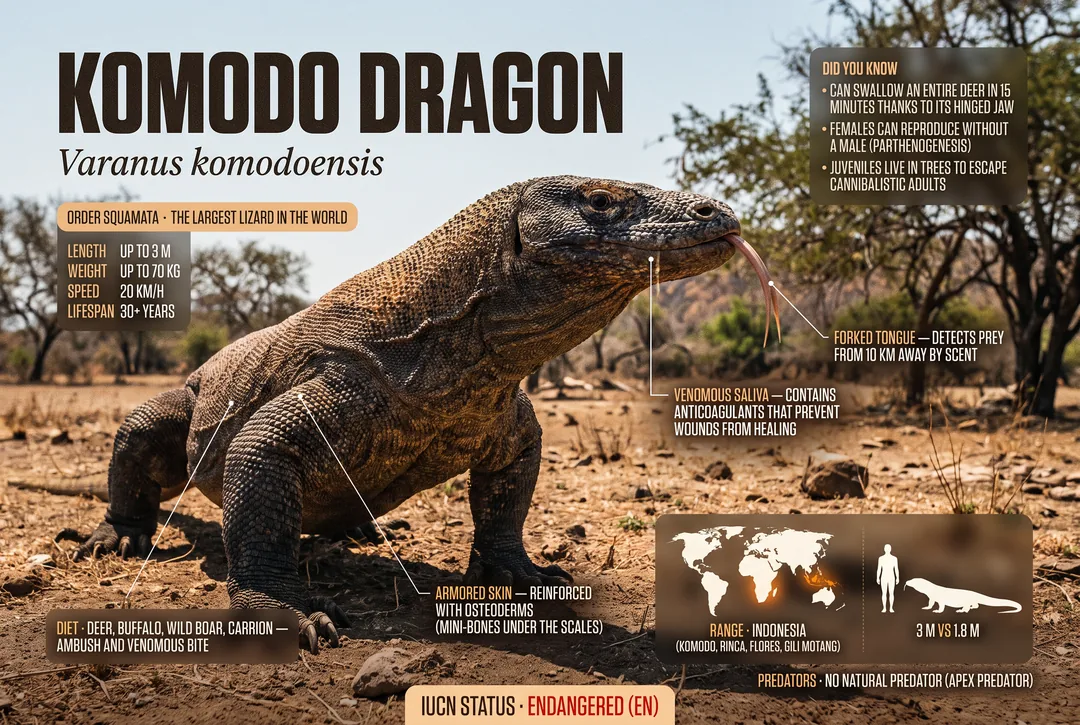
IDENTITY CARD
| Classification | Order Squamata, family Varanidae |
| Scientific name | Varanus komodoensis (Ouwens, 1912) |
| Size | Up to 3.1 m (average: 2.2-2.5 m for males) |
| Weight | Up to 90 kg (average: 70 kg for males) |
| Speed | 20 km/h in short sprints |
| Lifespan | 30-50 years |
| Depth | Terrestrial animal — swims between islands over short distances |
| Diet | Predator and scavenger — deer, wild boar, water buffalo, feral horses, birds, carrion |
| IUCN Status | Endangered (EN) |
PORTRAIT
The Komodo dragon has no business on a dive-trip itinerary — and yet it is one of the most unforgettable encounters a diver can have in Indonesia. Because Komodo, the island that lends the beast its name, is also the epicentre of some of the world's finest dive sites. Divers who come for the mantas at Manta Point and the currents of Batu Bolong often leave with a memory just as vivid: the unblinking stare of a three-metre monitor lizard on the beach at Rinca.
Varanus komodoensis is the last representative of a lineage of giant lizards that once roamed Australia and Southeast Asia. It is the largest living lizard on the planet, an ambush predator capable of felling an adult deer with a single bite. Its saliva, long believed to be simply loaded with pathogenic bacteria, actually contains a cocktail of venomous proteins that induce haemorrhagic shock in prey — a discovery that revolutionised our understanding of the animal in 2009.
The species is confined to five islands in Indonesia's Lesser Sunda Islands archipelago: Komodo, Rinca, Gili Motang, Gili Dasami and the coastal fringe of Flores. Nowhere else. Around 3,000 wild individuals survive, protected within Komodo National Park, a UNESCO World Heritage Site since 1991.
HOW TO RECOGNIZE IT
The Komodo dragon is immediately identifiable by its size alone — no other lizard approaches 3 metres. The body is massive, clad in scales reinforced by small osteoderms (subcutaneous bony plates) that form a natural coat of chainmail. The skin is grey-brown, rough, marked by dark spots in juveniles that fade with age.
The head is elongated and flattened, with a rounded snout. The tongue, long and forked, is bright yellow — it is the animal's primary sensory organ, sampling airborne molecules to detect carrion or prey from several kilometres away. The legs are powerful, armed with curved claws. The tail, as long as the body, serves as a defensive weapon — a tail strike can break a human leg.
Males are noticeably larger than females. Juveniles, which are arboreal during their first years (to escape cannibalistic adults), display a more contrasting pattern of bands and spots.
For subtitles in English: start the video firstthen click the gearat the top right of the video, select “Subtitles/CC”, then “Auto-translate” and choose “English”.
WAY OF LIFE
The Komodo dragon is an ambush predator. It waits, motionless in tall grass or scrubland, for prey to pass within striking distance. The attack is explosive: a sprint of a few metres, a bite to the throat, belly or leg, and the lizard withdraws. It does not need to maintain its grip — the venom does the work. The prey, weakened by haemorrhage and shock, is patiently followed for hours, sometimes days, until it collapses.
The diet is opportunistic and brutal. Timor deer (Rusa timorensis) are the primary prey, followed by wild boar and water buffalo. Juveniles eat insects, smaller lizards and eggs. Cannibalism is frequent — adults eat juveniles, which is why young dragons spend their first years in the trees.
Reproduction includes a remarkable phenomenon: parthenogenesis. A female can produce viable eggs without fertilisation by a male — all resulting offspring are then males (the monitor's ZW chromosomal system means unfertilised eggs produce ZZ individuals, hence males). This mechanism, documented in captivity in 2006, theoretically allows a single female to colonise a deserted island.
The breeding season runs from May to August. The female lays 15-30 eggs in a nest dug in the ground or in an abandoned megapode mound. Incubation lasts 7-8 months. Hatchlings measure 40 cm and are immediately left to fend for themselves.
WHERE TO SEE IT
The Komodo dragon can only be observed in Komodo National Park and its surroundings, in the province of East Nusa Tenggara, Indonesia. Access is from Labuan Bajo, on the western coast of Flores.
Rinca Island. The most reliable site for observing dragons. The Loh Buaya ranger station is the starting point for guided treks (compulsory). Dragons often gather around the ranger kitchen — attracted by smells, not fed — and in surrounding clearings. The island is drier and more open than Komodo, making observation easier. Around 1,300 individuals live here.
Komodo Island. The eponymous island is home to approximately 1,700 dragons. Kampung Komodo village, in the northeast, is the main access point. Treks depart from Loh Liang station. The habitat is more densely forested than Rinca — sightings are possible but sometimes less straightforward in the wet season.
Diving + dragons combo. The most popular formula is a 3-7 day liveaboard diving cruise departing from Labuan Bajo, alternating dives on the park's legendary sites (Batu Bolong, Castle Rock, Crystal Rock, Manta Point, Shotgun) with land excursions on Rinca or Komodo. It is the only destination on Earth where you can dive with manta rays in the morning and cross paths with a three-metre dragon in the afternoon.
OBSERVATION CALENDAR
| Destination | J | F | M | A | M | J | J | A | S | O | N | D |
|---|---|---|---|---|---|---|---|---|---|---|---|---|
| Rinca | ||||||||||||
| Komodo | ||||||||||||
| Diving Komodo |
Click each button to show/hide
The dragons are resident and visible year-round. The optimal diving season at Komodo runs from March to November (mantas are more present from December to February in the park's south, and from March to May in the north). The rainy season (December-February) makes boat crossings rougher but does not prevent land-based observations.
CONSERVATION
Varanus komodoensis has been listed as Endangered (EN) on the IUCN Red List since 2021 (upgraded from Vulnerable). The species is endemic to five Indonesian islands and its total population is estimated at around 3,000 adult individuals.
The threats are multiple. Climate change is the primary concern: models predict a significant reduction in suitable habitat by 2050, with rising temperatures and aridity that could render some areas uninhabitable. Poaching of deer — the main prey — shrinks the food base. Poorly managed mass tourism disturbs nesting areas.
In 2023, the Indonesian government introduced an entry fee of 3.75 million rupiah (around 230 euros) for foreign visitors to Komodo National Park — a controversial measure aimed at limiting numbers and funding conservation. Annual visitor numbers dropped from over 200,000 to around 80,000.
Organisations to support:
- Komodo Survival Program — in situ research and protection
- Komodo National Park — park management and population monitoring
- WWF Indonesia — protecting the Lesser Sunda Islands ecosystem
- IUCN Crocodile Specialist Group — monitor lizard population tracking
3 THINGS YOU PROBABLY DON'T KNOW
1. It is venomous, not septic. For decades, the prevailing belief was that the Komodo dragon's bite killed through bacterial infection — its saliva teeming with pathogens transmitted to prey. In 2009, a study by Bryan Fry (University of Melbourne) demonstrated that the monitor possesses genuine venom glands in its lower jaw, producing anticoagulant and hypotensive proteins. It is the venom, not bacteria, that causes the fatal haemorrhagic shock in prey.
2. A female can reproduce on her own. In 2006, at Chester Zoo (England), a female Komodo dragon named Flora laid viable eggs without ever having been in contact with a male. Parthenogenesis — asexual reproduction — was confirmed by genetic analysis: all offspring were genetically identical clones carrying two Z chromosomes. This mechanism, exceptional among vertebrates of this size, could explain how the species colonised new islands from a single stranded individual.
3. Juveniles live in trees to survive the adults. Cannibalism is so prevalent among Komodo dragons that juveniles (under 1.5 m) spend their first two to three years in the trees, out of reach of adults too heavy to climb. When they descend to the ground, they roll in faeces and carrion entrails — a strategy that makes them repulsive to adults, buying time until they are large enough to defend themselves.
PHOTO AND VIDEO TIPS
The Komodo dragon is a terrestrial subject — the rules of underwater photography do not apply here. But for divers combining a liveaboard cruise with a land excursion, a few pointers are essential.
Lens. Telephoto 70-200 mm or a versatile 24-105 mm zoom. The dragon is imposing but the safety distance enforced by rangers (2-3 metres minimum) rules out tight framing with a wide-angle. A good zoom lets you capture a close-up of the head while staying at a respectful distance.
Light. Indonesian light is intense and contrasty. The best hours are early morning (8-10 a.m.), when dragons bask in the sun and the light is still oblique. At midday, harsh shadows under the canopy crush detail — look for subjects on forest edges.
Behaviour. The dragon is often motionless — an advantage for framing. The forked tongue sampling the air is the signature gesture: shoot in burst mode when the animal flicks it. Interactions between dragons (ritual combat between males rearing on their hind legs) are rare but spectacular — they occur mainly during the breeding season (May-August).
Safety. Always follow the ranger, always. The Komodo dragon is capable of sprinting and attacks on humans, though rare, are documented. Never crouch down to ground level (prey posture), do not wear bright red, and do not wander from the group.