American Crocodile
Crocodylus acutus
The only crocodilian you can encounter on a dive lives in the sea.
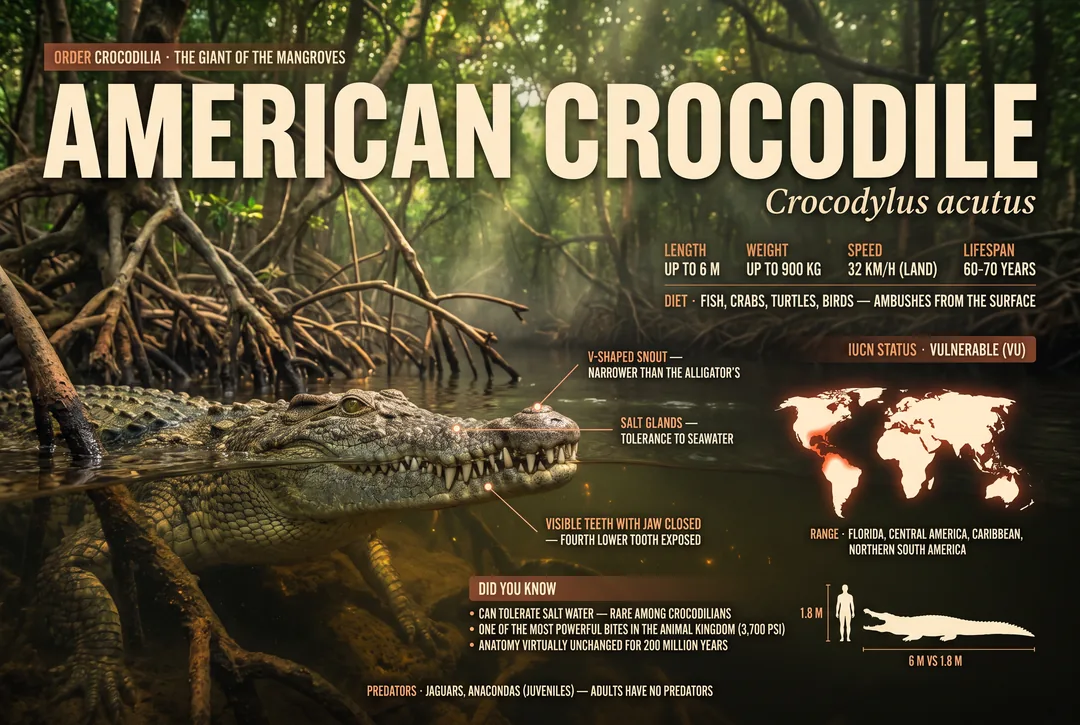
IDENTITY CARD
| Classification | Order Crocodilia, family Crocodylidae |
| Scientific name | Crocodylus acutus (Cuvier, 1807) |
| Size | Up to 6 m (observed average: 3-4 m) |
| Weight | 200 to 500 kg (adult males), up to 900 kg for the largest specimens |
| Speed | ~30 km/h top speed in water, 16 km/h on land |
| Lifespan | 60 to 70 years in the wild |
| Depth | Surface to 5 m, rarely beyond |
| Diet | Opportunistic predator — fish, crabs, turtles, waterbirds, small mammals |
| IUCN Status | Vulnerable (VU) — population increasing in some areas, but habitat continues to shrink |
PORTRAIT
There comes a moment in a diver's career when sharks no longer inspire fear. Then there is the moment when you find yourself two metres from a crocodile, motionless in turquoise water, and every instinct comes flooding back. The American crocodile produces that effect. It is the only large marine reptile you can encounter while freediving in the Americas — and the experience has no equivalent.
Crocodylus acutus is the most widespread crocodilian of the New World. It occupies coastlines and estuaries from southern Florida to Peru, through Mexico, Central America, Colombia, Venezuela, and the Greater Antilles. What sets it apart from all other American crocodilians is its salt water tolerance. Lingual glands located beneath the tongue excrete excess salt — a mechanism that alligators either lack or possess in such limited form that they never venture into the sea for long. The American crocodile, by contrast, crosses stretches of open ocean, colonises atolls, and patrols coral reefs. It is this ability that makes it a diving animal.
The animal is powerful and silent, yet attacks on humans remain exceptionally rare — far less frequent than with the Nile crocodile or saltwater crocodile of Australia. At Banco Chinchorro, where divers swim daily within metres of four-metre specimens, no serious incident has been recorded in over twenty years of supervised activity.
HOW TO RECOGNIZE IT
The American crocodile is distinguished at first glance by its narrow, V-shaped snout, noticeably more pointed than the broad, U-shaped snout of the alligator. This is the most reliable field criterion — and the only one you need.
Colouration ranges from olive-grey to light brown, paler than most crocodilians. Juveniles carry dark bands on the body and tail that fade with age. The belly is cream. The skin, armoured with large dorsal scales called osteoderms, is less densely plated than that of the Nile crocodile — which paradoxically gives it a leaner silhouette.
Underwater, it is the stillness that strikes first. The crocodile rests on the sandy bottom, legs splayed, tail relaxed, and only opens its eyes when the diver is already there. The fourth tooth of the lower jaw, visible when the mouth is closed, definitively distinguishes it from the alligator, whose corresponding tooth remains hidden. A four-metre adult American crocodile, motionless in two metres of crystal-clear water, is a sight you do not forget.
For subtitles in English: start the video firstthen click the gearat the top right of the video, select “Subtitles/CC”, then “Auto-translate” and choose “English”.
WAY OF LIFE
The American crocodile is an ambush predator. It does not chase its prey: it waits, motionless for hours, until one passes within jaw range. The strike is lightning-fast — less than half a second to close a mouth capable of exerting a force of over 3,000 newtons.
The animal is ectothermic: it depends on its environment to regulate body temperature. It is often seen basking on riverbanks with its mouth open — a thermoregulation posture, not a sign of aggression. At night, it actively hunts in the water, moving with remarkable stealth.
Breeding takes place during the dry season. The female digs a nest in sand or loose soil, lays 30 to 60 eggs, and stands guard throughout the 75 to 80 days of incubation. The sex of the hatchlings depends on nest temperature — a mechanism common to crocodilians known as temperature-dependent sex determination. At birth, the juveniles measure about 25 cm and emit high-pitched calls signalling the mother to dig them out. She then carries them in her jaws to the water — one of the few documented parental behaviours among reptiles.
In Mexico, American crocodiles frequent cenotes near the coast — natural freshwater sinkholes that sometimes connect to the sea through underground tunnel networks. Encountering a crocodile in the crystal-clear water of a cenote is an experience unique to the Yucatan Peninsula.
WHERE TO SEE IT
The American crocodile inhabits coastal waters, estuaries, and lagoons throughout the Neotropical zone. Here are the destinations where observation is most accessible and best supervised:
Mexico — Banco Chinchorro. This is the spot. This coral atoll off the southern coast of Quintana Roo, the largest in Mexico, harbours a resident population of American crocodiles that have coexisted with fishermen for generations. Since the mid-2000s, operators have been running supervised snorkelling sessions with crocodiles in the shallow waters of the lagoon — two metres deep, total visibility, animals accustomed to human presence. It is the only destination in the world where people regularly swim with crocodiles in a marine setting. The season runs from November to June, with December to March being the most reliable months.
Cuba — Jardines de la Reina. This protected archipelago south of Cuba, accessible only by liveaboard, is one of the best-preserved marine ecosystems in the Caribbean. American crocodiles are present in the mangroves and channels between the islets. Encounters are less predictable than at Chinchorro, but the setting — pristine reefs, sharks, few divers — more than compensates. It is also one of the last refuges of the Cuban crocodile, a critically endangered endemic species.
Florida — Everglades. Southern Florida is the only place in the world where the American crocodile and the American alligator coexist. Everglades National Park and Florida Bay harbour an American crocodile population that has risen sharply since the 1970s, when the species had fallen to a few hundred individuals. Observation is by kayak or boat through the mangrove channels — not while diving, but the experience is unforgettable.
Costa Rica — Rio Tarcoles. The bridge over the Rio Tarcoles, on the central Pacific highway, is one of the most accessible places in the world to observe large crocodilians. American crocodiles gather by the dozens beneath the bridge, drawn by the river's nutrients. Viewing is from the bank or by boat. Corcovado National Park, further south, offers wilder encounters in the estuaries of the Osa Peninsula.
Belize — atolls and coastal reserves. The Belizean marine reserve network — Turneffe Atoll, Lighthouse Reef, the Hol Chan Reserve — shelters American crocodiles in the lagoons and mangrove channels. Encounters are occasional and rarely the primary reason for a trip, but they regularly punctuate diving and snorkelling outings on the barrier reef.
OBSERVATION CALENDAR
| Destination | J | F | M | A | M | J | J | A | S | O | N | D |
|---|---|---|---|---|---|---|---|---|---|---|---|---|
| Mexico (Banco Chinchorro) | ||||||||||||
| Cuba (Jardines de la Reina) | ||||||||||||
| Florida (Everglades) | ||||||||||||
| Costa Rica (Tarcoles) | ||||||||||||
| Belize (atolls) |
Click each button to show/hide
CONSERVATION
Crocodylus acutus is classified as Vulnerable (VU) on the IUCN Red List. The species came close to extinction in the 1960s-1970s, decimated by the leather trade and systematic destruction of coastal wetlands. In the United States, it was listed as an endangered species in 1975, when only 200 to 400 individuals remained in Florida.
Since then, conservation programmes have borne fruit. The Florida population now exceeds 2,000 individuals. In Mexico, the creation of marine reserves such as Banco Chinchorro has allowed stabilisation. The species is listed on Appendix I of CITES, which prohibits all international trade.
Threats nonetheless remain serious: destruction of mangroves for coastal development, estuary pollution, boat strikes, and residual poaching. Climate change is an emerging threat — rising sea levels submerge nesting sites, and increasing temperatures alter the sex ratio of clutches.
Supervised tourism, such as at Banco Chinchorro, plays an unexpected role: by assigning economic value to a living crocodile, it incentivises local communities to protect the animal rather than eliminate it. It is a model that several Central American countries are beginning to replicate.
Organizations to support:
- Crocodile Specialist Group (CSG/IUCN) — global coordination of crocodilian research and conservation
- Amigos de Sian Ka'an — protection of wetlands on Mexico's Caribbean coast, a key American crocodile habitat
- Defenders of Wildlife — protection of endangered species in the United States, including the Florida crocodile
3 THINGS YOU PROBABLY DON'T KNOW
1. It really does cry — but not from sorrow. The expression "crocodile tears" comes from a real observation: crocodiles secrete fluid from their lacrimal glands when eating. The phenomenon, long considered legendary, was confirmed in 2006 by a University of Florida study. The cause is not emotion — it is air forced into the sinuses by chewing that stimulates the glands. The American crocodile displays this trait particularly prominently.
2. It can stay underwater for an hour without breathing. Thanks to a unique cardiac shunt among vertebrates — the foramen of Panizza — the American crocodile can redirect deoxygenated blood past the lungs, slowing its metabolism to the point of becoming nearly invisible on the bottom. This is what makes it such a formidable ambush predator: its prey does not see it because it does not move, and it does not move because it does not need to surface to breathe.
3. Its preferred water is neither fresh nor salt. Contrary to popular belief, the American crocodile is not a marine animal. It tolerates salt water, but leaves it as soon as it can. Its preferred habitat is brackish water — the estuaries, lagoons, and river mouths where fresh and sea water mingle. That is where it hunts most efficiently, and where it breeds. Excursions into open sea or freshwater cenotes are real, but they remain the exception.
PHOTO AND VIDEO TIPS
Photographing an American crocodile underwater is a visceral exercise. The subject is motionless, the water is clear, the light is good — and yet, everything is charged with tension. Success depends less on technique than on composure and distance management.
Lens. Wide angle is mandatory. In a housing: 10-17 mm fisheye or 14-16 mm rectilinear. The subject is large, close, and at ground level — you need to frame wide. With a GoPro or equivalent, the native field of view is sufficient and the wide-angle video produces immediately impressive footage.
Light. At Banco Chinchorro, encounters happen in 1 to 3 metres of water, over a white sand bottom. Natural light is abundant and flash is generally unnecessary — it mainly risks provoking a reaction from the crocodile. For skin and scale detail, a single low-angle video light at a raking angle brings out the texture without disturbing the animal.
Approach. Always from the side or front, never from behind — the crocodile cannot see what approaches from its rear and reacts abruptly. Staying at the same level as the animal, flat on the bottom, reduces the perceived threat. The minimum distance is dictated by the guide; generally, 2 to 3 metres. At that distance, a 10 mm lens frames the entire animal with its surroundings.
Classic mistake. Neglecting the background. A crocodile on white sand is a grey rectangle on a white rectangle — the image is flat. The best photos incorporate a contextual element: the surface above, a snorkeller in the background, mangrove roots, or the play of caustic light on the sand.