Manta Ray
Mobula birostris
Seven metres of wingspan, the largest brain of any fish — and she recognises herself in a mirror.
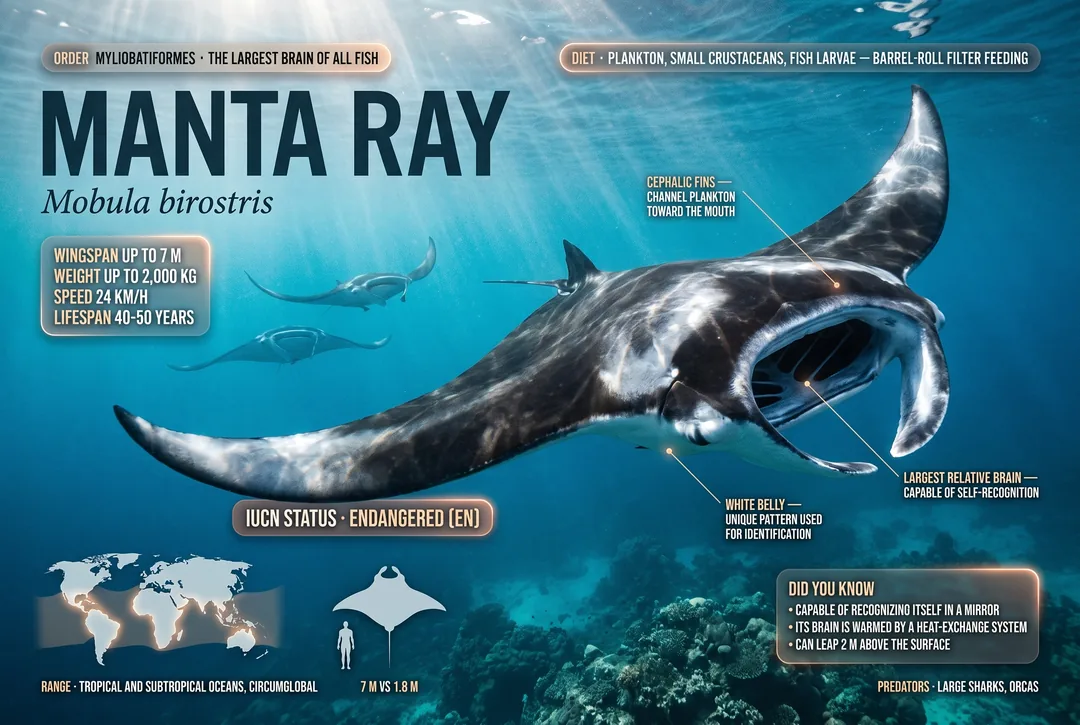
IDENTITY CARD
| Classification | Order Myliobatiformes, family Mobulidae |
| Scientific name | Mobula birostris (Walbaum, 1792) |
| Size | Wingspan up to 7 m (typical observed range: 4-5 m) |
| Weight | Up to 2,000 kg |
| Speed | ~24 km/h top speed |
| Lifespan | 40-50 years (estimates up to 60 years) |
| Depth | Surface to 1,400 m, but most commonly observed between 0 and 40 m |
| Diet | Filter feeder — plankton, small crustaceans, fish larvae |
| IUCN Status | Endangered (EN) — populations declining in most ocean basins |
PORTRAIT
She always arrives from below. The diver gazes into the blue, and suddenly an immense shadow glides overhead — silent, perfectly flat, wings spread across five or six metres. The manta ray does not swim: she flies. And when she pivots to circle back toward the bubbles, when her great eyes fix on the diver, something shifts in the encounter. This is no longer an animal passing by. This is an animal looking back.
Mobula birostris is the largest ray in the world. It also has, relative to its body size, the largest brain of any fish — an organ kept warm by a counter-current heat exchange network, a metabolic luxury shared only by tuna and certain sharks. That brain is not there for nothing: in 2016, a study demonstrated that the manta ray is capable of self-recognition in a mirror, a test passed only by great apes, dolphins, elephants, and a handful of corvids.
Like the whale shark, the manta is a filter feeder. Its cephalic fins — those two horn-like lobes curled on either side of the mouth — unfurl to funnel plankton-laden water into its wide-open maw. When food concentration is high, it executes barrel rolls in a tight loop, spinning over and over in the same spot, creating a vortex that concentrates the plankton. This ballet, which divers call barrel roll feeding, is one of the most mesmerising spectacles in the ocean.
HOW TO RECOGNIZE IT
Two species of manta ray exist: the oceanic manta (Mobula birostris, up to 7 m) and the reef manta (Mobula alfredi, up to 5 m). The distinction is based primarily on size, coloration, and habitat.
The oceanic manta has a dark dorsal surface — black, deep brown, or slate grey — and a white ventral surface marked with dark spots whose pattern is unique to each individual. That belly is the animal's identity card: photo-identification programmes such as Manta Matcher use these patterns to track global populations.
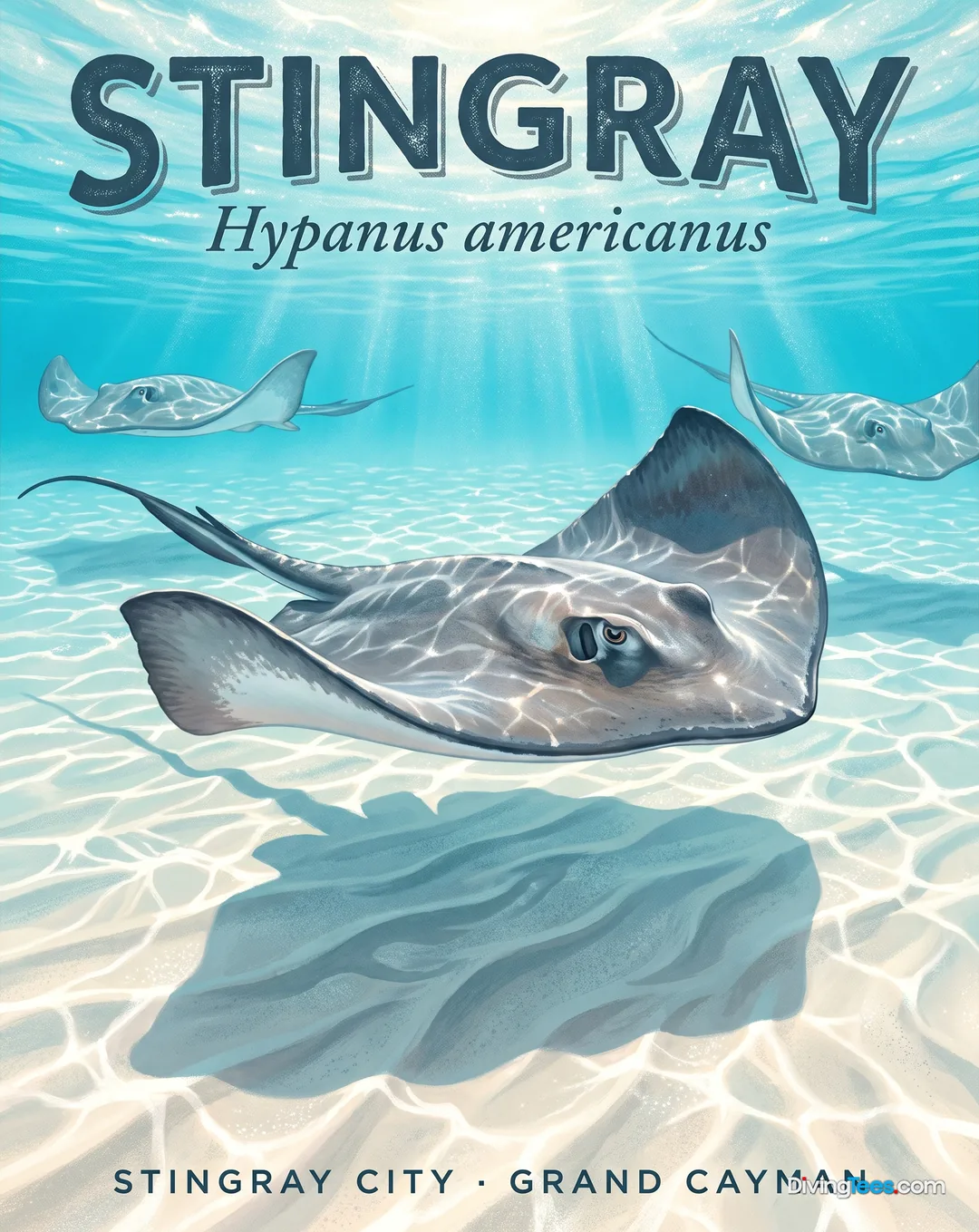
Underwater, the silhouette is instantly recognisable: a perfect diamond, two cephalic fins at the front, a long slender tail with no stinger. The manta has no venomous barb — unlike its cousin the stingray. The animal is entirely harmless.
Melanistic individuals — entirely black on both dorsal and ventral surfaces — account for roughly 10% of the population. They are particularly striking and highly sought after by photographers.
For subtitles in English: start the video firstthen click the gearat the top right of the video, select “Subtitles/CC”, then “Auto-translate” and choose “English”.
WAY OF LIFE
The manta ray is both a nomad and a creature of habit. She covers hundreds of kilometres between feeding grounds, cleaning stations, and breeding sites, yet returns regularly to the same locations — sometimes year after year, decade after decade. Photo-identified individuals in the Maldives have been resighted at the same cleaning stations for over 20 years.
Cleaning stations lie at the heart of manta social life. At these specific reef sites, cleaner wrasses and small fish rid the manta of parasites. The animal presents itself, slows down, sometimes stops completely — and waits. These stations are meeting points: mantas cross paths there, and courtship behaviour has been observed repeatedly.
Reproduction is slow. Females reach sexual maturity around 8-10 years of age. Gestation lasts approximately 13 months. The litter: a single pup, exceptionally two. The newborn already measures 1.5 m in wingspan and is independent from birth. With an interval of 2 to 5 years between litters, the population's capacity for renewal is extremely low — making the species particularly vulnerable to overexploitation.
WHERE TO SEE IT
The manta ray inhabits all tropical and subtropical seas. Here are the destinations where encounters are most reliable, featuring sites in the DivingDeal catalogue:
Maldives — Hanifaru Bay and Ari Atoll. Hanifaru Bay (Baa Atoll, UNESCO Biosphere Reserve) hosts, from June to November, the largest manta aggregations on Earth — up to 200 individuals feeding simultaneously in this funnel-shaped bay. Snorkelling only (scuba diving prohibited). At Ari Atoll, the cleaning stations of Lankan Reef, Rangali Madivaru, and Maalhos offer near-daily sightings year-round.
Indonesia — Komodo, Nusa Penida, Raja Ampat. Manta Point and Cauldron (Komodo) are classics. At Nusa Penida (Bali), Manta Bay offers nearly guaranteed reef manta sightings. Raja Ampat, in West Papua, is home to both species — oceanic mantas cruise the plankton-rich currents around Wayag and Dampier Strait.
Mozambique — Tofo. Manta Reef and Giant's Castle host mantas year-round, peaking from November to March. One of the rare places where scuba encounters just a few metres away are the norm rather than the exception.
Ecuador — Isla de la Plata. Nicknamed the "Little Galapagos," this island off the Ecuadorian coast offers encounters with large oceanic mantas from June to October, in nutrient-rich waters.
Mexico — Socorro (Revillagigedo). The Revillagigedo Islands, accessible only by liveaboard, are famous for their "social" giant mantas that seek contact with divers — a behaviour unique in the world. Season from November to May.
Hawaii — Kona (Big Island). The Kona night dive with mantas is a ritual: lights on the sea floor attract plankton, and the mantas come to feed just centimetres from the divers, mouths wide open, in a perfectly choreographed ballet.
OBSERVATION CALENDAR
| Destination | J | F | M | A | M | J | J | A | S | O | N | D |
|---|---|---|---|---|---|---|---|---|---|---|---|---|
| Maldives (Hanifaru Bay) | ||||||||||||
| Maldives (Ari Atoll) | ||||||||||||
| Indonesia (Komodo) | ||||||||||||
| Indonesia (Nusa Penida) | ||||||||||||
| Indonesia (Raja Ampat) | ||||||||||||
| Mozambique (Tofo) | ||||||||||||
| Mexico (Socorro) | ||||||||||||
| Hawaii (Kona) | ||||||||||||
| Ecuador (Isla de la Plata) |
Click each button to show/hide
CONSERVATION
Mobula birostris is listed as Endangered (EN) on the IUCN Red List. The species has been on Appendix II of CITES since 2013, and on the Convention on Migratory Species (CMS).
The primary threat is targeted fishing for gill plates, used in traditional Chinese medicine under the name peng yu sai. A kilogramme of dried gill plates fetches up to 400 dollars on Asian markets. This demand has decimated populations in Southeast Asia and the Indian Ocean over the past two decades. Added to this are bycatch in fishing nets, boat strikes, and microplastic pollution — which the manta, as a filter feeder, ingests in enormous quantities.
The manta's biology conspires against its resilience: late maturity, a single pup every 2 to 5 years. A decimated population takes decades to recover. It is the opposite of a reef fish producing millions of eggs per year.
Responsible divers never touch a manta, never block its path at a cleaning station, and maintain a minimum distance of 3 metres. Mantas accustomed to divers often tolerate shorter distances — but the animal decides.
Organisations to support:
- Manta Trust — global research, photo-identification, community programmes
- Marine Megafauna Foundation — population monitoring in Mozambique and Indonesia
- Manta Matcher — global photo-identification database (citizen science)
- PADI AWARE — participatory marine conservation programmes
3 THINGS YOU PROBABLY DON'T KNOW
1. She recognises herself in a mirror. In 2016, a study published in the Journal of Ethology showed that manta rays respond to their reflection in ways consistent with self-recognition: they alter their behaviour in front of the mirror, inspect their image, and perform unusual repetitive movements — as if testing the relationship between their gestures and the reflection. This mirror test has been passed by only a handful of species in the entire animal kingdom.
2. Her brain is heated. The manta ray possesses a counter-current heat exchange system — a rete mirabile — that maintains its brain at a temperature above that of the surrounding water. This mechanism, extremely rare in fish, enables faster neural processing in the cold waters where the manta regularly dives (down to 1,400 m, where the temperature drops below 4 degrees C).
3. She can leap out of the water. Manta rays are capable of spectacular jumps — up to 2 metres above the surface. The exact purpose of these leaps remains debated: social communication, parasite removal, play, or sheer excess of energy. The spectacle is sudden and thunderous — the slap of a 2-tonne manta landing flat can be heard hundreds of metres away.
PHOTO AND VIDEO TIPS
The manta ray is a dream subject for the underwater photographer: large, slow, elegant, and often curious. She does all the work.
Lens. Wide angle is mandatory — fisheye 10-17 mm or rectilinear 14-16 mm. The wingspan of the animal demands a very wide field of view. With a GoPro, SuperView mode or the native wide angle works perfectly.
Cleaning station. This is the ideal photo spot. The manta slows down, sometimes stops entirely, and stays in the same place for long minutes. Settle on the bottom, downcurrent, and wait. The animal comes to you — not the other way around. Ventral shots (from below) are the most spectacular and capture the identification pattern.
Barrel roll. When the manta loops to feed, position yourself to the side and film continuously. Don't try to follow the rotation — stay stable and let the animal pass through the frame.
Night dive (Kona). Flash is useful here to freeze the details, but the lights of other divers provide spectacular ambient illumination. Favour head-on shots, mouth open, with the light coming from below.
Classic mistake. Finning toward the manta. The noise of fins and bubbles drives her away. The best strategy is always stillness — a curious manta will come back on her own, sometimes to less than a metre.