Lionfish
Pterois volitans
Graceful, venomous, invasive — the reef predator that conquered the Atlantic in twenty years.
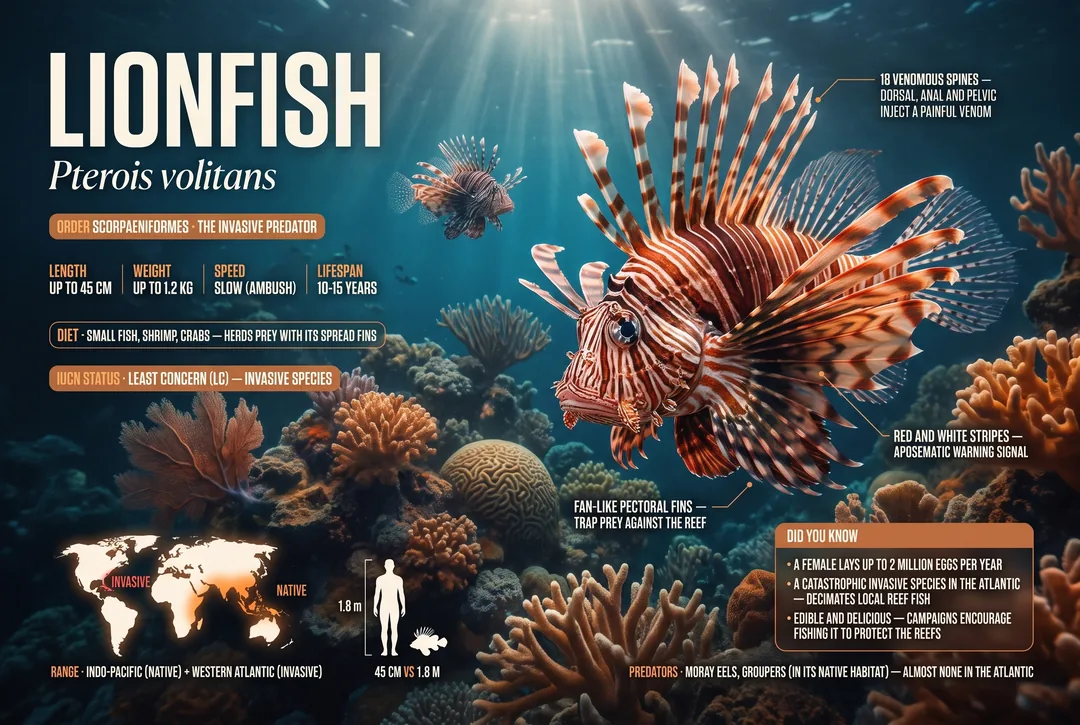
IDENTITY CARD
| Classification | Order Scorpaeniformes, family Scorpaenidae |
| Scientific name | Pterois volitans (Linnaeus, 1758) |
| Size | Up to 38 cm (average: 25-30 cm) |
| Weight | Up to 1.2 kg |
| Speed | Slow swimmer — ambush and stealth approach |
| Lifespan | 10-15 years |
| Depth | 1 to 300 m, typically between 5 and 40 m |
| Diet | Predator — small fish, shrimp, crustaceans — can swallow prey up to half its own size |
| IUCN Status | Least Concern (LC) in its native range — major invasive species in the Western Atlantic and Caribbean |
PORTRAIT
The lionfish is a swimming paradox. It is stunningly beautiful — fins unfurled like fans, alternating red and white stripes, the bearing of a baroque dancer — and at the same time, it ranks among the most destructive invasive species in modern marine history.
In its native range — the Western Pacific and the Indian Ocean — Pterois volitans is a discreet reef dweller, kept in check by natural predators such as groupers, moray eels, and sharks. In the Atlantic, where it was accidentally introduced in the 1980s — most likely by aquarium hobbyists in Florida — it has become a scourge. With no predators and explosive reproductive capacity (a single female can release up to 2 million eggs per year), it colonized the entire eastern seaboard of the United States, the Gulf of Mexico, and the Caribbean in under 20 years — one of the fastest marine invasions ever documented.
For divers, the lionfish remains a mesmerizing subject. Its gliding flight above the reef, its venomous spines fanned out like a permanent warning, the way it corners small fish against the coral before inhaling them in a single gulp — everything about this animal is calibrated for predatory efficiency.
HOW TO RECOGNIZE IT
The lionfish is instantly identifiable. Its laterally compressed body bears alternating vertical bands of red (or brown) and white. The pectoral fins are spectacularly developed — long rays connected by translucent membranes, spread wide like fans. The dorsal fin carries 13 venomous spines, the pelvic fins 2, and the anal fin 3 — a total of 18 needles loaded with a protein-based venom that is intensely painful but rarely fatal to humans.
Two lionfish species inhabit the Indo-Pacific zone: P. volitans (the more common, with 13 dorsal rays) and P. miles (12 dorsal rays, native to the Indian Ocean). Telling them apart underwater is virtually impossible — only a ray count, which requires close inspection, separates them. In the Atlantic, invasive populations are predominantly P. volitans.
Behavior is the most reliable tell: the lionfish is one of the few reef fish that does not flee from a diver. It remains motionless or drifts away very slowly, confident in its venomous defenses. That confidence makes it supremely photogenic — and easy to spear for population-control programs.
For subtitles in English: start the video firstthen click the gearat the top right of the video, select “Subtitles/CC”, then “Auto-translate” and choose “English”.
WAY OF LIFE
The lionfish is a crepuscular and nocturnal predator. At dawn and dusk, it leaves its shelter — a coral overhang, a wreck, a crevice — and patrols the reef with its pectoral fins fully deployed. Its technique: it uses those fan-shaped fins to herd small fish into coral corners, then engulfs them with a lightning-fast suction strike — its protrusible mouth creates a vacuum capable of inhaling prey from several centimeters away in mere milliseconds.
The lionfish's stomach is expandable: it can swallow prey measuring 50 % of its own body length. Its appetite is proportional — on invaded Caribbean reefs, a single lionfish can reduce juvenile fish recruitment by 79 % in just five weeks.
Reproduction is prolific. Females reach maturity at around one year and spawn every 3-4 days under optimal conditions, releasing gelatinous egg masses that drift in open water. Larvae are pelagic for 25-30 days, dispersed by currents across vast distances — which explains the blistering speed of the Atlantic invasion.
The venom, contained in the dorsal, pelvic, and anal spines, is a cocktail of neurotoxins and cytotoxins. A sting is excruciatingly painful — likened to a hornet sting but ten times more intense — and can cause nausea, dizziness, and localized paralysis. Emergency treatment: immerse the wound in the hottest water you can tolerate (45 degrees C) — the heat denatures the venom proteins.
WHERE TO SEE IT
The lionfish inhabits most tropical and subtropical reefs worldwide. In its native range, it is a discreet reef resident; in invaded waters, it is everywhere.
Red Sea — Egypt. The Red Sea is one of the best places on Earth to observe the lionfish in its natural habitat. The reefs of Ras Mohammed, Tiran, Dahab, and the Brothers shelter spectacular specimens, often tucked beneath overhangs and inside reef cavities. Night dives offer the finest sightings — the animal is actively hunting.
Indonesia — Komodo, Raja Ampat, Lembeh. In the Coral Triangle, the lionfish is common but inconspicuous, held in check by its natural predators. The sites of Lembeh Strait are ideal for macro photography — individuals perch on colorful sponges in picture-perfect compositions.
Thailand — Similans, Koh Tao. The walls of the Similans (Koh Bon, Koh Tachai) and Koh Tao's dive sites harbor lionfish beneath coral overhangs and inside caves.
Maldives. Common on thilas and drop-offs, often hanging upside down beneath overhangs with fins fully spread.
Caribbean — Bonaire, Cozumel, Belize. In invaded waters, the lionfish is omnipresent. Bonaire has implemented one of the most active control programs in the world — divers are encouraged to hunt lionfish by spear (with a permit). Cozumel and Belize offer abundant sightings on every reef between 5 and 40 m.
OBSERVATION CALENDAR
| Destination | J | F | M | A | M | J | J | A | S | O | N | D |
|---|---|---|---|---|---|---|---|---|---|---|---|---|
| Red Sea (Egypt) | ||||||||||||
| Indonesia (Lembeh) | ||||||||||||
| Thailand (Similans) | ||||||||||||
| Maldives | ||||||||||||
| Caribbean (Bonaire) |
Click each button to show/hide
CONSERVATION
Pterois volitans is classified as Least Concern (LC) in its native range but poses a major ecological threat in the Western Atlantic, the Caribbean Sea, and the Gulf of Mexico. Since its introduction (around 1985), the species has colonized more than 7 million square kilometers of reefs where it has no natural predators.
The impact is documented and severe: a 65 to 95 % reduction in juvenile reef-fish biomass on some invaded sites, competition with native predators (groupers, snappers), and disruption of food chains. The lionfish preys on herbivorous fish that keep algae in check — without them, algae smother the coral, and the reef dies.
The only effective control method to date: spearfishing by divers. Several Caribbean islands have launched "lionfish derbies" — hunting competitions that combine awareness, citizen science, and gastronomy (lionfish flesh, once the spines are removed, is excellent).
Organizations to support:
- REEF — Reef Environmental Education Foundation — hunting and monitoring program across the United States and Caribbean
- Lionfish University — training and certification for lionfish hunting
- NOAA Lionfish Portal — scientific tracking of the invasion
- PADI AWARE — awareness and action against invasive species
3 THINGS YOU PROBABLY DON'T KNOW
1. The invasion probably started with 6 individuals. Population genetics analyses have shown that the entire invasive Atlantic population descends from an extremely small founding group — perhaps 6 to 8 females released into Biscayne Bay, Florida, in the mid-1980s, most likely by aquarium hobbyists. From those few individuals, millions of descendants colonized an entire ocean in 20 years.
2. It hunts with water jets. The lionfish fires jets of water at its prey to disorient them before sucking them in. This "water-jet hunting" behavior, documented in 2014, is rare among fish and speaks to an unusual level of predatory sophistication for an animal of this size.
3. You can eat it — and it is delicious. The "Eat 'em to beat 'em" campaign encourages lionfish consumption as a tool for invasion control. The venom is confined to the spines — the flesh is white, delicate, comparable to snapper or grouper. Restaurants across the Caribbean and Florida now serve lionfish as ceviche, tacos, or grilled. Every plate is an act of conservation.
PHOTO AND VIDEO TIPS
The lionfish is one of the most photogenic subjects on the reef: motionless, colorful, symmetrical, and cooperative. It does not flee.
Lens. Macro (60-100 mm) for tight portraits showing fin and eye detail. Wide angle (fisheye) for compositions that include the reef, especially when the animal sits beneath an overhang with backlight streaming from behind.
Lighting. Two strobes positioned laterally at 45 degrees are ideal. Side lighting brings out the translucency of the membranes between the rays — the effect is spectacular. In backlit setups (a cave opening behind the animal), switch off the strobes and play with the silhouette for a dramatic rendering.
Night diving. The best moment. The lionfish is actively hunting, fins spread wide, eyes glinting in the beam of your torch. Colors appear more vivid under artificial light than in natural daylight. Approach slowly, with a narrow beam to avoid startling it.
Composition. Look for specimens positioned against graphic backgrounds: a colorful sponge, a sea fan, black coral. The animal does not move — you have time to frame. Head-on portraits with the pectoral fins symmetrically spread are the most striking.
Safety. Keep your distance from the spines. A photographer focused on framing can get stung by accidentally brushing a neighboring rock where another lionfish was hiding. Always check your immediate surroundings before settling into position.