Toco Toucan
Ramphastos toco
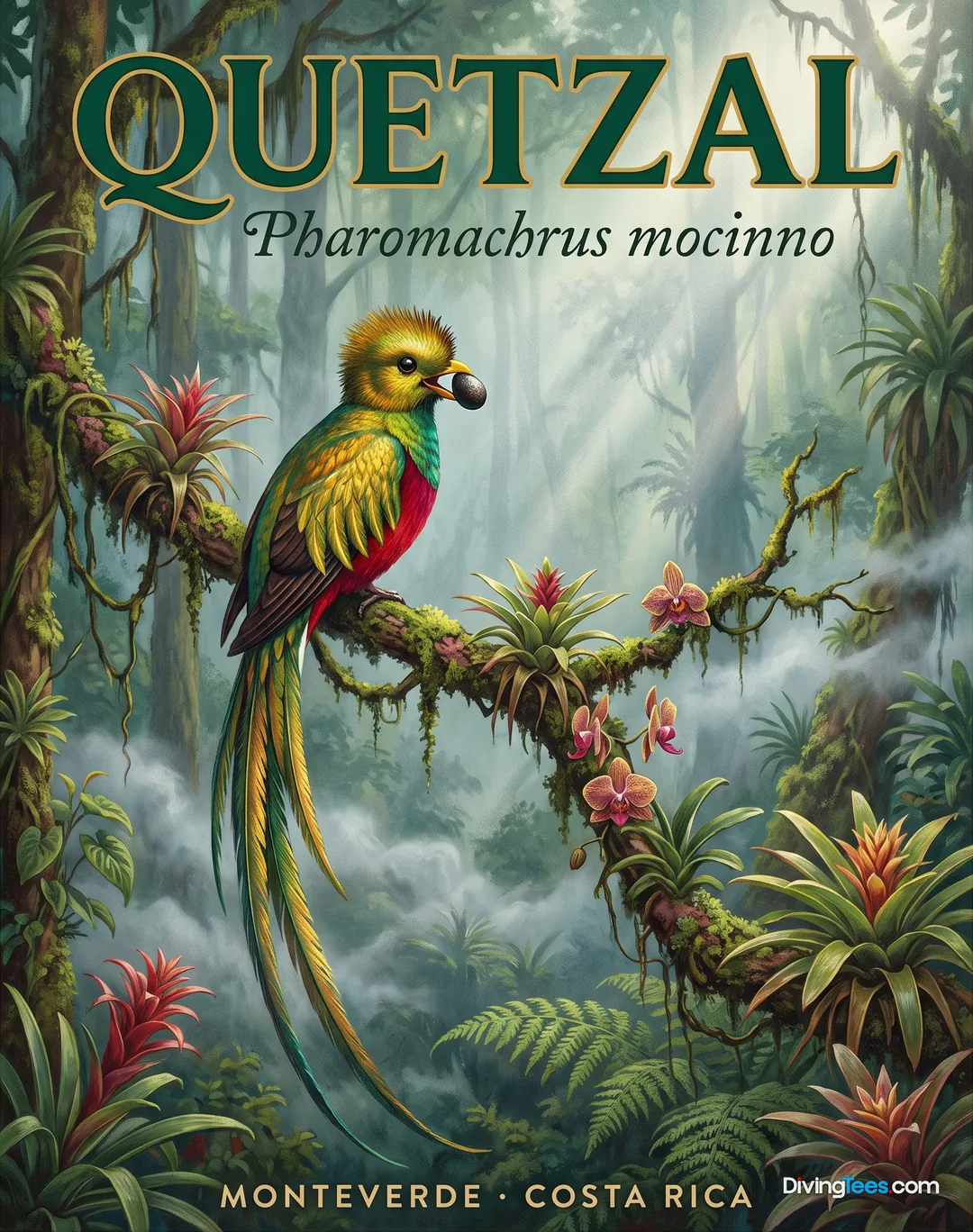
The largest of the toucans carries an orange bill a third of its body length — and it is far easier to find than the quetzal for a diver on a Latin American stopover.
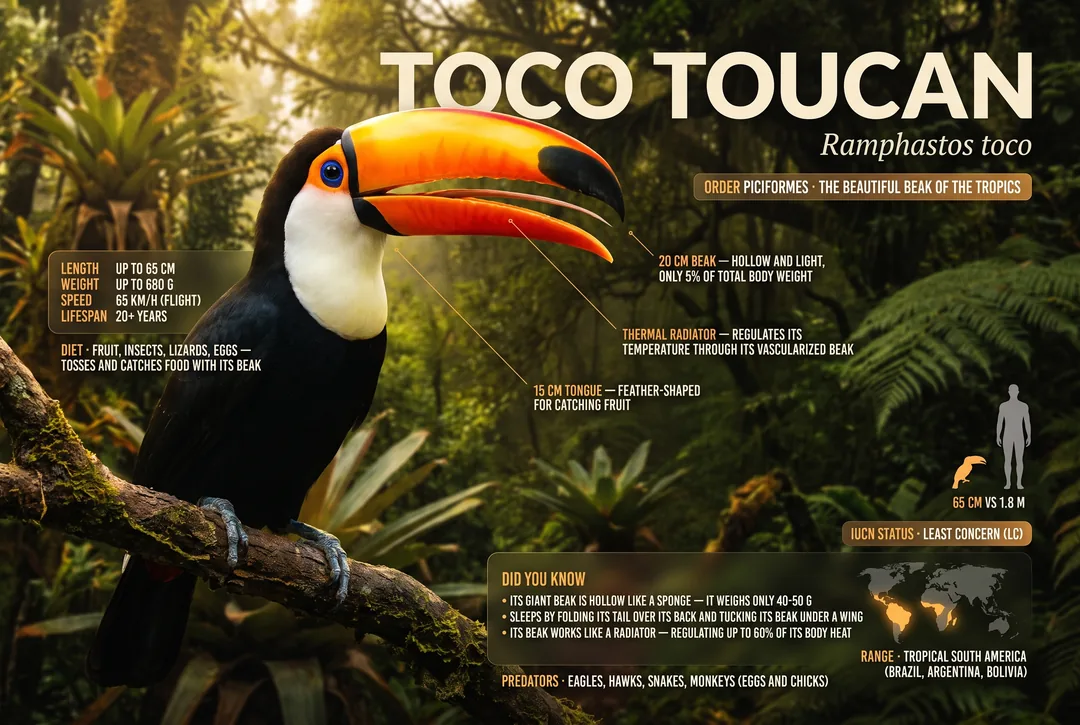
IDENTITY CARD
| Classification | Order Piciformes, family Ramphastidae |
| Scientific name | Ramphastos toco (Statius Muller, 1776) |
| Size | 55-65 cm (of which 20 cm is bill) |
| Weight | 500-860 g |
| Speed | Undulating flight, relatively slow — 40-55 km/h |
| Lifespan | 15-20 years in the wild |
| Depth | Terrestrial — tropical forests, wooded savannas, from sea level to 1,800 m |
| Diet | Omnivore — fruit (60-70% of diet), insects, eggs, nestlings, small reptiles |
| IUCN Status | Least Concern (LC) |
PORTRAIT
The toco toucan is the most recognisable bird in South America. Its vivid orange bill, edged in black, disproportionately large compared to the body, has become the emblem of the American tropics — printed on cereal boxes, travel posters, and logos for the better part of a century. But behind the advertising icon lies an animal whose biology is far more subtle than its image suggests.
The bill, which measures up to 20 cm (one third of the bird's total length), is in fact extraordinarily light — its honeycomb structure of keratin, reinforced with bony fibres, weighs barely 50 grams. It serves as a thermal radiator (the blood vessels irrigating it can dissipate body heat), as a long-reach harvesting tool (for plucking fruit from branches too thin to bear the bird's weight), and as a weapon of intimidation against predators and competitors.
For the diver on a trip, the toco toucan is the most rewarding terrestrial observation in Latin America. Unlike the resplendent quetzal, which demands a high-altitude expedition and a specialist guide, the toco toucan is easily observed in the semi-open landscapes of Brazil, Paraguay, Argentina, and Bolivia — often from the lodge terrace between dives. Brazilian dive destinations (Fernando de Noronha, Bonito, Abrolhos) all lie within the toco toucan's range.
HOW TO RECOGNIZE IT
The toco toucan is immediately identifiable — no other bird in South America looks anything like it. The body plumage is black on the back, wings, and tail, with a white throat bordered by a thin red line. The rump is white, the undertail coverts red. The orbital ring is bare skin of a vivid cobalt blue — a detail that photographs do not always render well.
The bill is the absolute diagnostic feature. In the toco toucan, it is vivid orange with an oval black spot at the distal tip. In juveniles, the bill is shorter and duller, but already recognisable.
It should not be confused with other toucans: the keel-billed toucan (Ramphastos sulfuratus, Central America) has a green, red, and orange bill; the channel-billed toucan (Ramphastos vitellinus) has a shorter, multicoloured bill. The toco toucan is the only one with an almost entirely orange bill, and it is the largest of all.
In flight, the silhouette is characteristic: the bill creates an elongated profile, the short, rounded wings beat rapidly between long phases of undulating glide. The flight is noisy — you hear the wingbeats before you see the bird.
For subtitles in English: start the video firstthen click the gearat the top right of the video, select “Subtitles/CC”, then “Auto-translate” and choose “English”.
WAY OF LIFE
The toco toucan is the only toucan that does not live exclusively in dense forest. It prefers the cerrado (wooded savannas), forest edges, gallery forests along rivers, plantations, and even urban parks. This adaptability explains why it is far easier to observe than its forest-dwelling cousins.
The diet is dominated by fruit — mangoes, papayas, wild figs, palm fruits — which the toucan plucks with the precision of a pair of forceps at the end of its elongated bill. The bird swallows the fruit whole and regurgitates the seeds intact, playing a crucial role as a seed disperser in tropical ecosystems. The diet is supplemented by insects, spiders, eggs and nestlings stolen from other nests, and occasionally small lizards and frogs.
The toco toucan nests in tree cavities — often enlarged woodpecker holes. The pair lays 2-4 white eggs, incubated by both parents for 17-18 days. The chicks hatch naked, blind, with a tiny bill that does not reach its final proportions until 4-5 months. The family stays together — toucans are social birds that move in groups of 6 to 12 individuals, roosting packed together in the same cavity at night, bills folded over their backs.
The thermoregulatory behaviour of the bill is fascinating. The blood vessels in the bill can be dilated (to dissipate heat during the day) or constricted (to conserve it at night). Thermal imaging shows that the bill radiates intensely at sunset, then cools abruptly — the toucan uses its bill as a radiator it can switch off.
WHERE TO SEE IT
Pantanal — Brazil. The largest wetland in the world is the best site on Earth for the toco toucan. Lodges along the Transpantaneira (the causeway road crossing the wetland) offer daily sightings, often from the breakfast terrace. The toucans come to feed in mango trees and palms just metres from the buildings. The Pantanal is combinable with Bonito (freshwater diving, crystal-clear river snorkelling).
Iguazu — Argentina / Brazil. Iguazu National Park (Argentine side) and Foz do Iguacu National Park (Brazilian side) harbour several toucan species, including the toco toucan. The park trails along the edge of the Atlantic Forest offer regular sightings. The Iguazu Falls are a classic excursion between dive trips on the Brazilian coast.
Chapada dos Guimaraes — Brazil. The Chapada dos Guimaraes National Park, in Mato Grosso, combines cerrado, red sandstone cliffs, and waterfalls. The toco toucan is common here. Accessible from Cuiaba, the gateway to the Pantanal.
Bonito — Brazil. The capital of Brazilian ecotourism, in Mato Grosso do Sul, is known for its river snorkelling (crystal-clear waters, schools of freshwater fish). The toco toucan is regularly spotted in the surrounding reserves and lodges. The combination of snorkelling and birdwatching makes Bonito a unique site.
Los Llanos — Venezuela / Colombia. The flooded plains of the Llanos, on both banks of the Orinoco, harbour dense toucan populations. Access is more difficult than the Pantanal, but the wildlife is comparable.
OBSERVATION CALENDAR
| Destination | J | F | M | A | M | J | J | A | S | O | N | D |
|---|---|---|---|---|---|---|---|---|---|---|---|---|
| Pantanal (Brazil) | ||||||||||||
| Iguazu (Argentina/Brazil) | ||||||||||||
| Bonito (Brazil) | ||||||||||||
| Chapada dos Guimaraes |
Click each button to show/hide
The toco toucan is resident and visible year-round. The dry season (May--October in central Brazil) offers better observation conditions: vegetation is thinner, birds concentrate around water sources, and light is better for photography.
CONSERVATION
Ramphastos toco is listed as Least Concern (LC) by the IUCN, with a global population estimated at several million individuals. The species is not globally threatened thanks to its great adaptability — it tolerates modified environments (plantations, urban parks, agricultural areas) far better than other toucans.
The main threat remains deforestation of the Brazilian cerrado, one of the most threatened biomes in the world — more than 50% of the original area has been converted to pasture and soybean cultivation since the 1970s. The toco toucan survives in forest fragments and galleries, but the loss of nesting cavities (large trees felled) limits reproduction in the long term.
The illegal pet trade is a secondary threat. The toco toucan, spectacular and relatively easy to capture, is sold as an exotic pet in South America and, illegally, abroad. Captive individuals rarely survive long — the frugivorous diet is difficult to replicate, and the bill deforms without adequate nutrients.
Organisations to support:
- Instituto de Conservacao de Animais Silvestres (ICAS) — Brazilian wildlife conservation
- WWF Brazil — Pantanal and Cerrado protection
- BirdLife International — species and habitat protection
- Fundacion Vida Silvestre Argentina — conservation in Argentina
3 THINGS YOU PROBABLY DON'T KNOW
1. Its bill is a radiator — and it can switch it off. The toco toucan's bill is irrigated by a dense network of blood vessels that function as a biological radiator. Thermographic imaging has shown that the bill can dissipate up to 60% of the bird's body heat when the vessels are dilated — and that the toucan "switches off" its radiator within minutes at sunset, constricting the vessels to conserve heat through the night. Relative to body surface, it is the most efficient thermoregulatory organ in the animal kingdom — more effective than the elephant's ears.
2. It sleeps in a ball — with its bill turned over its back. To sleep in the cramped space of tree cavities, the toucan folds its bill over its shoulder and rests it on its back, then tucks its tail over the top — transforming itself into a compact ball of feathers. Up to 5-6 toucans stack into the same cavity, packed bill to tail, in a configuration that resembles a 3D puzzle. This behaviour is not just social — it reduces nocturnal heat loss in an enclosed space.
3. Its honeycomb bill has inspired engineers. The internal structure of the toucan's bill — a closed-cell foam of keratin, reinforced by a network of bony fibres, all covered by a rigid outer shell — is a masterpiece of natural engineering. It combines exceptional impact resistance with negligible weight (50 g for 20 cm). Teams at MIT and the University of San Diego have studied it to design ultra-lightweight composite materials for aeronautics and protective helmets.
PHOTO AND VIDEO TIPS
The toco toucan is a terrestrial subject of open woodland — accessible, cooperative, and spectacular.
Lens. Telephoto 200-400 mm for ground-level observations. At a lodge (Pantanal, Bonito), a 70-200 mm is often sufficient — toucans come to feed at 5-15 metres. The bill demands a tight framing to reveal the colour and texture detail — the portrait at 300 mm is the classic image.
Light. Morning light (6-8 AM) and late afternoon (4-6 PM) is ideal. The orange bill blazes in warm light — in harsh midday sun, it is overexposed and flat. A dark canopy background, in controlled backlight, makes the bill glow like a lantern.
Composition. The signature image is the strict profile portrait, full bill in the frame, with a blurred background (foliage bokeh). The toucan in flight is spectacular but hard to capture — the undulating flight is fast and unpredictable. Wait for the bird perched, in profile, a fruit in its bill: that is the photograph.
Behaviour. Watch fruit trees and ripe palms — toucans return every day at the same times. Pantanal lodges that maintain fruit feeders attract toucans at a predictable distance — position and timing are reproducible day after day.