Atlantic Puffin
Fratercula arctica
The clown of the seas only earns that nickname from those who have never watched it dive.
IDENTITY CARD
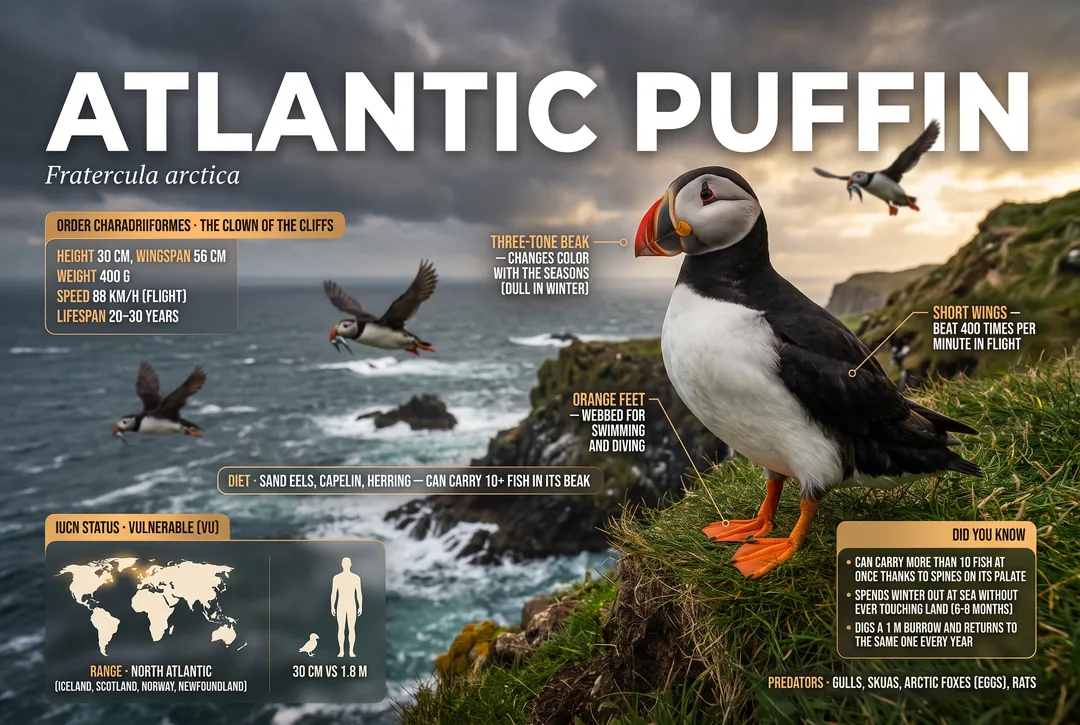
| Classification | Order Charadriiformes, family Alcidae |
| Scientific name | Fratercula arctica (Linnaeus, 1758) |
| Size | 26 to 29 cm; wingspan 47 to 63 cm |
| Weight | 310 to 500 g |
| Speed | Up to 88 km/h in flight (wing-beat rate: ~400 per minute) |
| Lifespan | 20 to 30 years in the wild (record: 40+) |
| Depth | Up to 60 m; usually hunts at 15-30 m |
| Diet | Piscivore — sand eels, sprats, juvenile herring, capelin |
| IUCN Status | Vulnerable (VU) |
PORTRAIT
They call it the clown of the seas, and it is unfair. The Atlantic puffin is no entertainer. It is a bird built for effort — capable of diving to sixty metres in the frigid North Atlantic and slicing through the air at eighty-eight kilometres per hour, beating its wings four hundred times a minute. The nickname comes from its face: a triangular black-and-white mask topped by a massive beak painted in bands of orange, red, and blue-slate — a beak so disproportionate it seems borrowed from another animal entirely. The effect is comical. The bird itself is deadly serious.
Fratercula arctica — "little brother of the Arctic" — is the only Atlantic puffin. Two cousins, the tufted puffin and the rhinoceros auklet, live in the Pacific. This one occupies the windswept cliffs and offshore islets from Iceland to Brittany, Norway to Newfoundland. It is fundamentally a pelagic bird: outside the breeding season it spends months at sea without touching land, sleeping on waves, feeding by diving, invisible to anyone without a research vessel.
The famous beak is not permanent. In autumn, after breeding, the coloured horny plates that sheath the bill fall off. The winter beak is smaller, duller, almost unrecognisable. Ornithologists who first described the bird in winter plumage thought they were looking at a different species. The puffin does not disguise itself — it undresses.
HOW TO RECOGNIZE IT
At sea, look for a compact silhouette flying fast and low over the waves with frantic, almost desperate wing-beats. There is no soaring grace here — the puffin flies as if perpetually about to fall. Its wings, adapted primarily for underwater propulsion, are too short for comfortable flight. This is the classic alcid compromise: excellent swimmers, laborious fliers.
On land in breeding plumage (April to August), the bird is unmistakable. White belly, black back and cap, vivid orange feet, and the tricolour beak — bands of orange, red, and blue-slate separated by ridged lines — that has launched a thousand postcards. In winter the face darkens, the orbital ornaments shrink, and the beak loses both size and colour, becoming a smaller, muted version of its summer self.
Underwater, the puffin literally flies — using its wings as flippers with the same rowing motion it employs in the air, orange webbed feet trailing behind as a rudder. It is startlingly quick, and watching one hunt through a shoal of sand eels is a reminder that the "clown" label does the animal no justice at all.
For subtitles in English: start the video firstthen click the gearat the top right of the video, select “Subtitles/CC”, then “Auto-translate” and choose “English”.
WAY OF LIFE
The Atlantic puffin leads a double life. From September to March it is a solitary oceanic wanderer, riding the cold swells of the North Atlantic hundreds of kilometres from the nearest coast. Then, in spring, it returns by the thousand to the same natal cliffs it has used for years — sometimes for decades.
It nests in burrows dug into soft, peaty soil atop sea cliffs — the only European seabird that excavates its own nesting chamber. Pairs are monogamous and often faithful across many breeding seasons, reuniting at the same burrow each spring with an elaborate mutual bill-tapping display known as "billing." A single egg is laid. Both parents share incubation duties for approximately six weeks.
The fishing technique is the puffin's most celebrated feat. It dives from the surface, catches fish one by one, and lines them crosswise in its beak — using a rough tongue and serrated palatal denticulations as a rack to hold each catch while seizing the next. The record is sixty-two sand eels in a single beakful. A typical load is ten to twenty fish, fanned out like a hand of cards, silver bodies glinting on either side of the orange bill. It is one of the most iconic images in ornithology — and one of the most mechanically improbable.
WHERE TO SEE IT
The Atlantic puffin breeds on North Atlantic coasts and islands from roughly 43 N to 80 N. Outside the breeding season, it is virtually impossible to observe — lost somewhere on the open ocean. The window is narrow: arrive in spring, leave by late summer.
Iceland — Vestmannaeyjar and Latrabjarg. Iceland holds the largest puffin population on Earth — millions of breeding pairs, more than half the world total. Vestmannaeyjar (the Westman Islands) is the epicentre. Latrabjarg, the westernmost point of Europe, offers the rarest experience: puffins nesting at arm's length along the cliff edge, seemingly indifferent to human visitors. May to mid-August; peak June and July.
Norway — Runde and Lofoten. The island of Runde hosts approximately 100,000 breeding pairs on its western sea cliffs. The Lofoten archipelago offers a more spectacular setting — puffins against a backdrop of jagged Arctic mountains rising straight from the sea. May to August.
Scotland — Lunga and Isle of May. Lunga, in the Treshnish Isles, is the most photographed puffin site in the United Kingdom — the birds are remarkably tame and nest among wildflowers just steps from the landing point. The Isle of May, a national nature reserve in the Firth of Forth, provides a more managed experience with boardwalks and research stations. April to end of July.
Newfoundland — Witless Bay. The largest North American colony, with approximately 260,000 breeding pairs nesting on islands in the Witless Bay Ecological Reserve. Observation is by boat only — landings are not permitted. The advantage is the marine context: puffins seen from the water, flying to and from the colony with beaks full of capelin, often alongside humpback whales feeding on the same baitballs. May to September; peak June and July.
Brittany — Sept-Iles. The only breeding site in France. Roughly 150 to 200 pairs nest on the Sept-Iles archipelago, managed by the LPO (Ligue pour la Protection des Oiseaux) since 1912. It is the southernmost puffin colony on the European Atlantic coast. Boat observation from Perros-Guirec; no landing on the breeding islands.
OBSERVATION CALENDAR
| Destination | J | F | M | A | M | J | J | A | S | O | N | D |
|---|---|---|---|---|---|---|---|---|---|---|---|---|
| Iceland (Vestmannaeyjar) | ||||||||||||
| Iceland (Latrabjarg) | ||||||||||||
| Norway (Runde) | ||||||||||||
| Norway (Lofoten) | ||||||||||||
| Scotland (Lunga) | ||||||||||||
| Scotland (Isle of May) | ||||||||||||
| Newfoundland (Witless Bay) | ||||||||||||
| Brittany (Sept-Iles) |
Click each button to show/hide
CONSERVATION
The Atlantic puffin has been listed as Vulnerable (VU) on the IUCN Red List since 2015. The global population is estimated at 12 to 14 million individuals, but it is declining — most steeply in Iceland, which holds more than half the world total.
The principal threat is climate change, operating through a deceptively simple mechanism. As North Atlantic waters warm, sand eel populations — the puffin's staple prey — shift northward. Breeding adults must fly ever farther from the colony to find food for their chick. In good years, the extra distance is manageable. In poor years, adults return too rarely, too light, and chick survival collapses. The species is protected under the EU Birds Directive and Bern Convention Annex III.
Other threats compound the problem. Gillnet bycatch drowns birds that dive into fishing nets. Light pollution on coastal developments disorients fledglings making their first flight to the sea. Introduced predators — rats, American mink — devastate ground-nesting colonies on islands where they gain a foothold. Oil spills, though rarer, remain catastrophic for pelagic birds that spend their lives on the water surface.
Traditional net-catching of puffins persists in Iceland but is declining as both the practice and the population contract. On breeding cliffs, responsible observation means staying on marked paths — trampling the thin turf above a burrow can collapse the nesting gallery — and leaving drones on the boat.
Organisations to support:
- RSPB — seabird monitoring and habitat protection across the UK
- LPO — management of the Sept-Iles reserve, France's only puffin colony
- BirdLife International — global population tracking and marine Important Bird Area designation
- Project Puffin (Audubon) — pioneering puffin reintroduction in the Gulf of Maine since 1973
3 THINGS YOU PROBABLY DON'T KNOW
1. Its beak is fluorescent. Discovered in 2018: under ultraviolet light, the puffin's beak emits a vivid blue-white fluorescence along the ridged crests. Birds see well into the UV spectrum, so what looks like a painted bill to us is almost certainly a glowing signal to them — likely playing a role in courtship and partner recognition in the dim light of dawn and dusk. The puffin does not merely have colour. It glows in the dark.
2. It digs with its feet, not its beak. Despite owning one of the most impressive beaks in the bird world, the puffin excavates its burrow with its clawed feet, shovelling earth behind it like a rabbit. The beak pulls roots and clears stones, but the heavy digging is done by the legs. Burrows average 70 cm to 1.1 m in length, sometimes reaching 2 m. The nesting chamber at the end is lined with feathers and dry grass — a modest comfort after weeks of excavation.
3. Fledglings leave alone, at night, having never seen the sea. The chick — called a puffling — is fed in the burrow for approximately six weeks, then abandoned by both parents. After several days of fasting, it emerges alone, at night, and makes its way toward a sea it has never seen. In Iceland's Vestmannaeyjar, disoriented fledglings are drawn to the town's street lights and land in streets, gardens, and car parks instead of reaching the ocean. Every August, local children go out with cardboard boxes, collect the stranded pufflings, and release them on the coast at dawn. The tradition — part rescue operation, part community ritual — saves thousands of birds each year.
PHOTO AND VIDEO TIPS
The Atlantic puffin is one of the most photogenic seabirds alive, and several of its breeding sites are so accessible that a good image is almost guaranteed. The challenge is making yours stand out from the millions already taken.
Lens. A telephoto in the 100-400 mm range is the workhorse. At tame sites like Lunga or Latrabjarg, a 70-200 mm — or even a 50 mm prime — is sufficient: the birds stand so close that a longer lens becomes a liability. At boat-only sites like Witless Bay, 400 mm or more is essential.
Light. Golden hour provides the warmth the beak deserves. But overcast conditions — common across the puffin's entire range — can be better for plumage detail, softening the stark black-and-white contrast and revealing texture in the back feathers that harsh sun obliterates.
Approach. Sit and wait. On cliff-top sites, choose a position near a well-used landing area, lower yourself to ground level, and stay still. The birds will walk past within a metre, carrying on their business as if you were a rock. Direct pursuit scatters them and collapses burrows.
The money shot. A puffin returning from a fishing trip with a beak full of sand eels — the silver fan against the orange bill, spray still trailing from the feet. It requires patience: the bird arrives fast and low, and you will miss the first ten before you learn the timing. Pre-focus on a known landing spot and shoot in continuous burst as the bird approaches.
Common mistake. Framing nothing but tight portraits. A puffin's head fills the frame beautifully, but it tells no story. A puffin standing on a flower-covered cliff — sea thrift, red campion — with the Atlantic stretching behind it says infinitely more. Think context: the colony, the flight, the clumsy landing, the billing couple. The bird is always the subject; the landscape is what makes it unforgettable.