Blue-footed Booby
Sula nebouxii
Its feet are an impossible blue. Its dance is absurd. Its plunge dive is perfect.
IDENTITY CARD
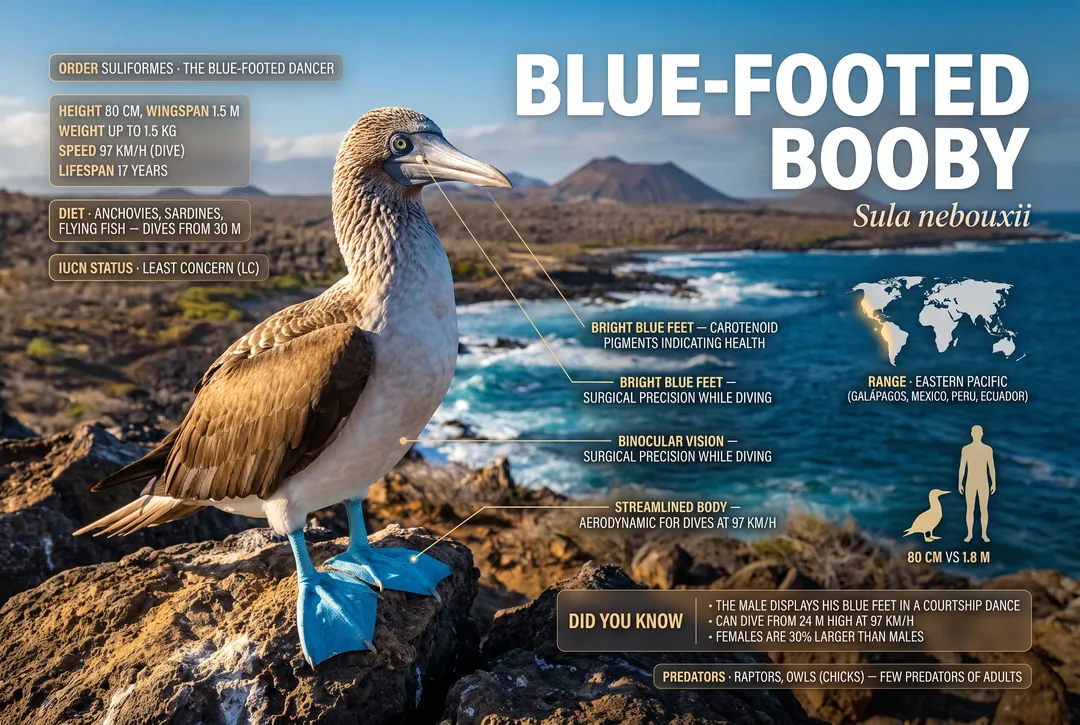
| Classification | Order Suliformes, family Sulidae |
| Scientific name | Sula nebouxii (Milne-Edwards, 1882) |
| Size | 76 to 84 cm in length, wingspan of 1.50 m |
| Weight | 1.5 kg (female slightly heavier than the male) |
| Speed | Up to 97 km/h on entry into the water |
| Lifespan | 15 to 20 years |
| Depth | Dives to 25 m, hunts primarily between 0 and 12 m |
| Diet | Piscivore — sardines, anchovies, mackerels, flying fish, squid |
| IUCN Status | Least Concern (LC) — population estimated at approximately 80,000 breeding pairs |
PORTRAIT
You do not forget it. Not because of its size, not because of its rarity — because of its feet. A turquoise blue so vivid, so saturated it looks painted on. The blue-footed booby is one of the most photographed birds in the eastern Pacific, and it has earned the distinction entirely: everything about it seems designed to hold the eye. The impossible color of its webbed feet. The fixed stare of its straw-yellow eyes, ringed in dark. And above all that walk — deliberate, almost theatrical — that it adopts before its mate during the courtship display.
Sula nebouxii is a booby, a seabird of the open ocean, cousin to the northern gannet and the brown booby. The name "booby" comes from the Portuguese bobo — the fool — and refers to the ease with which these birds let themselves be caught by sailors, unable to grasp the danger humans posed. But there is nothing foolish in the way this bird earns its living: it hunts by plunge-diving from heights of twenty to thirty meters, folding its wings a fraction of a second before impact to pierce the surface like a javelin.
It nests on the ground, on arid Pacific islands from the Galapagos to the Gulf of California. It is visible from a boat, from the beach, from a cliff — and, for the divers and snorkelers fortunate enough, from underwater, when a flock begins hammering the surface above a school of sardines.
HOW TO RECOGNIZE IT
The blue-footed booby cannot be confused with any other seabird, provided you see its feet. In flight, it resembles its cousins — a streamlined silhouette, long narrow wings, pointed bill. Perched, the diagnosis is instant: the webbed feet are a bright blue, sometimes tending toward turquoise, sometimes closer to cobalt depending on the individual's health and diet.
The plumage is chocolate brown on top, white on the belly and breast. The head and neck are streaked with brown and white, giving a distinctive striped appearance. The bill, blue-grey, is long, conical, and finely serrated along the edges — an adaptation for gripping fish underwater. The eyes, bright yellow in males, darker in females, are oriented forward, providing the binocular vision essential for judging the distance to a fish during the dive.
Sexual dimorphism is subtle but detectable: the female is slightly larger, her pupils appear broader, and she produces a low, raspy quack, while the male whistles — a high, slightly plaintive whistle audible from far across the colony.
For subtitles in English: start the video firstthen click the gearat the top right of the video, select “Subtitles/CC”, then “Auto-translate” and choose “English”.
WAY OF LIFE
The blue-footed booby is an aerial hunter. It spots prey in flight, from an altitude of 15 to 30 meters, then dives with wings folded tight against its body. Entry into the water can reach speeds of 97 km/h. Subcutaneous air sacs protect the skull from the impact, and the nostrils, fused shut, prevent water from flooding the airways. The catch happens below the surface, usually in the first few meters, sometimes down to 25 m. The bird can remain submerged for several seconds.
Hunting is often collective. When a group spots a fish school, the boobies dive in unison — sometimes dozens of birds in rapid succession, peppering the surface like a rain of projectiles. The spectacle, seen from a boat or from underwater, is riveting.
The courtship display is the other great spectacle. The male plants himself before the female and begins by lifting one foot, then the other, with deliberate slowness — a solemn, unhurried dance, bright blue webbed feet spread in the sunlight. He then offers a stick or a blade of grass, points his bill skyward (sky-pointing), and whistles. The female watches, evaluates, and chooses — or not. Because the color of the feet is not decorative: it is a reliable indicator of the male's physical condition. The blue comes from carotenoid pigments acquired through a diet of fresh fish, and their concentration reflects both the quality of the diet and the absence of parasites. A male with vivid blue feet is a well-fed male. A male with dull feet has slimmer chances.
The female lays two or three eggs directly on the ground, within a circle of guano that marks the territory. Incubation lasts approximately 41 days, shared by both parents — who warm the eggs under their webbed feet, lacking a well-developed brood patch.
WHERE TO SEE IT
The blue-footed booby lives exclusively in the eastern Pacific, from the coasts of Mexico to northern Peru. A handful of destinations concentrate the most accessible colonies:
Galapagos — North Seymour and Espanola. This is where the blue-footed booby became an icon. The archipelago shelters approximately half the world's breeding population. On North Seymour, the birds nest within meters of the trail and allow approach without flushing — their familiarity with humans is total, the animals having no terrestrial predator. Espanola, farther south, hosts the subspecies excisa and offers the combined spectacle of blue-footed boobies, Galapagos albatrosses, and marine iguanas. Courtship displays occur year-round, peaking from June to August.
Mainland Ecuador — Isla de la Plata. Nicknamed "the poor man's Galapagos," this small island off Puerto Lopez harbors a large, easily observed colony accessible via marked trails. The boat ride takes 90 minutes, and the excursion is often combined with humpback whale watching from June to September. A realistic alternative for those unable to reach the Galapagos.
Mexico — Isla Isabel and Baja California. Isla Isabel, off San Blas (Nayarit), is a national park where thousands of blue-footed boobies nest alongside frigatebirds and brown boobies. Farther north, the Gulf of California — the Sea of Cortez — shelters several island colonies (Isla San Pedro Martir, Isla Espiritu Santo). Divers exploring the sites around La Paz regularly see boobies diving around them.
Peru — Islas Ballestas and the northern coast. The Ballestas, off Paracas, hold only a small colony, but the combined marine fauna — sea lions, Humboldt penguins, pelicans — makes the excursion remarkable. The larger colonies lie farther north, along the coast of Piura and Tumbes, near the Ecuadorian border.
OBSERVATION CALENDAR
| Destination | J | F | M | A | M | J | J | A | S | O | N | D |
|---|---|---|---|---|---|---|---|---|---|---|---|---|
| Galapagos (North Seymour) | ||||||||||||
| Galapagos (Espanola) | ||||||||||||
| Ecuador (Isla de la Plata) | ||||||||||||
| Mexico (Isla Isabel) | ||||||||||||
| Mexico (Baja California) | ||||||||||||
| Peru (Islas Ballestas) |
Click each button to show/hide
CONSERVATION
Sula nebouxii is classified as Least Concern (LC) on the IUCN Red List, with a global population estimated at approximately 80,000 breeding pairs. The species is not globally threatened, but it experiences marked fluctuations, particularly in the Galapagos.
The primary concern is local. The Galapagos breeding population dropped by approximately 50% between the 1960s and the 2010s, falling from 20,000 pairs to fewer than 10,000. The causes are multiple: El Nino events warm the waters and scatter the sardine schools on which the bird depends, triggering massive breeding failures. The decline in fish stocks — linked to industrial overfishing off South America — reduces carotenoid availability and therefore the ability of males to attract mates. The loop is direct: less fish, paler feet, fewer pairs formed, fewer chicks.
Invasive species are the other threat. Rats and cats introduced to certain islands prey on eggs and chicks. Eradication programs led by the Charles Darwin Foundation and the Galapagos National Park have shown encouraging results on treated islands.
The diver or visitor observing blue-footed boobies can contribute by respecting minimum distances (2 meters in the Galapagos), never leaving marked trails in the colonies, and reporting observations via citizen science platforms such as eBird.
Organizations to support:
- Charles Darwin Foundation — research and conservation in the Galapagos
- Galapagos Conservancy — archipelago protection and habitat restoration
- BirdLife International — global monitoring of seabird populations
- Island Conservation — eradication of invasive species on islands
3 THINGS YOU PROBABLY DON'T KNOW
1. Its feet fade within 48 hours without food. The blue color of the webbed feet depends on carotenoid pigments supplied by fresh fish. These pigments are not stored: they circulate in the blood and are constantly renewed. If a booby stops feeding — illness, El Nino, stress — its feet shift to a dull grey-blue in under two days. Females detect this variation and refuse to mate with males whose feet have faded. The color is not an ornament: it is a real-time health bulletin.
2. It practices facultative fratricide. The female typically lays two eggs several days apart. The first chick to hatch is larger and stronger than the second. When food is plentiful, both survive. When it grows scarce, the elder expels the younger from the nest — which then dies of starvation or exposure. This mechanism, called facultative siblicide, is an evolutionary strategy: the mother bets on two chicks when conditions allow, and on one when they do not.
3. Its nostrils are fused shut — it breathes through the corners of its bill. To plunge at 97 km/h without water flooding the airways, the blue-footed booby's external nostrils are completely sealed. Air enters through two narrow slits at the base of the bill, shielded by folds of skin. This adaptation, shared by all Sulidae, also explains why the booby cannot pant to regulate its temperature: it uses gular fluttering instead, a rapid vibration of the throat skin that dissipates heat.
PHOTO AND VIDEO TIPS
The blue-footed booby is a subject of disarming ease — on land. In flight or mid-dive, it is an entirely different matter.
On land (colonies). The bird does not flush. In the Galapagos, it sits a meter from the trail and watches you pass with total indifference. The trap is too much proximity: a 24-70 mm is more than adequate, a 100-400 mm telephoto is unnecessary and cumbersome. Getting down to the animal's level changes everything: blue feet in the foreground, the bird's gaze at eye height, the lava horizon as backdrop. Early morning light (before 9 a.m.) or late afternoon (after 4 p.m.) avoids harsh shadows under the bill.
The courtship display. This is THE scene to capture. The male lifts his feet in slow motion — each step lasts several seconds. In burst mode, the full sequence can be recorded. The sky-pointing gesture (bill toward the sky, wings slightly spread) is the most photogenic moment. Remain still and at a respectful distance: the bird will not interrupt its display if you do not move.
The plunge dive. Far more difficult. From a boat, a stabilized 70-200 mm at a shutter speed of at least 1/2000 s freezes the entry into the water. From below the surface, the spectacle is extraordinary but unpredictable: white torpedoes punch through the surface, brake with a stroke of webbed feet, seize a fish, and rocket back up in seconds. An underwater housing with a wide-angle lens and a generous supply of patience are the only tools.
Classic mistake. Forgetting the feet. Subject number one is the blue. Framing the entire bird without including the feet in the composition is missing the essential. The best shots are often the simplest: a tight crop on two blue feet planted on black rock.