Resplendent Quetzal
Pharomachrus mocinno
The bird-god of the Maya wears a one-metre emerald train — and remains one of the hardest sightings to earn in a cloud forest.
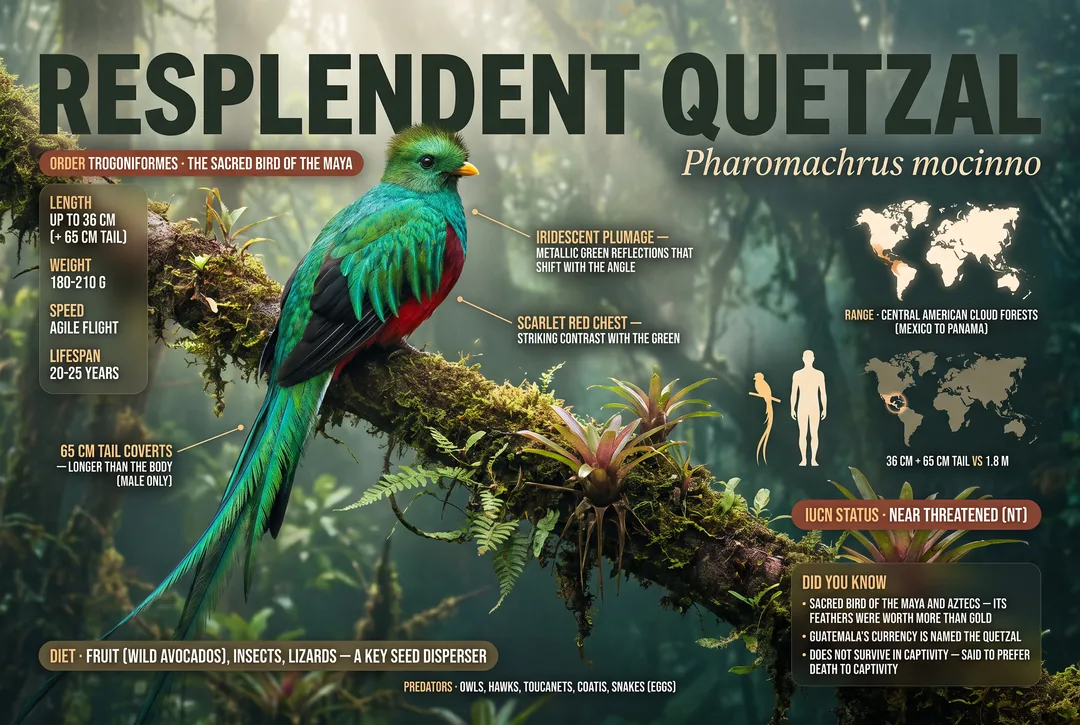
IDENTITY CARD
| Classification | Order Trogoniformes, family Trogonidae |
| Scientific name | Pharomachrus mocinno (de la Llave, 1832) |
| Size | 36 cm (body), up to 65 cm upper tail coverts in males (total train: 1 m) |
| Weight | 180-210 g |
| Speed | Undulating flight, not timed — fast and agile among the trees |
| Lifespan | 15-20 years in the wild |
| Depth | Terrestrial — cloud forests between 1,500 and 3,000 m elevation |
| Diet | Primarily frugivore — wild avocados (Lauraceae), small fruits, insects, lizards |
| IUCN Status | Near Threatened (NT) |
PORTRAIT
The resplendent quetzal is probably the most sacred bird on the American continent. The Maya and the Aztecs venerated it as the incarnation of Quetzalcoatl, the feathered serpent — a god of creation and wind. Its tail feathers were worth more than gold: killing a quetzal was punishable by death. Today, the quetzal appears on the flag and the currency of Guatemala, of which it is the national symbol.
The bird's beauty defies description. The breeding male is an iridescent emerald green on the back, head, and chest, with a crimson belly. The head bears a crest of dishevelled green feathers. But the most spectacular feature is the train — two elongated upper tail coverts, green and blue, that ripple behind the bird in flight like two silk ribbons. These feathers can measure 65 cm, doubling the animal's total length.
For the diver on a trip, the quetzal is a high-altitude bonus. Central American dive destinations (Belize, Honduras, Costa Rica) are all within driving distance of the cloud forests where it lives. A one-day excursion between two dive trips can deliver one of the most memorable birdwatching experiences in the world.
HOW TO RECOGNIZE IT
The breeding male is immediately identifiable — no other bird in Central America combines iridescent green, a red belly, and a disproportionate train. In flight, the silhouette is unique: the compact body vanishes behind the green ribbons undulating in the air.
The female is more subdued: green on the back, grey on the chest, with a duller red belly and no train. The head carries a reduced crest. The outer tail feathers are barred black and white, visible in flight.
The bill is short, broad, and yellow — adapted for grasping fruit and excavating nest cavities in rotten wood. The legs are short and weak (trogons almost never walk). The iris is dark brown, circled by a bare orbital ring.
In the cloud forest, the quetzal is located by call before it is seen — a soft, fluty, repetitive two-note descending whistle. Local guides locate it by sound and direct visitors to the fruiting tree or active nest cavity. Without a guide, observation is extremely difficult — the iridescent green melts into the foliage.
For subtitles in English: start the video firstthen click the gearat the top right of the video, select “Subtitles/CC”, then “Auto-translate” and choose “English”.
WAY OF LIFE
The resplendent quetzal lives in the cloud forests of Central America, between 1,500 and 3,000 m elevation — a misty, mossy, cool (10-20 C), perpetually damp ecosystem. These forests rank among the most threatened habitats on the planet.
The diet is dominated by fruits of the Lauraceae family — miniature wild avocados for which the quetzal is one of the primary seed dispersers. The bird swallows the fruit whole, digests the flesh, and regurgitates the intact pit, often far from the parent tree. This ecological relationship makes the quetzal a key player in forest regeneration.
Breeding is the event that makes observation possible. The male excavates a nest in a rotten trunk (often a standing dead tree) 5-15 m above the ground. The pair alternates incubation of 1-3 pale-blue eggs over 17-19 days. The male's train, too long for the cavity, sticks out through the entrance hole — a first-rate photographic spectacle. Parents feed the chicks insects, lizards, and small fruits for 3-4 weeks.
The quetzal undertakes altitudinal migration: after breeding (March--June), it descends to lower elevations (800-1,200 m) where fruit is more abundant. This behaviour complicates conservation — protecting the nesting site is not enough if the lower-elevation feeding habitat is destroyed.
WHERE TO SEE IT
Monteverde — Costa Rica. The Monteverde Biological Reserve and its surroundings (Santa Elena, Curi-Cancha) are the world's most accessible site for quetzal observation. Local guides know the fruiting trees and active nests, and success rates are high from January to May. Access is easy from San Jose (4-hour drive).
Biotopo del Quetzal — Guatemala. The Mario Dary Rivera Reserve, known as "Biotopo del Quetzal," in the Baja Verapaz mountains, is the country's flagship site. Trails wind through intact cloud forest between 1,800 and 2,300 m. The nesting season (March--May) is most favourable.
San Gerardo de Dota — Costa Rica. The San Gerardo de Dota valley, in the Cordillera de Talamanca, is regarded by many ornithologists as the world's best quetzal site. Local lodges (Savegre, Trogon Lodge) organise daily outings with expert guides. The success rate exceeds 90% in season.
Chiapas — Mexico. The El Triunfo Biosphere Reserve and Lagunas de Montebello National Park in southern Chiapas harbour breeding populations. Less accessible than Costa Rica, but less crowded.
Honduras — La Tigra National Park, Celaque. Honduran cloud forests hold healthy populations. Celaque National Park (Honduras's highest point, 2,849 m) offers good sightings.
OBSERVATION CALENDAR
| Destination | J | F | M | A | M | J | J | A | S | O | N | D |
|---|---|---|---|---|---|---|---|---|---|---|---|---|
| Monteverde (Costa Rica) | ||||||||||||
| San Gerardo de Dota (Costa Rica) | ||||||||||||
| Biotopo del Quetzal (Guatemala) | ||||||||||||
| Chiapas (Mexico) |
Click each button to show/hide
The nesting season (February--June) is by far the best period. The male displays with his train, pairs are faithful to their nest, and guides know the locations.
CONSERVATION
Pharomachrus mocinno is listed as Near Threatened (NT) by the IUCN. The global population is estimated at 20,000-50,000 individuals, in continuous decline.
The principal threat is the destruction of cloud forests. Mountain agriculture (coffee, avocados, pasture) is encroaching at an alarming rate — more than 50% of Central American cloud forests have disappeared over the 20th century. The quetzal needs continuous forest between its high-altitude nesting areas and its lower-elevation feeding grounds — fragmentation severs these corridors and isolates populations.
Poaching for the illegal pet trade exists but remains marginal — the quetzal survives very poorly in captivity (hence the ancient Maya belief that it "prefers death to captivity"). Tourist pressure at nests is an emerging threat: too many visitors around an active nest can cause abandonment.
Organisations to support:
- Monteverde Conservation League — cloud forest protection
- Cloudbridge Nature Reserve — high-altitude reforestation in Costa Rica
- FUNDAECO — cloud forest conservation in Guatemala
- BirdLife International — species and habitat protection
3 THINGS YOU PROBABLY DON'T KNOW
1. Killing a quetzal was punishable by death among the Maya. Quetzal feathers were the most precious currency in pre-Columbian Mesoamerica — more valuable than gold or jade. Priests and kings wore quetzal feather headdresses during ceremonies. The bird was captured alive, plucked of its long tail coverts (which regrow), then released. Killing one was a capital offence. The headdress of Moctezuma II, preserved at the Museum of Ethnology in Vienna, contains more than 400 quetzal feathers.
2. It does not survive in captivity — and the Maya knew it. The resplendent quetzal dies almost invariably in captivity, usually within days to weeks. Attempts at zoo breeding failed for decades. The ancient Maya interpreted this behaviour as a refusal of servitude — the quetzal embodied freedom. Guatemala's currency is called the quetzal, and the local proverb says: "It prefers death to the cage."
3. Its train grows and falls each year — like a deer's antlers. The spectacular upper tail coverts of the male are not permanent. They grow before the breeding season (starting in December), reach maximum length in March--April, and fall after nesting (June--July). The male spends the rest of the year without his train — and without it, he is as inconspicuous as the female. This seasonal cycle explains why the observation window is so narrow.
PHOTO AND VIDEO TIPS
The quetzal is a terrestrial subject of the cloud forest — the rules of underwater photography do not apply, but for the diver-photographer on a side trip, a few keys are essential.
Lens. A 400-600 mm telephoto (or 100-400 mm with a teleconverter). The bird often perches 15-30 m up in the canopy. A tripod or monopod stabilises the framing in low-light conditions — the cloud forest is dark.
Light. The cloud forest is by definition misty and dim. High ISO (3200-6400), maximum aperture, and accept grain that will add atmosphere. Rare breaks of sunlight through the mist create spectacular pools of light on the iridescent plumage. The quetzal's green changes dramatically with the angle of light — the iridescence produces flashes of gold, blue, and emerald on a single bird.
Timing. A nest photography session is the most productive. When the male incubates, his train protrudes from the hole and trembles in the breeze — an iconic image. Returns to the nest with fruit in the bill offer the best flight shots. Arrive at the nest at dawn (5:30-6:30 AM) to maximise chances of capturing the morning exit.
Ethics. Maintain a minimum distance of 15 metres from the nest. Never use direct flash. Never use playback (recorded call broadcast to attract the bird) near a nest — it disrupts incubation. Follow the local guide's instructions — they know the tolerance threshold of each pair.