Greater Flamingo
Phoenicopterus roseus
The most photographed bird of the tropical lagoons owes its colour to what it eats — and is born white.
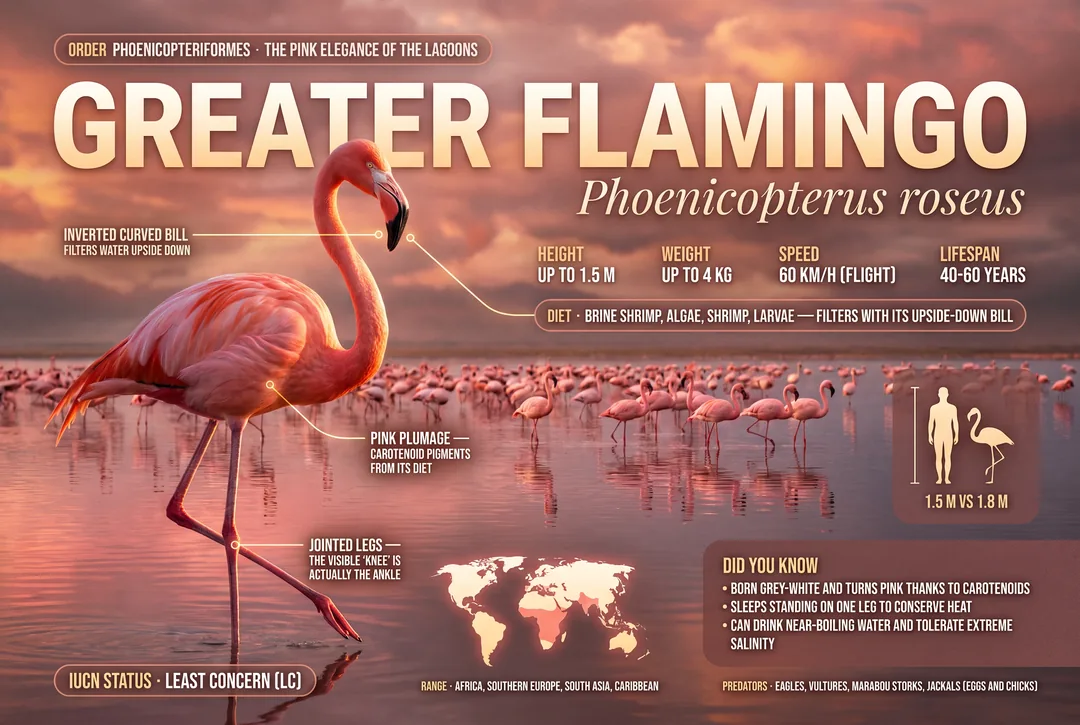
IDENTITY CARD
| Classification | Order Phoenicopteriformes, family Phoenicopteridae |
| Scientific name | Phoenicopterus roseus (Pallas, 1811) |
| Size | 1.10-1.50 m standing, wingspan 1.40-1.70 m |
| Weight | 2-4 kg |
| Speed | 50-60 km/h in flight |
| Lifespan | 20-30 years in the wild, up to 80 years in captivity |
| Depth | Shallow waters (10-50 cm) — lagoons, salt lakes, coastal marshes |
| Diet | Filter feeder — brine shrimp, shrimp, algae, insect larvae, diatoms |
| IUCN Status | Least Concern (LC) |
PORTRAIT
The greater flamingo is one of those species people think they know without ever having truly looked at. Postcard bird, garden ornament silhouette, swimsuit motif — and yet it is an extraordinary animal. A filter feeder that stands on one leg in brackish water, its bill upside down, pumping mud to extract micro-crustaceans invisible to the naked eye. A migrant capable of crossing the Mediterranean at night. A parent that feeds its chick with red "crop milk" — a secretion comparable to mammalian milk, produced by the lining of the oesophagus.
Six flamingo species exist worldwide. The greater flamingo (Phoenicopterus roseus) is the most widespread and the largest — found from the Camargue to the salt lakes of East Africa, from the Indian subcontinent to the Iranian coast. The American flamingo (P. ruber), smaller and a deeper pink bordering on red, is the emblematic species of the Bahamas, Cuba and the Yucatan.
For the travelling diver, the flamingo is an unexpected terrestrial bonus. Tropical dive destinations that harbour flamingo colonies are plentiful — Bonaire, Curacao, the Galapagos, the Yucatan — and the encounter at sunset, between two dives, is a memory that rivals any pelagic sighting.
HOW TO RECOGNIZE IT
The flamingo is instantly identifiable: long S-curved neck, impossibly long legs, pink plumage. The bill is the animal's keystone — curved downward at mid-length, it works as a filter. The bird plunges its head upside down into the water and pumps with its tongue (up to 20 times per second), forcing water and mud through horny lamellae that trap micro-organisms.
The pink colour is not innate. Chicks are born grey-white. The pigmentation comes from carotenoids — pigments found in the brine shrimp, shrimp and algae the bird consumes. The richer the diet in carotenoids, the more intense the plumage. In captivity, flamingos fed without supplements lose their colour and turn white.
In flight, the flamingo reveals black-and-pink wings — a striking contrast invisible at rest. The neck is held outstretched (unlike the heron, which folds it) and the legs trail behind, longer than the tail. Flocks in flight form V-shapes or irregular lines, and their harsh call — a nasal "ka-ha" — carries several hundred metres.
For subtitles in English: start the video firstthen click the gearat the top right of the video, select “Subtitles/CC”, then “Auto-translate” and choose “English”.
WAY OF LIFE
The greater flamingo is gregarious in the extreme. Breeding colonies can number from a few hundred to over a million individuals — Lake Natron, in Tanzania, hosts three-quarters of the world population of lesser flamingos (Phoeniconaias minor), more than 2 million birds.
Reproduction is synchronised within the colony. Pairs form after spectacular collective courtship displays — hundreds of birds marching in step, turning their heads in unison, spreading their wings. The nest is a mud mound 30-40 cm high, built at the water's edge or on mudflats. A single egg is laid. Both parents incubate for 28-31 days, then feed the chick with "crop milk" — a fat- and protein-rich secretion, pigmented red by the same carotenoids that colour the plumage.
Chicks join collective creches (up to 30,000 young) supervised by a handful of adults while the parents leave to feed. Each parent locates its chick in the crowd by voice — every individual has a unique call recognisable amid the din of the colony.
Feeding takes place in shallow, hypersaline waters — environments so hostile that few other species exploit them. The flamingo occupies an ecological niche with virtually no competition.
WHERE TO SEE IT
Bonaire — Dutch Caribbean. The southern part of Bonaire is home to a resident colony of American flamingos (P. ruber), in vivid pink. The Pekelmeer salt pans, visible from the coastal road, are a protected area where flamingos feed just a few dozen metres from observers. The combination of world-class diving and flamingos at sunset makes Bonaire a unique destination.
Camargue — France. The Rhone delta is the main breeding site for the greater flamingo in Europe. The Parc Ornithologique de Pont de Gau offers close-range observation year-round. The colony at Etang du Fangassier hosts 10,000 to 15,000 breeding pairs — the largest in Europe.
Galapagos — Ecuador. The Galapagos flamingo (a sub-population of P. ruber) is one of the rarest in the world — around 500 individuals. It can be observed in the lagoons of Floreana, Isabela (Punta Moreno) and Rabida. In the archipelago, it is an encounter as memorable as a giant tortoise.
Yucatan — Mexico. The Ria Lagartos and Celestun biosphere reserves, on the north coast of the Yucatan, shelter Mexico's largest colony of American flamingos — up to 40,000 individuals during breeding season. Boat excursions at sunrise depart from fishing villages.
Lake Nakuru / Lake Bogoria — Kenya. The lakes of the Rift Valley host spectacular concentrations of lesser flamingos and greater flamingos — sometimes over a million birds, transforming the lake into a pink carpet visible from space.
OBSERVATION CALENDAR
Click each button to show/hide
CONSERVATION
Phoenicopterus roseus is listed as Least Concern (LC) on the IUCN Red List. The global population is estimated at 500,000-680,000 adult individuals, with a stable to slightly increasing trend in the Mediterranean (thanks to protection of breeding sites) and fluctuating numbers in Africa.
The threats centre on habitat. Saline wetlands — salt pans, lagoons, alkaline lakes — are among the most endangered ecosystems on Earth: urbanisation, industrial salt extraction, river diversion and chemical pollution reduce available surface area. Lake Natron, in Tanzania, which hosts 75% of the world's lesser flamingo breeding population, is regularly threatened by industrial projects (soda ash plants, mining).
Disturbance during the breeding season is critical. A human disruption (helicopter overflight, too-close approach) can trigger the simultaneous abandonment of thousands of nests — catastrophic for a species that lays only one egg per year.
Organisations to support:
- Tour du Valat — research and conservation of Mediterranean wetlands, historic flamingo programme
- Wildfowl & Wetlands Trust (WWT) — global population monitoring
- BirdLife International — protection of critical habitats
- Ramsar Convention — protection of internationally important wetlands
3 THINGS YOU PROBABLY DON'T KNOW
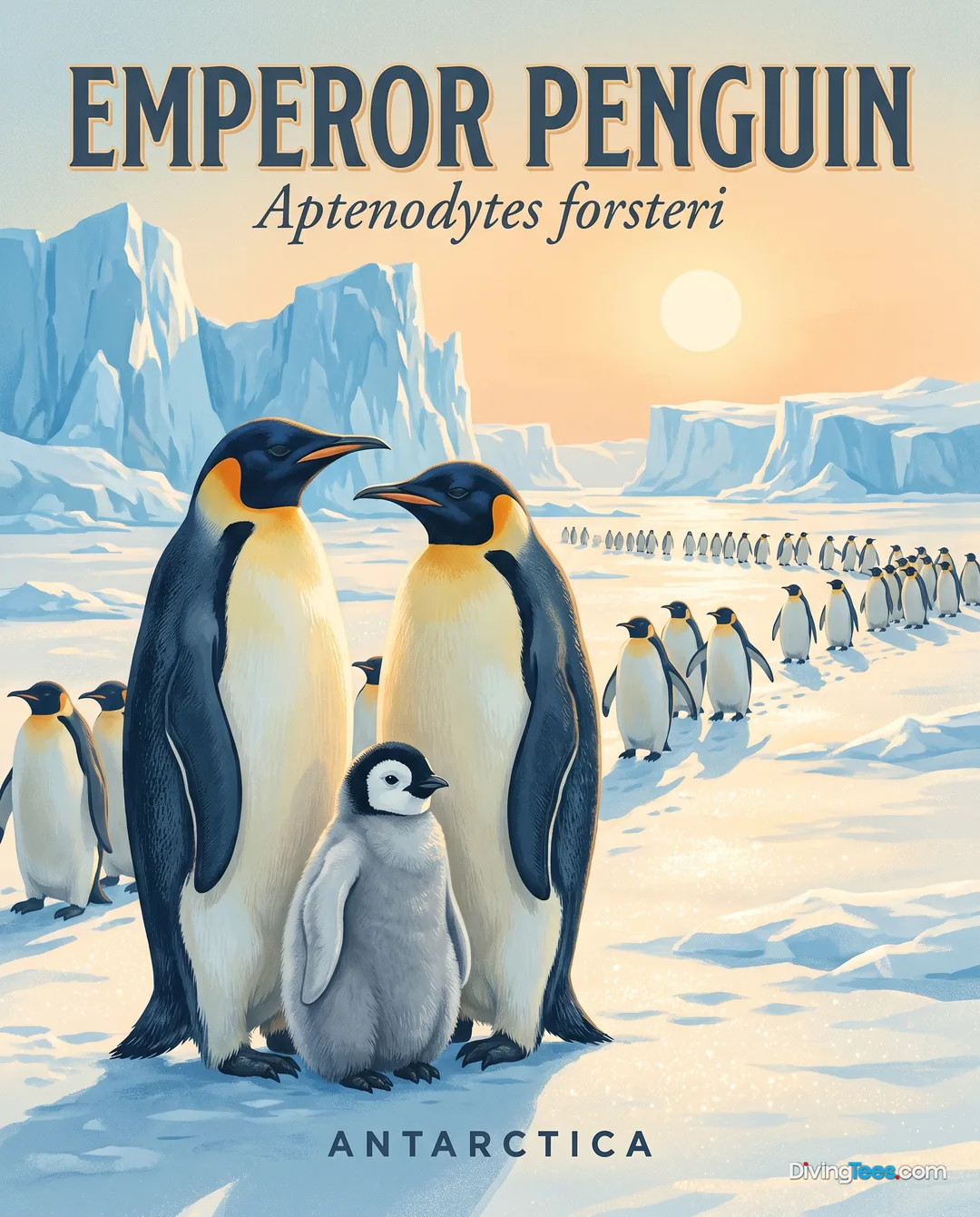
1. It produces "milk" — like a mammal. The flamingo, both male and female, feeds its chick with a secretion from the crop called "crop milk." This red liquid, rich in fat (5-15%) and protein, is comparable to the breast milk of mammals. Only three groups of birds in the world produce this secretion: flamingos, pigeons and emperor penguins. Parents lose their pink colour while feeding the chick — the carotenoids pass from the plumage into the milk.
2. It sleeps (and eats) on one leg to save energy. Standing on one leg is neither a balancing exercise nor a comfort posture — it is thermoregulation. By tucking one leg against its body, the flamingo halves the skin surface exposed to the cold lagoon water, saving up to 16% of its body heat. The standing leg locks passively thanks to a tendon mechanism — the bird expends no muscular energy to remain upright.
3. Its colour is a fitness signal. The pinkest flamingos are not simply the best-fed — they are the most competitive. Research has shown that individuals with the most intense plumage feed faster, occupy the best positions in the colony, and breed earlier. Some flamingos even apply carotenoids to their feathers as "make-up" — they rub their bill against the uropygial gland (loaded with pigments) then preen their plumage to intensify the colour before the breeding season.
PHOTO AND VIDEO TIPS
The flamingo is a terrestrial (or lagoonal) subject, but for the diver on holiday, it is a first-rate photographic bonus.
Lens. Telephoto 100-400 mm — observation distances in reserves require substantial magnification. A 70-200 mm with a 1.4x teleconverter is a good travel compromise. On recent smartphones with 5x optical zoom, acceptable results are possible in good light.
Light. The flamingo looks its best during the golden hours — sunrise and sunset. The pink of the plumage explodes under warm, raking light. At midday, blown whites and harsh shadows flatten the subtleties. Backlighting, with wings spread in flight, creates spectacular silhouettes.
Composition. The flock is the subject. A single flamingo is beautiful; a thousand flamingos are a landscape. Look for compositions that convey the scale of the colony — lines of flamingos stretching to the horizon, reflections in still water, the simultaneous take-off of hundreds of birds. The tight close-up of the head (golden eye, bicoloured black-and-pink bill) is the other register.
Behaviour. The courtship display (groups marching in step, synchronised) is the highlight — it typically occurs in the late afternoon, in the weeks leading up to breeding. Take-off and landing (trailing legs, outstretched neck) are the most dynamic sequences. Inverted feeding (bill turned upside down in the water) is the most characteristic gesture.