Narwhal
Monodon monoceros
The unicorn of the sea exists. It wears its horn backwards: it's a tooth.
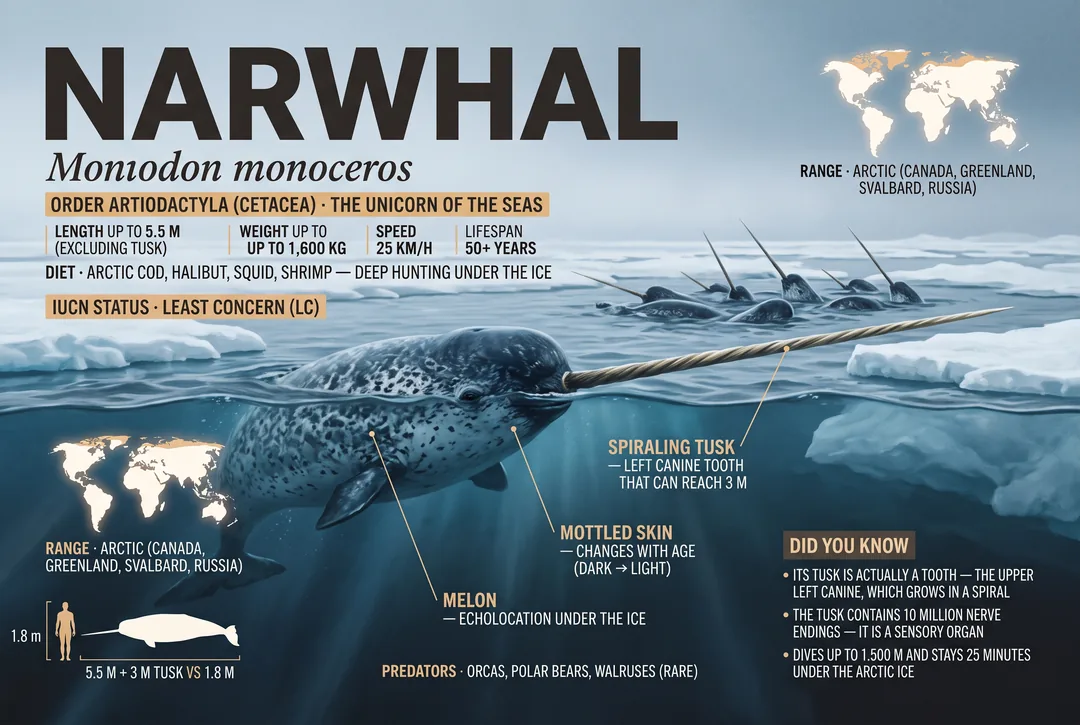
IDENTITY CARD
| Classification | Order Cetacea, family Monodontidae |
| Scientific name | Monodon monoceros (Linnaeus, 1758) |
| Size | 4 to 5.5 m (body, excluding the tusk) |
| Weight | 800 to 1,600 kg |
| Tusk | Up to 3 m — a continuously growing upper left canine |
| Lifespan | 50 years on average, up to 115 years (isotopic estimates) |
| Depth | Regular dives to 800 m, recorded maximum of 1,864 m |
| Diet | Greenland halibut, Arctic cod, squid, shrimp |
| IUCN Status | Least Concern (LC) — but populations are vulnerable to climate change |
PORTRAIT
They call it the unicorn of the sea. For once, the romantic name is not entirely wrong: the narwhal does carry a spiralling tusk that can exceed three metres in length, pointing straight ahead like the horn of a mythical beast. Except it is not a horn. It is a tooth.
More precisely, it is the upper left canine, which pierces the lip and grows in a leftward spiral. It develops almost exclusively in males — only about 15% of females carry one, and it is shorter. One in 500 males grows two. For centuries, Vikings sold narwhal tusks as unicorn horn — alicorn — at prices rivalling gold. The deception held until the seventeenth century.
In 2014, researchers at Harvard demonstrated that the tusk is a sensory organ: 10 million nerve endings detect variations in temperature, salinity, and pressure. The narwhal does not brandish a weapon. It carries an antenna.
HOW TO RECOGNIZE IT
The narwhal is a medium-sized cetacean, stocky and compact, with no dorsal fin — a trait it shares only with the beluga. A low dorsal ridge runs along the back instead.
Its colouring changes with age: newborns are blue-grey, juveniles become mottled, adults wear a pattern of black and grey spots on a white background, and old males turn almost entirely white. The name itself comes from the Old Norse nar (corpse) and hvalr (whale) — "corpse whale" — a reference to the mottled skin's resemblance to a drowned body.
At the surface, the absence of a dorsal fin, the mottled colouring, and the tusk (when it breaks the waterline) are unmistakable. Groups sometimes engage in tusking — raising their tusks vertically above the surface, possibly as a social or sensory behaviour.
For subtitles in English: start the video firstthen click the gearat the top right of the video, select “Subtitles/CC”, then “Auto-translate” and choose “English”.
WAY OF LIFE
The narwhal is an Arctic specialist, living between 70 and 80 degrees north latitude and never straying south of the Arctic Circle. It is a gregarious animal, typically travelling in groups of 10 to 20, though migration can bring hundreds together.
In summer, narwhals move into the fjords and coastal bays of the Canadian High Arctic and Greenland. In winter, they head offshore to deep waters — Baffin Bay, the Davis Strait — hunting beneath the pack ice.
Their diving abilities are extraordinary. Regular dives reach 800 m, and the recorded maximum is 1,864 m. A narwhal makes around 25 deep dives per day, each lasting up to 20 minutes, hunting Greenland halibut on the seabed in total darkness using echolocation. It surfaces to breathe through polynyas — openings in the ice.
Reproduction occurs in April, with a gestation of 14 to 15 months producing a single calf. Nursing lasts over a year, and the interval between births is approximately three years.
WHERE TO SEE IT
The narwhal is not an animal one encounters on a dive. Observation takes place from the surface — the edge of the pack ice, a boat, or a kayak.
Canadian Arctic — Baffin Island and Lancaster Sound. Around 45,000 narwhals gather in these waters during summer. Arctic Bay and Pond Inlet offer floe-edge excursions from late May to early August, where travellers watch from the ice margin as narwhals surface to breathe in the leads between ice floes.
Greenland — Scoresby Sound. The world's largest fjord system hosts narwhals from July to September. Expedition vessels are the standard means of access.
Svalbard (Norway). Occasional sightings occur, but they remain rare and unpredictable.
OBSERVATION CALENDAR
| Destination | J | F | M | A | M | J | J | A | S | O | N | D |
|---|---|---|---|---|---|---|---|---|---|---|---|---|
| Canadian Arctic | ||||||||||||
| Greenland | ||||||||||||
| Svalbard |
Click each button to show/hide
CONSERVATION
The narwhal is classified as Least Concern (LC) on the IUCN Red List, with an estimated global population of around 80,000 individuals across 12 distinct stocks. But the status is deceptive: few large mammals are as vulnerable to climate change.
The narwhal's range is narrow, its diet demands cold water, and its survival depends on polynyas — openings in the ice through which it breathes. As Arctic ice patterns shift, orcas are increasingly present in narwhal territory, and shipping traffic through once-frozen passages grows each year. Ice entrapments — events where shifting ice traps entire groups — are becoming more frequent.
Inuit communities harvest narwhals for subsistence. Muktuk — the skin and blubber — is a vital source of vitamin C in the Arctic diet. Trade in tusks is regulated under CITES Appendix II.
Organisations to support:
- Narwhal Tusk Research / Harvard — sensory biology and tusk function research
- WWF Arctic Programme — Arctic ecosystem protection
- Oceans North — marine conservation in the Canadian Arctic
- Polar Bears International — Arctic climate change awareness and research
3 THINGS YOU PROBABLY DON'T KNOW
1. The tusk always spirals to the left. Every narwhal tusk, without exception, twists counterclockwise when viewed from its base. Even the rare individuals bearing two tusks show the same leftward spiral on both. The asymmetry originates at the cellular level, and the mechanism remains a mystery.
2. It hunts in conditions no diver could survive. The narwhal holds its breath for 25 minutes, descends in total darkness to depths exceeding 1,500 m, beneath continuous pack ice, under crushing pressure. It locates prey by echolocation alone. The water temperature is -1.5 degrees Celsius. A 12-centimetre layer of blubber insulates it from the cold.
3. The Inuit use it as a barometer. The narwhal's arrival at the floe edge in spring is a traditional indicator of the ice breakup. This ecological knowledge, accumulated over millennia, is now being integrated into modern climate models.
PHOTO AND VIDEO TIPS
Lens. A telephoto zoom in the 200-600 mm range is essential — distances are often 100 m or more. Drones are ideal for overhead shots that reveal the tusk and the mottled skin pattern against the dark Arctic water.
Light. Arctic light sits low and golden, raking across the surface. The midnight sun in June and July provides continuous shooting opportunities. Work at ISO 800-3200 and underexpose by 1/3 to 2/3 of a stop to preserve detail in the ice and water.
Approach. Patience is paramount. Narwhals are wary animals. The floe edge is the best vantage point. Avoid standing upright against the skyline — keep a low profile against the ice.
Classic mistake. Firing the shutter at the first blow. Wait for the second or third breath in a surfacing sequence, when the animal settles into its breathing rhythm and the tusk rises fully clear of the water.