Walrus
Odobenus rosmarus
The colossus of the Arctic is not encountered underwater: it is observed from the deck of a zodiac.
IDENTITY CARD
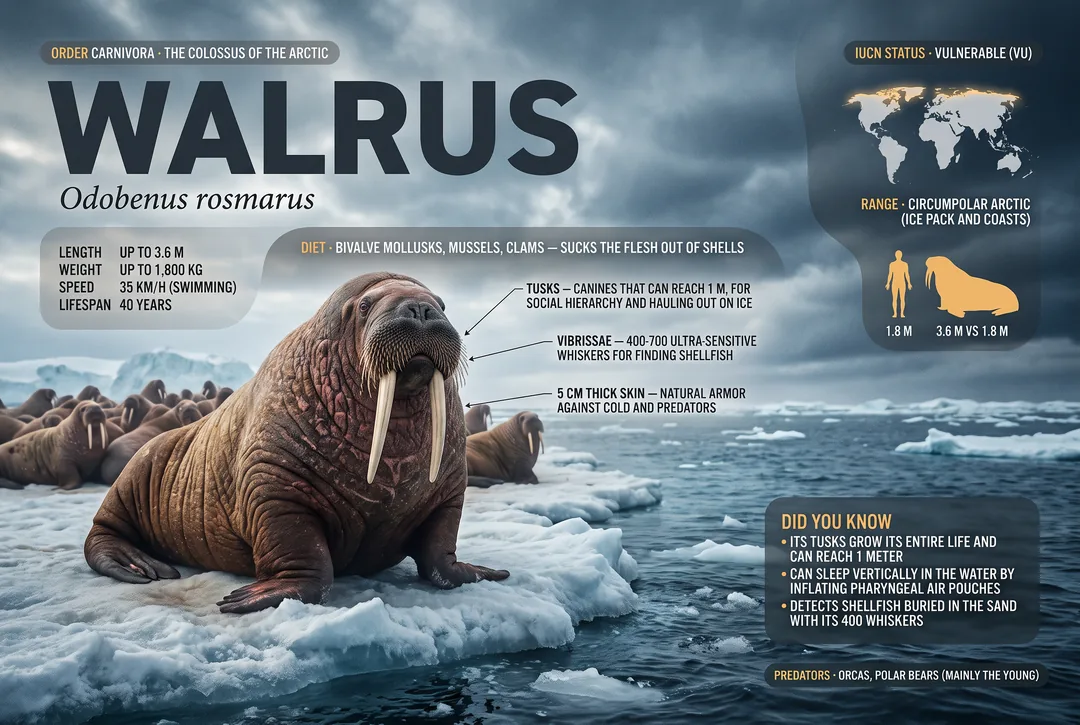
| Classification | Order Carnivora, family Odobenidae |
| Scientific name | Odobenus rosmarus (Linnaeus, 1758) |
| Size | Up to 3.6 m (males); females: 2.4-2.8 m |
| Weight | Up to 1,500 kg (males); females: 400-800 kg |
| Lifespan | 30-40 years in the wild |
| Depth | Commonly dives to 80 m, rarely beyond 100 m |
| Diet | Benthivore — bivalves, gastropods, worms, sea cucumbers, occasionally crustaceans |
| IUCN Status | Vulnerable (VU) — Laptev subspecies classified as Data Deficient (DD) |
PORTRAIT
You do not stumble upon a walrus. You reach one at the end of an expedition — five days at sea, an icebreaker or a polar sailboat, fog that refuses to lift. And then, one morning, a haulout beach appears. Dozens of massive bodies piled on top of one another, grunting and shoving in a guttural clamor audible from hundreds of meters away. The zodiac draws near. The tusks rise. The smell arrives.
Odobenus rosmarus — literally "the one who walks with its teeth" — is the only pinniped to carry tusks. These hypertrophied upper canines, reaching a meter in the oldest males, serve neither to hunt nor to feed. The walrus uses them to haul itself out of the water onto the pack ice, to assert its rank within the group hierarchy, and occasionally to defend against polar bears. They are all-purpose tools, natural ice axes driven into the floe.
The animal is an absolute Arctic specialist. It never ranges below the 55th parallel, cannot tolerate temperate waters, and depends entirely on pack ice or coastal shallows to rest between its foraging dives. In a warming ocean, this dependence makes it acutely vulnerable.
HOW TO RECOGNIZE IT
The walrus cannot be mistaken for anything else. Its massive silhouette, wrinkled reddish-brown skin, ivory tusks, and bristling whiskers make it identifiable at several hundred meters — even lying in the middle of a tightly packed herd.
The vibrissae are the most striking feature after the tusks. The muzzle bears between 400 and 700 of these stiff, short, sensitive whiskers, arranged in dense rows. They are not ornaments: they are a precision sensory organ. The walrus dives into opaque, near-freezing waters and probes the muddy bottom in total darkness. The vibrissae detect shellfish buried several centimeters beneath the sediment — by touch, not by sight.
Adult males are distinguished by thicker skin covered in nodules (subcutaneous bumps called "bosses") on the neck and shoulders, which serve as shields during confrontations. Male tusks are generally longer and thicker than those of females, but tusk size alone is not enough to determine sex: body mass and neck width are more reliable cues.
For subtitles in English: start the video firstthen click the gearat the top right of the video, select “Subtitles/CC”, then “Auto-translate” and choose “English”.
WAY OF LIFE
The walrus is a deeply gregarious animal. Colonies — known as haulouts — gather dozens to thousands of individuals, pressed flank against flank on a gravel beach or a slab of pack ice. This constant contact is not imposed by lack of space: it is social behavior. An isolated walrus is a walrus in trouble.
Hierarchy rests on tusk size. Males with the longest, thickest canines dominate access to females and the best resting positions, often without fighting: the display alone usually suffices. When it does not, confrontations are brutal — tusks driven into the neck and shoulders — but rarely fatal.
Feeding is benthic. The walrus dives to 10-80 meters, sets its muzzle against the bottom, and sweeps the sediment with its vibrissae to locate bivalves — clams, mussels, cockles — which it suctions out of their shells using its powerful tongue and the vacuum created by its mouth. It can ingest several dozen kilograms of mollusks per day. Dives are short: 5 to 8 minutes on average, rarely exceeding 25.
Reproduction is slow. Females produce only a single calf every two to three years, after a gestation of 15 months that includes delayed implantation. The calf stays with its mother for two years, sometimes three. This reproductive pace makes populations extremely vulnerable to any excess mortality — a lesson the hunters of the nineteenth century learned as they emptied the North Atlantic.
WHERE TO SEE IT
The walrus is an Arctic animal. It is encountered neither while diving nor at the edge of a tourist beach: you must go looking for it, on expedition, along coasts that few vessels frequent. Here are the destinations where observation is most accessible:
Svalbard (Norway) — the most accessible destination. The Svalbard archipelago, and particularly the area around Longyearbyen, has become the premier point of access to walruses for European travelers. Expedition cruises from June to August follow the coasts of Spitsbergen, where stable colonies occupy well-mapped haulouts — Poolepynten, Sarstangen, the northeastern islands. Zodiacs approach to 30-50 meters. The polar light, low and golden 24 hours a day in summer, provides exceptional photographic conditions.
Russia — Franz Josef Land and Wrangel Island. Franz Josef Land, one of the most northerly archipelagos on Earth, harbors populations of both Pacific and Atlantic walruses. Wrangel Island, a UNESCO World Heritage Site, hosts massive late-summer haulouts — several thousand individuals on a single beach. Access requires a Russian permit and an expedition vessel: it is a rare and costly destination, but the concentrations are among the most impressive in the world.
Arctic Canada — Hudson Bay, Nunavut, and the High Arctic. The waters of Nunavut and the Northwest Passage shelter the Atlantic subspecies. Expedition cruises traversing the Northwest Passage regularly encounter walruses on slabs of pack ice. Foxe Basin and the coast of Baffin Island are known zones. The season is short: July and August only.
Greenland. The northeastern and northwestern coasts of Greenland harbor Atlantic populations. Observation takes place as part of Arctic cruises or stays organized by local Inuit communities. Numbers are lower than at Svalbard, but the remoteness is absolute.
Round Island, Alaska (United States). This small islet in Bristol Bay, in southwestern Alaska, is the only regular terrestrial haulout for male walruses in the United States. Managed by the Alaska Department of Fish and Game, the site is accessible only by light aircraft and then by boat, with the number of visitors strictly limited. The season runs from May to August, peaking in July.
OBSERVATION CALENDAR
| Destination | J | F | M | A | M | J | J | A | S | O | N | D |
|---|---|---|---|---|---|---|---|---|---|---|---|---|
| Svalbard (Norway) | ||||||||||||
| Franz Josef Land (Russia) | ||||||||||||
| Wrangel Island (Russia) | ||||||||||||
| Arctic Canada | ||||||||||||
| Greenland | ||||||||||||
| Round Island, Alaska |
Click each button to show/hide
CONSERVATION
Odobenus rosmarus is classified as Vulnerable (VU) on the IUCN Red List. The global population is estimated between 200,000 and 250,000 individuals, distributed among three subspecies: the Atlantic walrus (O. r. rosmarus), the Pacific walrus (O. r. divergens), and the Laptev walrus (O. r. laptevi), the last so poorly studied that the IUCN classifies it as Data Deficient.
The walrus's story is one of collapse followed by partial recovery. Commercial hunting in the eighteenth and nineteenth centuries — for ivory, oil, and leather — decimated North Atlantic populations, some of which have never recovered. The walrus vanished from Nova Scotia, from the Gulf of St. Lawrence, and from Svalbard itself, where it returned only after decades of strict protection.
Today, the principal threat is climate change. The walrus depends on pack ice to rest between foraging dives — without it, the animal must return to shore, sometimes tens of kilometers from its feeding grounds. The resulting overcrowded terrestrial haulouts trigger deadly stampedes, particularly among calves. The retreat of Arctic sea ice, which has lost roughly 40% of its summer extent since the 1980s, directly reduces the habitat available.
Other threats include disturbance from increasing Arctic shipping traffic, pollution by hydrocarbons and persistent organic pollutants (POPs), and subsistence hunting by Indigenous communities — the latter being legal and regulated, but sensitive in the context of fragile populations.
The responsible observer maintains the 30-meter distance recommended by Svalbard authorities, cuts the zodiac engine on approach to a haulout, and never lands on an occupied beach. A disturbed colony throws itself into the water en masse — calves are trampled.
Organizations to support:
- WWF Arctic Programme — population monitoring and Arctic habitat protection
- IUCN Pinniped Specialist Group — conservation status assessment of pinnipeds
- Pacific Walrus Coastal Haulout Database — USGS monitoring of Alaskan haulouts
- Norwegian Polar Institute — research and conservation at Svalbard
3 THINGS YOU PROBABLY DON'T KNOW
1. It sleeps floating upright. The walrus possesses two pharyngeal pouches (air sacs located in the throat) that it can inflate like buoys. By filling them, it floats vertically, head above water, and can sleep this way for hours without sinking. This system allows it to rest in the open sea when no pack ice and no beach is available — a vital advantage in an Arctic where the ice is retreating.
2. Its tusks never stop growing. Like the incisors of rodents, walrus tusks grow continuously throughout their lives, at a rate of several centimeters per year. Wear and impact shorten them, but an aged male that has avoided confrontations can carry canines a meter long. Cross-sections of tusks, like tree rings, reveal the animal's age, its diet, and even periods of physiological stress.
3. It can suction a bivalve out of its shell without breaking it. The walrus does not crush its prey. It presses its thick, fleshy lips against the shell of a clam or mussel, retracts its massive tongue in a sharp motion, and creates a suction so powerful that the mollusk is wrenched from its shell and sucked into the mouth. The shell remains intact on the bottom. This technique, confirmed by analysis of stomach contents — which contain soft bodies but almost never shell fragments — is one of the most elegant feeding adaptations in the animal kingdom.
PHOTO AND VIDEO TIPS
The walrus is not photographed while diving: it is framed from a zodiac, the deck of a ship, or — more rarely — a position on shore, at a safe distance from the haulout. Arctic conditions impose their own rules.
Lens. A telephoto is essential. A 100-400 mm (or equivalent) covers the majority of situations: a tight crop on an individual at 30-50 meters, a wide view of the haulout at 100-200 meters. A 70-200 mm works if the zodiac draws close, but you will quickly regret the lack of reach. A wide angle (24-70 mm) is useful for landscapes or when an individual swims a few meters from the boat — it happens.
Light. In the Arctic summer, the sun does not set. The light is low, golden, and changes little for hours — dream conditions for photography. But the air is laden with humidity and fog drops without warning: protect the optics with a UV filter and keep a dry cloth at hand. Wet walruses gleam under the low sun — watch the highlights on the tusks and muzzle.
Stability. The zodiac moves. Always. Push the shutter speed to 1/1000 s minimum, activate image stabilization, and brace your elbows against the tube of the boat. A monopod is useless — the floor shifts constantly. Experienced photographers work in short bursts and accept a high discard rate.
Classic mistake. Photographing the pile. A haulout of 200 walruses makes a documentary image, not a good photograph. Seek the detail: a calf climbing its mother's back, two males crossing tusks, a yawning individual — tusks spread, tongue visible, eye half-shut. It is the gesture that makes the image, not the mass.