Sperm Whale
Physeter macrocephalus
The largest toothed predator on the planet dives to 3,000 metres into absolute darkness — and comes back.
IDENTITY CARD
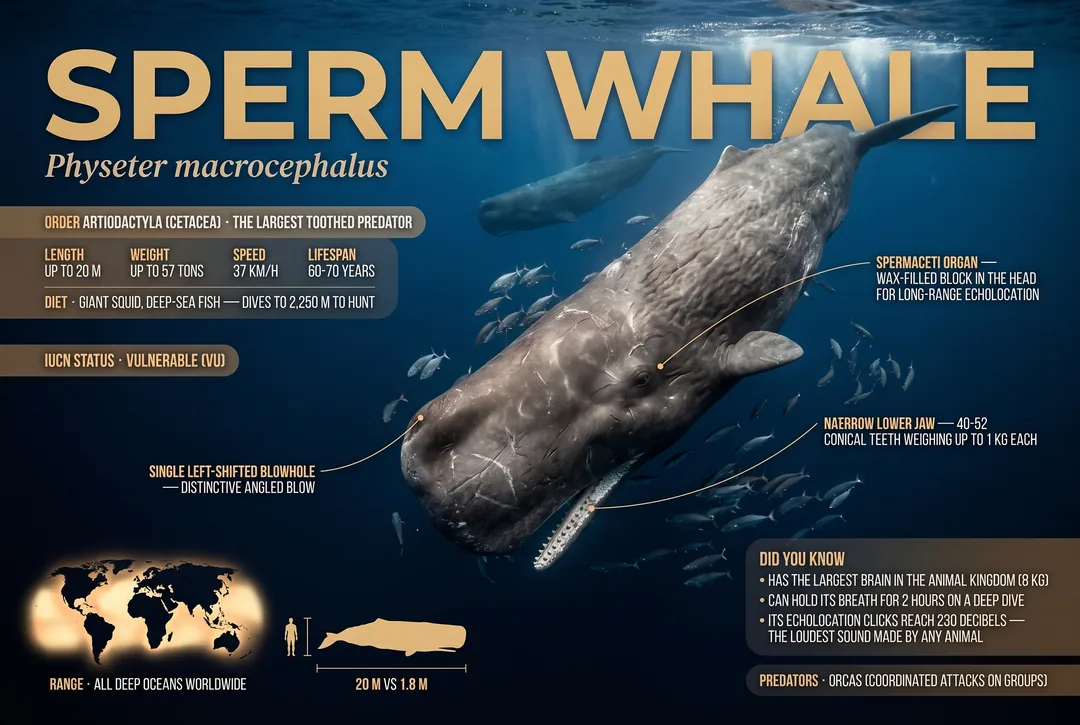
| Classification | Order Artiodactyla, suborder Odontoceti, family Physeteridae |
| Scientific name | Physeter macrocephalus (Linnaeus, 1758) |
| Size | Up to 18 m (adult male), 11 m (female) |
| Weight | Up to 57 tonnes (male), 14 tonnes (female) |
| Speed | ~6 km/h cruising, up to 35 km/h in bursts |
| Lifespan | 60 to 70 years (some individuals beyond 80) |
| Depth | Regular dives to 1,000-2,000 m, documented record beyond 2,250 m |
| Diet | Squid (including the giant squid), deep-sea fish, octopuses |
| IUCN Status | Vulnerable (VU) — population slowly recovering after centuries of whaling |
PORTRAIT
You have to see a sperm whale face to face to grasp what the ocean keeps hidden. The animal rises from the deep without a sound — a grey, glistening mass whose outsized head fills a full third of its body — and lingers at the surface for a moment, its blow shooting forward and to the left at a distinctive angle visible from hundreds of metres away. Then the back arches, the tail flukes rise vertically like a dark banner, and it slips back into a world no diver will ever follow it to.
Physeter macrocephalus is the largest toothed animal on Earth. An adult male reaches 18 metres and 57 tonnes — the weight of a loaded semi-trailer. But it is not the sheer size that captivates biologists; it is what the animal does with it. The sperm whale is the undisputed deep-diving champion among mammals. It routinely descends past 1,000 metres, sometimes beyond 2,000, into total darkness, hunting giant squid and other deep-sea cephalopods. It stays down for thirty to ninety minutes before surfacing to breathe.
It is also the creature that inspired the most famous novel of the sea. Herman Melville gave the white sperm whale Moby Dick a mythic stature in 1851, yet reality outstrips fiction: the living animal possesses the largest brain ever to exist — up to 9 kilograms — produces the most powerful sounds in the animal kingdom, and maintains social bonds of a complexity that science is only beginning to unravel.
HOW TO RECOGNIZE IT
The sperm whale looks like no other cetacean. The head — massive and blunt-squared — accounts for roughly a third of the total body length, a proportion unmatched anywhere in the animal kingdom. That block-like shape owes its existence to the spermaceti organ, a reservoir of liquid wax occupying most of the skull, whose exact function is still debated: buoyancy control, acoustic focusing, or both.
The lower jaw is narrow, elongated, and fitted with 18 to 26 pairs of conical teeth that can weigh a kilogram each. The upper jaw carries few or none. The skin ranges from dark grey to brown, wrinkled like a prune over most of the body — a corrugated texture unmistakable at any distance.
From afar, the blow is the most reliable tell. The sperm whale has a single blowhole, set to the left of the head, producing a low, bushy spout angled forward and to the left at roughly 45 degrees. No other large cetacean blows in that direction. On a dive, the tail flukes lifted straight to the vertical — broad, triangular, with deeply notched trailing edges — have become one of the most iconic images in marine life.
For subtitles in English: start the video firstthen click the gearat the top right of the video, select “Subtitles/CC”, then “Auto-translate” and choose “English”.
WAY OF LIFE
Sperm whales live in a matriarchal society. Females and young form stable groups of 10 to 25 individuals, bound by matrilineal ties that last a lifetime. These family units share distinctive click dialects passed down across generations — a phenomenon of vocal culture documented through the work of Shane Gero, Hal Whitehead, and others.
Males follow a different path. At adolescence, around 10 to 15 years of age, they leave the maternal group and join bachelor bands. As they age, they become increasingly solitary and migrate toward higher latitudes — the waters off Norway, Iceland, the Azores — where food is plentiful. They return to tropical waters only to mate, briefly and without lingering.
Hunting happens in total darkness. The sperm whale wields one of the most powerful echolocation systems in the animal kingdom: its clicks reach 230 decibels — the loudest sound produced by any living creature. These sonic pulses, generated inside the spermaceti organ and focused by an acoustic reflector at the back of the skull, allow it to pinpoint a squid several hundred metres away in pitch blackness.
Reproduction is slow. Gestation lasts 14 to 16 months, and a female gives birth to a single calf every four to six years. The newborn already measures 4 metres at birth and nurses for at least two years. While the mother dives, the calf is watched at the surface by other females in the group — a system of cooperative care observed in very few marine mammals.
WHERE TO SEE IT
The sperm whale inhabits every ocean on the planet, but it is accessible to observers only where deep water lies close to shore. The most renowned destinations follow.
Dominica (Caribbean). The only country in the world hosting a year-round resident population of sperm whales. Females and young live in deep water off the west coast, just minutes by boat from Roseau. In 2023, Dominica established the first marine reserve dedicated to the sperm whale, permitting guided in-water snorkelling encounters. It is today the world benchmark for observing the species.
Azores (Portugal). The archipelago built its reputation on the sperm whale. Solitary males and family groups frequent the deep waters around Pico, Faial, and Sao Miguel from May to October. The former whaling tradition — abolished in 1986 — has been converted to ecotourism, and the old lookout posts (vigias) now serve to spot blows from the clifftops.
Sri Lanka — Mirissa and Trincomalee. The submarine canyon off Mirissa (south coast) concentrates sightings from December to April. The seabed drops to over 1,000 metres just a few miles from shore, drawing sperm whales close to the coast. The northeast (Trincomalee) offers a second window from March to September. Trips out of Mirissa rank among the most accessible in the world.
Norway — Andenes and Vesteralen. The deep waters of the Bleikdypet, off the Vesteralen Islands, attract adult males feeding year-round, with a peak from May to September. The midnight-sun lighting conditions between May and July allow extended observations against a spectacular backdrop.
Mauritius. The deep waters of the Mascarene Plateau, off the west coast, harbour sperm whale family groups for much of the year. Guided in-water snorkelling encounters have been developing since the mid-2010s, following a model close to that of Dominica.
Kaikoura (New Zealand). The Kaikoura submarine canyon, plunging to 1,600 metres just a few kilometres offshore, draws adult males year-round. It is one of the rare locations where sperm whales are observed near-permanently, and one of the pioneering whale-watching sites (early 1990s).
OBSERVATION CALENDAR
| Destination | J | F | M | A | M | J | J | A | S | O | N | D |
|---|---|---|---|---|---|---|---|---|---|---|---|---|
| Dominica (Caribbean) | ||||||||||||
| Azores (Portugal) | ||||||||||||
| Sri Lanka (Mirissa) | ||||||||||||
| Norway (Andenes) | ||||||||||||
| Mauritius | ||||||||||||
| Kaikoura (New Zealand) |
Click each button to show/hide
CONSERVATION
Physeter macrocephalus is listed as Vulnerable (VU) on the IUCN Red List. The species was the prime target of the whaling industry for nearly three centuries, hunted for its spermaceti — a wax used in candles, lubricants, and cosmetics — and for ambergris, an intestinal concretion prized in luxury perfumery. At its mid-twentieth-century peak, industrial whaling killed more than 25,000 sperm whales per year. The global population fell to between a third and a quarter of its pre-whaling numbers.
Since the 1986 international moratorium on commercial whaling, stocks have been recovering slowly — but the species' longevity, late sexual maturity, and low reproductive rate make the comeback a drawn-out affair. The sperm whale is listed under Appendix I of CITES and the Convention on Migratory Species (CMS).
Current threats are numerous: ship strikes from commercial vessels, ingestion of plastic debris (stomachs containing tens of kilograms of plastic have been documented), underwater noise pollution interfering with echolocation, bycatch in longlines and drift nets, and disturbance from poorly regulated tourism at resting sites.
A responsible observer keeps to the regulatory distance (typically 100 metres by boat, 15-20 metres in water), never approaches an animal resting at the surface, and never cuts the engine nearby — sudden silence can startle the whale as much as the noise itself.
Organizations to support:
- The Dominica Sperm Whale Project — Shane Gero's long-term research programme on the resident families of Dominica
- Ocean Alliance — great-whale research and conservation, including the non-invasive SnotBot monitoring programme
- International Whaling Commission (IWC) — regulatory and population-monitoring body for great whales
- WWF — cetacean programme — habitat protection and campaigns against plastic and noise pollution
3 THINGS YOU PROBABLY DON'T KNOW
1. The loudest sound in the animal kingdom — 230 decibels. Sperm whale echolocation clicks reach 230 dB re 1 uPa — louder than a rocket engine at one metre. At that intensity, the sound could theoretically rupture a diver's eardrum at close range. But underwater acoustics obey different laws from those in air, and in practice, swimmers alongside surfacing sperm whales report an intense vibration through the chest cavity, not auditory pain.
2. They sleep standing up, heads skyward, in groups. In 2008, researchers stumbled upon a pod of sperm whales hanging vertically in the water column, heads pointing up, perfectly motionless. These sleep bouts last 10 to 15 minutes and account for less than 7 percent of the day — the lowest sleep rate of any mammal. During these collective naps, the animals respond to no stimulus: they are temporarily deaf to the world.
3. Ambergris — gold born from squid. Ambergris is a concretion that forms in the sperm whale's intestine, likely around indigestible squid beaks. Fresh, the substance is soft and foul-smelling. After months or years adrift at sea, it hardens, pales, and develops a complex fragrance coveted in high perfumery. A single beached lump can be worth tens of thousands of euros — earning the sperm whale the nickname of the abyss's perfume factory.
PHOTO AND VIDEO TIPS
Encounters with sperm whales happen at the surface, where the animal breathes between dives, and during guided snorkelling at the handful of sites that permit it. Scuba diving with sperm whales is virtually nonexistent in organised tourism — the vast majority of footage is shot on breath-hold, while snorkelling, or from the boat.
Lens. In water: a wide angle is mandatory — 14-16 mm in a housing, or the native field of view on a GoPro. The animal is enormous and often very close; the best frames are taken at 5-10 metres, where only a fisheye or ultra-wide can fit the full body into the shot. From the boat, for blows and flukes, a 70-200 mm or 100-400 mm telephoto is the right tool.
Light. At the surface and while snorkelling, natural light is enough. The sperm whale is dark grey: shot into the light, it becomes a dramatic silhouette; with the sun behind the photographer, the wrinkled skin and the sucker scars left by giant squid come alive. Dive torches are useful only at very close range and are rarely used with this species.
Approach. Slip into the water in silence — no jumping, no splashing. Swim slowly toward the animal from the side, never head-on and never from behind the tail flukes (strike risk). Stay at the surface. A curious sperm whale will come to you — some individuals, especially juveniles, approach within two metres and scan the swimmer with their sonar. The vibration of clicks resonating through the ribcage is a sensory experience without equal.
Classic mistake. Kicking frantically to keep up with a whale beginning its dive. Once the back arches and the flukes rise, the animal descends vertically at more than 1 m/s — chasing it is futile and disrespectful. The decisive moment is the fluke lift: that is the shot that matters, and it lasts five seconds.