Orca
Orcinus orca
The largest dolphin on Earth has never killed a human in the wild — and it is the only known predator of the great white shark.
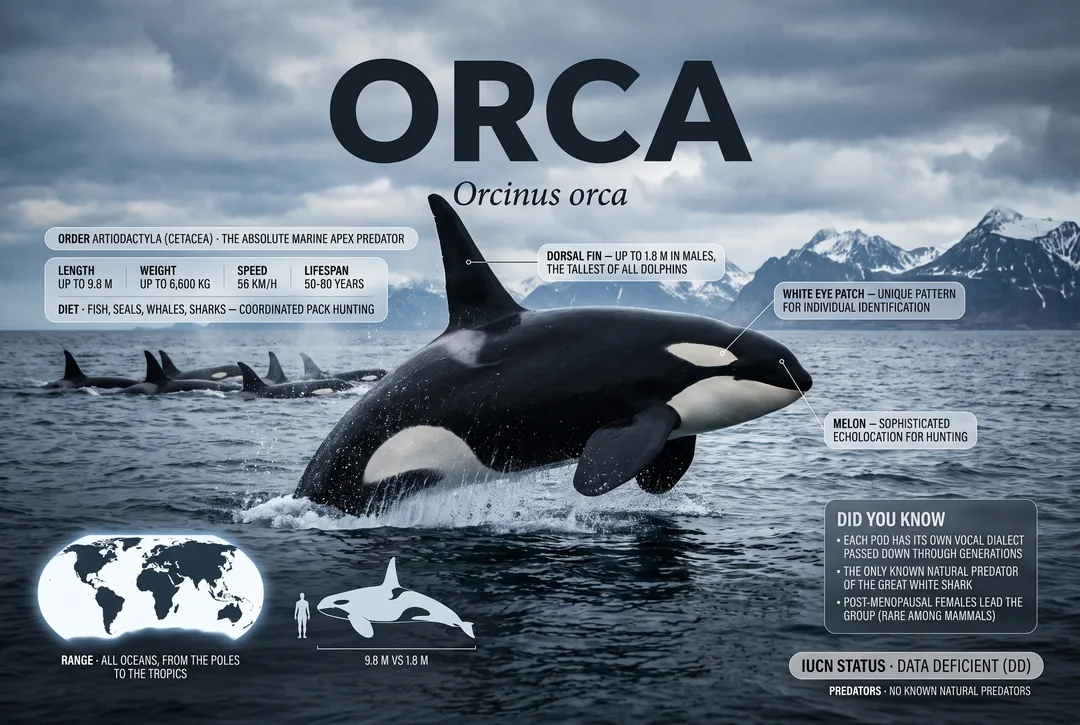
IDENTITY CARD
| Classification | Order Artiodactyla (infraorder Cetacea), family Delphinidae |
| Scientific name | Orcinus orca (Linnaeus, 1758) |
| Size | Up to 9.8 m in males (typical observed range: 6-8 m; females smaller, 5-7 m) |
| Weight | Up to 6,600 kg in males |
| Speed | Up to 56 km/h in bursts |
| Lifespan | 50-80 years (females live significantly longer than males, up to 90 years for certain documented individuals) |
| Depth | Surface to 200 m in regular use, exceptional dives beyond 500 m |
| Diet | Apex generalist predator — fish, sea lions, seals, dolphins, sharks, other cetaceans, penguins, cephalopods — the menu varies radically by ecotype |
| IUCN Status | Data Deficient (DD) — the species likely conceals several distinct species or subspecies, some local populations being severely threatened |
PORTRAIT
She does not hide. A two-meter black dorsal fin slicing the surface, a breath that cracks like thunder, a black-and-white silhouette no other marine animal can imitate: the orca is one of the few ocean giants that announces itself before it arrives. And yet, despite a name that evokes terror — killer whale — no fatal attack by a wild orca on a human has ever been documented with certainty. Folklore owes her a great deal; the facts, almost nothing.
Orcinus orca is not a whale at all. She is a dolphin — the largest of all Delphinidae, a family that also includes bottlenose and common dolphins. This kinship explains her spectacular social intelligence, her refined echolocation abilities, and an organization into family groups of a stability few marine species can rival. Whether underwater or from a boat, the encounter has something electric about it: the orca observes as much as she is observed, and she makes it known.
For this is what truly sets the orca apart from every other marine predator: she hunts as a team, with tactics passed down from generation to generation and unique to each population. Certain Antarctic orcas coordinate to create a wave that sweeps a seal off its ice floe. Certain New Zealand orcas chase rays through water only meters deep. Certain South African orcas surgically extract the liver from a great white shark, leaving the carcass nearly intact. One species, dozens of hunting cultures — perhaps the most staggering aspect of the animal.
HOW TO RECOGNIZE IT
The orca is unmistakable. Her black-and-white pattern — black dorsal surface, white belly, oval eye patch above the eye, grey saddle patch behind the dorsal fin — is one of the most recognizable markings in the animal kingdom. The shape and angle of the saddle patch and dorsal fin are unique to each individual: they form the basis of all photo-identification of populations, a method that has allowed researchers to track certain individuals for over fifty years.
The dorsal fin itself is the quickest marker at sea. In adult males, it is tall, triangular, and nearly upright — reaching up to 1.8 m, the tallest in the entire animal kingdom. In females and juveniles, it is smaller and noticeably curved backward, sickle-shaped. A group displaying several tall male dorsals generally signals an ecotype that hunts high-value prey — seals, other cetaceans.
Underwater, size impresses as much as contrast. An 8-meter male displaces a volume close to that of a bus, yet swims with an ease and precision that bear no resemblance to the apparent bulk of a great white shark or a whale shark. The pectoral fins, broad and rounded — almost like paddles — allow turns of unexpected brutality for an animal of this mass.
For subtitles in English: start the video firstthen click the gearat the top right of the video, select “Subtitles/CC”, then “Auto-translate” and choose “English”.
WAY OF LIFE
The orca lives in a matriarchal society. The core of the group, the pod, is built around an older female and her descendants across several generations — sons and daughters often remain with their mother their entire lives, a social structure of exceptional stability among marine mammals. And it is the grandmother, not the dominant male, who leads the group's movements: she knows where to find food in lean years, and her experience outweighs brute strength.
What makes each population even more remarkable: its vocal dialects. Every pod possesses its own repertoire of calls, culturally transmitted from mother to calf, and distinctive enough to identify an individual's group membership by ear alone — an acoustic signature comparable, in broad terms, to a human regional accent. Populations that share the same waters while eating different prey (fish versus marine mammals) never intermingle and never share their dialects, despite decades of geographic cohabitation.
Reproduction is slow. Gestation lasts 15 to 18 months, producing a single calf, exceptionally two. The interval between births ranges from 3 to 10 years. And the orca shares with humans, certain whales, and a handful of other species an extremely rare trait in the animal kingdom: menopause. Females stop reproducing around age 35-40 but may live several more decades, devoting this post-reproductive longevity to guiding the group and passing on hunting knowledge to younger generations — the "grandmother hypothesis," documented notably among the resident orcas of the northeastern Pacific.
WHERE TO SEE IT
The orca inhabits every ocean on the globe, from the poles to the tropics — she is one of the most widely distributed mammals on Earth. Encounters almost always happen at the surface, while snorkeling or from a boat: the animal's speed and unpredictability make scuba diving rarely practical, and the best destinations organize observation accordingly.
Norway — Tromso and the northern fjords (Skjervoy, Kvanangen). Every winter, vast shoals of herring migrate into the northern Norwegian fjords to overwinter, followed by hundreds of orcas and humpback whales. Boat excursions bring you close, and snorkeling in a dry suit — the water hovers around 4-6 degrees C — offers encounters in the midst of the bait balls the orcas herd together. This is the most reliable destination in the world for a guaranteed encounter during active hunting.
Iceland — Snaefellsnes peninsula. Following the same herring migrations, a population of orcas frequents Breidafjordur Bay from February to April. Excursions depart from Olafsvik or Grundarfjordur; the conditions, rougher and less predictable than Norway, often reward with encounters with complete family groups, tall adult male dorsals included.
Antarctica — Antarctic Peninsula. Austral summer expedition cruises (November to March) offer encounters with several distinct ecotypes, including the Type B and Type C orcas that hunt seals on the pack ice using coordinated waves — a cultural behavior unique in the world, observed nowhere else.
New Zealand — Kaikoura. On the east coast of the South Island, resident orcas hunt rays and sharks in shallow water, sometimes just meters from shore. Encounters are possible year-round but more frequent in the austral summer (December to February), alongside the excursions dedicated to sperm whales, Kaikoura's great specialty.
Canada — Vancouver Island (Johnstone Strait, Telegraph Cove). The waters of British Columbia are home to two well-studied resident populations that feed on salmon, as well as the "Bigg's" orcas that hunt marine mammals. From July to October, at the height of the salmon runs, boat-based encounters are near-daily in Johnstone Strait and the Salish Sea.
Galapagos — waters off Darwin and Wolf. Encounters here are less predictable, as the orca remains more oceanic and elusive around the archipelago, but the months from June to November, the period of peak productivity driven by the cold Humboldt Current, offer the best chances — often on the fringes of a dive dedicated to hammerhead sharks or whale sharks.
OBSERVATION CALENDAR
| Destination | J | F | M | A | M | J | J | A | S | O | N | D |
|---|---|---|---|---|---|---|---|---|---|---|---|---|
| Norway (Tromso/Skjervoy) | ||||||||||||
| Iceland (Snaefellsnes) | ||||||||||||
| Antarctica (peninsula) | ||||||||||||
| New Zealand (Kaikoura) | ||||||||||||
| Canada (Vancouver Island) | ||||||||||||
| Galapagos |
Click each button to show/hide
CONSERVATION
Unlike most large marine species, Orcinus orca has no clear-cut global status on the IUCN Red List: she is classified as Data Deficient (DD), a rare designation for an animal so extensively studied. The reason is as much taxonomic as ecological — the different ecotypes (fish-eaters, mammal-hunters, pack-ice orcas, oceanic orcas) are so genetically, culturally, and behaviorally distinct that several researchers consider them separate species or subspecies awaiting formal description. A single global assessment, therefore, holds little meaning.
Certain local populations, however, have been precisely evaluated and are gravely threatened. The Southern Resident orcas (Salish Sea, between Vancouver Island and Washington State) number only a few dozen individuals — fewer than 75 at the last census — and are classified as critically endangered by both Canadian and American authorities. Their threats: the collapse of Chinook salmon populations on which they depend almost exclusively, vessel traffic and underwater noise that disrupt their hunting echolocation, and extreme chemical contamination — as apex predators at the top of the food chain, orcas accumulate concentrations of PCBs and other organic pollutants among the highest ever measured in a marine mammal, to the point of compromising reproduction.
Captivity remains an open wound for the species' image: decades of marine parks have presented the public with a stressed orca, dorsal fin collapsed, bearing little resemblance to the wild animal — a subject brought to wide attention by the documentary Blackfish (2013) and the fate of the orca Tilikum. Several countries have since banned captive breeding, and sanctuary projects are working to retire the last captive individuals from concrete tanks.
Organizations to support:
- Whale and Dolphin Conservation (WDC) — protection campaigns and ending cetacean captivity
- Center for Whale Research — photo-identified monitoring of Southern Resident orcas since 1976
- Orca Behavior Institute — behavioral research and citizen science in the northeastern Pacific
- The Whale Sanctuary Project — creating marine sanctuaries for cetaceans retired from captivity
3 THINGS YOU PROBABLY DON'T KNOW
1. She is not a whale — she is a dolphin. Despite the English name killer whale, the orca belongs to the family Delphinidae — the same as the bottlenose dolphin. She is simply the largest dolphin in the world, and by a wide margin: up to ten times the mass of an adult bottlenose. The name "killer whale" likely derives from a historical corruption of the Spanish expression ballena asesina, given by whalers who had witnessed her attacking whales far larger than herself.
2. She is the only known predator of the great white shark. Off the coast of South Africa, a pair of orcas nicknamed Port and Starboard has been filmed stalking and killing great white sharks to consume only the liver, rich in squalene. Since their first documented attacks in 2017, great whites have massively deserted certain bays where they were once abundant. Similar behavior had already been filmed in 1997 near the Farallon Islands off California.
3. The grandmothers lead — and they stopped reproducing long ago. The orca is among the rare animal species, alongside humans, certain pilot whales, and a few other cetaceans, that experience menopause. Research published in 2015 showed that post-reproductive females, often aged 50 to 90, are statistically the ones who guide the group to hunting grounds during times of scarcity — their ecological memory, accumulated over decades, is worth more to the pod's survival than their ability to reproduce.
PHOTO AND VIDEO TIPS
The orca is almost always photographed at the surface — while snorkeling in the middle of a hunt or from the deck of a boat — which radically changes the approach compared to the other large marine species in this guide.
Lens. For snorkeling in Norway or Iceland, a wide-angle action camera (GoPro or equivalent) is more than sufficient, in 4K video mode rather than photo burst — the scene evolves too fast to frame a useful still photograph. From a boat, a 70-200 mm zoom captures the dorsal fin and identification details without getting close.
Cold water. Most encounters take place between 2 and 8 degrees C. A dry suit with an integrated hood is essential, as is a housing or action camera pre-tested against internal fogging — the thermal shock between the boat's air and the fjord's water is the lens's main enemy.
Do not swim toward them. The orca swims far faster than any diver or snorkeler. Best practice, in Norway and elsewhere, is to be dropped into the water ahead of the group's trajectory and remain still — the animal, curious by nature, often comes within meters of its own accord.
Dorsal and saddle patch. For identification as well as composition, the shot that matters is the complete profile — dorsal fin, grey saddle, eye patch — taken perpendicular to the animal's direction of travel. It is also the best angle for distinguishing an adult male (tall, upright dorsal) from a female or juvenile (curved dorsal).
Classic mistake. Fixating on the first dorsal fin you spot and missing the hunting action unfolding just below — a compressed bait ball, seabirds plunging at the surface, silver flashes of panicked herring. It is often this broader scene, far more than the isolated portrait of a single orca, that makes the strongest photograph.