Beluga Whale
Delphinapterus leucas
The "canary of the seas" — white, vocal, and as curious as a dolphin born in ice water.
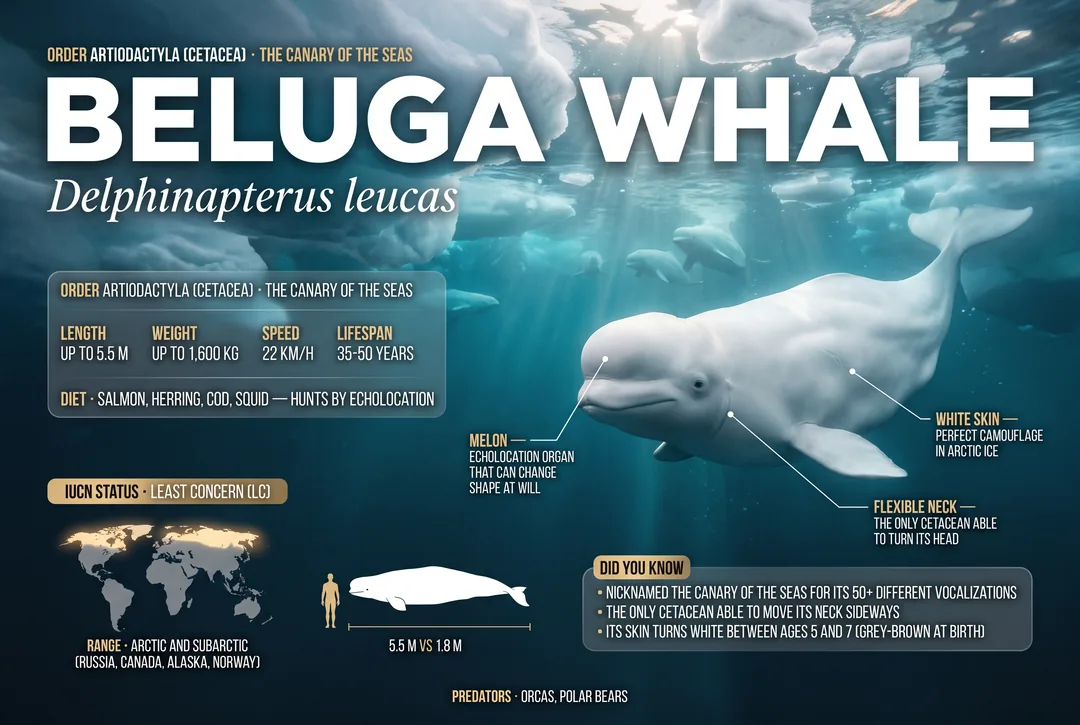
IDENTITY CARD
| Classification | Order Cetacea, family Monodontidae |
| Scientific name | Delphinapterus leucas (Pallas, 1776) |
| Size | 3 to 5.5 m (males larger than females) |
| Weight | 700 to 1,600 kg |
| Speed | 3 to 9 km/h cruising, bursts up to 22 km/h |
| Lifespan | 35 to 50 years (some individuals exceed 70 years) |
| Depth | Surface to 700 m, occasionally beyond 1,000 m |
| Diet | Opportunistic carnivore — fish (capelin, cod, herring), crustaceans, cephalopods, marine worms |
| IUCN Status | Least Concern (LC) globally — but the St. Lawrence population is Endangered |
PORTRAIT
There is a cetacean that sings, whistles, clicks, and chirps with such exuberance that sailors nicknamed it the "canary of the seas." The beluga whale is the most vocal of all cetaceans. It can be heard through the wooden hull of a boat without a hydrophone — a concert of clicks, modulated whistles, and sounds that evoke, by turns, a songbird and a child. This repertoire is not decorative: it serves social communication within groups that can number several hundred individuals, and navigation by echolocation through waters that are often murky and dark.
Delphinapterus leucas — literally "the white dolphin without wings" — is the only cetacean that is entirely white in adulthood. Newborns arrive grey-brown, sometimes slate-colored, and lighten progressively over the years. By five to seven years of age, the coat is uniformly white, effective camouflage in a world of drifting ice and diffused light. This whiteness, combined with a rounded silhouette and the complete absence of a dorsal fin, makes the beluga instantly recognizable — and profoundly endearing.
For divers, the beluga is one of the most accessible and curious cetaceans on the planet. In the St. Lawrence River in Quebec, snorkeling excursions bring observers within meters of belugas in cold but surprisingly clear water. The whales approach of their own accord, intrigued by the humans in the water — they turn their heads to look at you, alter course to pass closer, and vocalize so intensely that the vibrations can be felt in the chest. Churchill, Manitoba, offers similar summer encounters in the shallow waters of Hudson Bay, where hundreds of belugas congregate each year to calve.
HOW TO RECOGNIZE IT
The beluga resembles no other cetacean. Three traits set it apart at first glance: the uniform white color of the adult, the complete absence of a dorsal fin — replaced by a simple dorsal ridge — and a round, prominent head that appears too large for the body.
That head houses the melon, a fatty organ that concentrates and directs the sonar beams of echolocation. In the beluga, the melon is mobile: the animal can change its shape at will, giving it surprisingly readable facial expressions — a "smile," a "frown," a pout. It is one of the few marine mammals whose mood can be read on its face.
Another trait unique among cetaceans: the beluga possesses unfused cervical vertebrae. It can turn its head sideways and nod its neck — a movement impossible for a dolphin or a whale. This flexibility allows it to maneuver in the shallow waters of estuaries and to probe the bottom in search of prey.
For subtitles in English: start the video firstthen click the gearat the top right of the video, select “Subtitles/CC”, then “Auto-translate” and choose “English”.
WAY OF LIFE
The beluga is a gregarious animal. It lives in groups of ten to several hundred individuals, structured by age and sex — mothers and calves on one side, adult males on the other. These groups return every summer to the same estuaries and coastal bays, with remarkable site fidelity: a beluga comes back to the same estuary its entire life, and its descendants after it.
Summer is the season of molting. Belugas rub themselves against the gravel of shallow banks to shed their old skin — a spectacular behavior when dozens of white animals roll in a meter of water in the intertidal zone. The rest of the year, they migrate offshore, following the edge of the pack ice and the channels kept open by currents.
Reproduction is slow. Gestation lasts fourteen to fifteen months, and a female produces only a single calf every three years or so. The young stays with its mother for two years, sometimes longer. This reproductive pace makes populations vulnerable — a decline is hard to reverse when each female produces only five or six calves in a lifetime.
The beluga is also playful. Field observations document chase games, object exchanges (seaweed, pieces of driftwood), and a marked curiosity toward humans — particularly divers and kayakers. It is one of the rare cetaceans that approaches a boat voluntarily rather than fleeing.
WHERE TO SEE IT
The beluga is an Arctic and subarctic animal. Its populations are circumpolar, distributed from Alaska to Russia by way of Canada, Norway, and Greenland. Here are the destinations where observation is most accessible:
Churchill, Manitoba — Canada. This is the beluga capital of the world. Every summer, from June to September, thousands of individuals ascend the Churchill River and fill the estuary of Hudson Bay. The water is shallow, the animals are curious — and Churchill is one of the only places on Earth where it is possible to snorkel with wild belugas. Local operators offer excursions by zodiac, kayak, and dry suit. Visibility is modest (2-5 m), but proximity is extraordinary: the belugas come to you.
St. Lawrence Estuary — Canada. The mouth of the Saguenay River is home to a resident population of approximately 900 belugas — the only non-Arctic population of the species. Observation is by boat from Tadoussac or Riviere-du-Loup, from May to October. Entering the water is prohibited: this population is classified as endangered and strictly protected. But surface observation is remarkable — the belugas share these waters with fin whales, humpbacks, and minke whales, in a concentration of biodiversity found nowhere else.
Svalbard — Norway. The Svalbard archipelago, at 78 degrees north latitude, hosts belugas throughout the summer, from June to September. Sightings occur from expedition vessels navigating between glaciers and the fjords of Spitsbergen. The setting is spectacular — white belugas against blue glacier fronts — but encounters are opportunistic, not guaranteed. Certain northwestern fjords (Kongsfjorden, Krossfjorden) are regular transit corridors.
White Sea — Russia. The White Sea, a southern arm of the Arctic Ocean enclosed in northwestern Russia, harbors a sedentary beluga population. The Solovetsky Islands and Cape Beluzhi (literally "beluga cape") are the historic observation sites, accessible from June to August. Tourism infrastructure is limited, but concentrations are spectacular — dozens of animals in calm, shallow waters.
OBSERVATION CALENDAR
| Destination | J | F | M | A | M | J | J | A | S | O | N | D |
|---|---|---|---|---|---|---|---|---|---|---|---|---|
| Churchill (Canada) | ||||||||||||
| St. Lawrence (Canada) | ||||||||||||
| Svalbard (Norway) | ||||||||||||
| White Sea (Russia) |
Click each button to show/hide
CONSERVATION
Delphinapterus leucas is classified as Least Concern (LC) on the IUCN Red List globally, with a population estimated between 130,000 and 150,000 individuals. But this global status masks vastly different local realities.
The St. Lawrence population is classified as Endangered by COSEWIC (Canada). It numbered around 10,000 individuals before the commercial hunting of the twentieth century; roughly 900 remain today, and the decline has not been halted. The Cook Inlet population (Alaska) is in a comparable situation — some 280 individuals, declining despite the cessation of hunting.
Threats vary by population: chemical pollution (St. Lawrence belugas are among the most contaminated marine mammals on Earth — PCBs, heavy metals, pesticides), underwater noise (vessel traffic directly interferes with communication and echolocation), climate change (retreating pack ice exposes belugas to new predators, particularly orcas), and live capture for aquariums — a practice in decline but not yet extinct.
The responsible observer maintains a distance of 400 meters in the St. Lawrence (Canadian regulation), never pursues a group that moves away, and cuts the engine when animals approach of their own accord.
Organizations to support:
- GREMM — Group for Research and Education on Marine Mammals — monitoring of the St. Lawrence population and photo-identification program
- Polar Bears International / Beluga Boat — research and education at Churchill
- Ocean Wise / Vancouver Aquarium — Arctic beluga research program
- WWF Arctic — protection of Arctic and subarctic habitats
3 THINGS YOU PROBABLY DON'T KNOW
1. It can swim backwards. Thanks to its broad, mobile pectoral fins and flexible neck, the beluga is one of the very few cetaceans capable of swimming in reverse. In the shallow waters of estuaries and ice-clogged channels, this maneuverability makes the difference between feeding and getting stuck. No bottlenose dolphin and no whale can do the same.
2. Its melon changes shape in real time. The melon — the rounded bulge on the forehead — is not rigid. It is a fatty organ that the beluga deforms at will to modulate the direction and frequency of its sound emissions. Observed up close, the melon can be seen undulating, flattening, swelling — as though the animal were "sculpting" its sounds before releasing them. This plasticity, unique among cetaceans, partly explains why the beluga is the ocean's virtuoso of sound.
3. Sailors heard it through the hull. Before the invention of the hydrophone, eighteenth-century whalers already knew that the beluga "sang": its vocalizations, which span a frequency range from 0.1 to 120 kHz, penetrate the wooden hulls of ships. It was this peculiarity that earned it the nickname "canary of the seas" — a name that appears in logbooks well before science took an interest in marine bioacoustics.
PHOTO AND VIDEO TIPS
The beluga is a subject that is both rewarding and demanding. Its white color makes it photogenic in any light — but Arctic conditions complicate the shot.
Lens. From the surface (boat, kayak): a stabilized 70-200 mm covers most situations. Belugas often approach within meters, but a zoom allows framing behaviors at a distance without disturbance. For snorkeling at Churchill: a wide-angle (GoPro or equivalent) is the right choice — the animals come to you, and the challenge is framing them when they are at arm's length.
Light. The Arctic in summer offers low, golden light for extended hours (the sun barely sets, or not at all). Underwater visibility, however, is often limited to 2-5 meters in estuaries — water loaded with sediment and phytoplankton. Backlighting is rarely viable underwater; favor sidelight, which makes the beluga's white stand out against the green of the water.
Approach. A curious beluga approaches on its own. Do not pursue it, do not touch it, do not block its path. Remaining motionless in the water and letting the animal come — that is the best method and the only ethical one. Groups with newborns (dark grey, pressed against the mother) are more distant: respect that distance.
Classic mistake. Overexposing the white. A beluga in full sunlight fools the metering of any camera: the body underexposes everything else to compensate for the white mass. Correct by at least +0.7 EV, or meter manually on the water rather than on the animal.