Sea Otter
Enhydra lutris
It cracks shellfish with a stone, sleeps holding hands, and wears the densest fur in the animal kingdom.
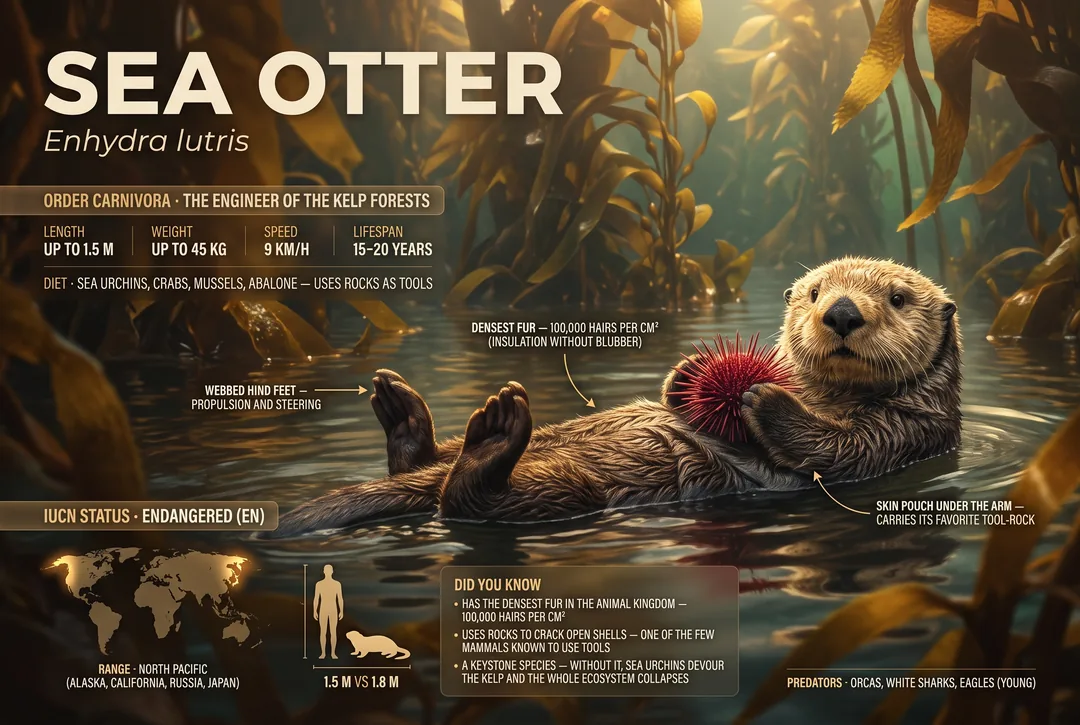
IDENTITY CARD
| Classification | Order Carnivora, family Mustelidae |
| Scientific name | Enhydra lutris |
| Size | 1.00 to 1.50 m (males up to 1.50 m, females up to 1.20 m) |
| Weight | 14 to 45 kg (males 22-45 kg, females 14-33 kg) |
| Speed | ~9 km/h swimming, ~1.5 km/h cruising |
| Lifespan | 15 to 20 years (males ~15, females ~20) |
| Depth | Common dives 5-20 m, capable of reaching 100 m |
| Diet | Carnivore — sea urchins, abalone, mussels, crabs, clams, small fish |
| IUCN Status | Endangered (EN) — approximately 125,000 individuals |
PORTRAIT
You spot it from a distance before anything else registers. A dark shape floating on its back in a raft of kelp, a flat stone balanced on its belly, a sea urchin clamped between stubby forepaws. Then it strikes — a sharp crack that carries across the water — and you realize you are watching one of the most intelligent marine mammals on Earth use a tool, exactly the way its ancestors have done for millennia. The sea otter is the smallest marine mammal but perhaps the most charismatic, a creature whose daily rituals — cracking, grooming, floating, holding hands — look almost theatrically human.
Beneath the charm lies extraordinary biology. Enhydra lutris carries the densest fur of any mammal ever measured: up to 150,000 hairs per square centimetre — roughly one million per square inch, more than a human head holds in total. Unlike seals and whales, the sea otter has no blubber. Its survival in the frigid North Pacific depends entirely on that fur and the layer of air it traps against the skin. This makes grooming a matter of life and death: much of the day is spent blowing air into the coat, rolling at the surface, and combing through the undercoat with those dexterous forepaws. A single oil stain can destroy the insulation and kill the animal within hours.
For divers and kayakers, the encounter is intimate rather than dramatic. Sea otters inhabit shallow kelp forests along the Pacific coast, often within metres of shore. They tolerate quiet observers remarkably well — a kayaker drifting through a Monterey kelp bed may find an otter cracking abalone ten metres away, entirely unconcerned. The moments to watch for are the ones no aquarium can reproduce: a mother grooming her pup on her belly, a raft of dozens sleeping at dusk with paws intertwined, or a lone individual diving and resurfacing with a prize, the same stone waiting faithfully in its armpit.
HOW TO RECOGNIZE IT
The sea otter is much larger than any river otter and entirely marine — it almost never comes ashore. Its long, fusiform body ends in short, webbed hind feet that are broad and flat like flippers, while the forepaws are short, round, and mitten-like, built for gripping prey and wielding tools rather than swimming. The tail is short, thick, and flattened — a compact rudder, nothing like the long, tapering tail of a river otter.
Fur colour ranges from dark chocolate brown to light tawny brown. The head and neck are often noticeably paler, and in old individuals the face can turn almost white — a distinctive field mark visible at range. The muzzle is short and rounded, set with extremely sensitive vibrissae that the otter uses to locate prey by touch in murky water.
The single most reliable field identification: a sea otter floating on its back. No other marine mammal habitually adopts this posture at the surface.
For subtitles in English: start the video firstthen click the gearat the top right of the video, select “Subtitles/CC”, then “Auto-translate” and choose “English”.
WAY OF LIFE
The sea otter is an animal of the coastal North Pacific, inseparable from the giant kelp forests that provide its food, shelter, and anchor. At rest, it wraps fronds of kelp around its body to avoid drifting with the current — a living mooring line. When a group sleeps together, individuals hold paws, forming rafts of dozens to hundreds of animals that bob in unison through the night. The image of two otters clasping each other's paws at sunset is not anthropomorphic projection; it is a practical strategy for staying together.
Tool use sets the sea otter apart from nearly every other marine species. An otter dives to depths of 40 metres or more, pries a sea urchin or abalone from the rock with its forepaws, tucks a flat stone under one arm, and returns to the surface. Floating on its back, it places the stone on its belly and hammers the prey against it until the shell cracks. Researchers have documented individual stone preferences — flat stones for abalone, rounder ones for mussels — and some otters keep the same favourite stone for years, storing it in a loose pouch of skin beneath the armpit. Wear patterns on retrieved stones confirm that each otter develops its own technique.
This lifestyle demands phenomenal energy. A sea otter's metabolic rate runs 2.5 times higher than expected for a mammal of its size. To fuel that furnace, it eats 25 to 30 percent of its body weight every single day — the equivalent of a human consuming 15 to 20 kilograms of food between sunrise and sunset.
WHERE TO SEE IT
Monterey Bay, California. The undisputed capital of sea otter watching. Some 3,000 otters live in and around the bay, many of them visible from shore along Cannery Row and the coastal trail. Kayaking through the kelp forest here offers the closest, most relaxed encounters anywhere — otters are habituated to quiet paddlers and often feed within arm's reach. Available year-round.
Alaska. Home to the largest population, approximately 90,000 animals. Kenai Fjords, Katmai, and Prince William Sound all offer reliable sightings from boats and shorelines. Best from May to September, when weather and daylight cooperate.
British Columbia — Vancouver Island and Tofino. One of conservation's great success stories: from just 13 individuals reintroduced in 1969-1972, the population has grown to over 8,000. The west coast of Vancouver Island, particularly around Tofino, offers excellent kayaking encounters. Best from May to October.
Commander Islands, Russia. The ancestral home of the nominate subspecies E. l. lutris, where naturalist Georg Wilhelm Steller first described the species in 1751. Remote and difficult to reach, but a pilgrimage for those who want to see the otter where Western science first found it.
CONSERVATION
The sea otter's history is one of near-annihilation and incomplete recovery. Before the fur trade began in 1741, an estimated 150,000 to 300,000 otters ranged across the North Pacific from Japan to Baja California. By 1911, when the International Fur Seal Treaty finally halted commercial hunting, fewer than 2,000 remained — scattered in a handful of remnant colonies. The species has never recovered its full historic range.
Modern threats are subtler but persistent. The Exxon Valdez oil spill in 1989 killed an estimated 2,800 otters in Prince William Sound — a catastrophe that demonstrated how a single environmental accident can devastate a fur-dependent species. Since the 1990s, orca predation on otters has increased significantly in Alaska, possibly because the orcas' preferred prey — seals and sea lions — have themselves declined. Urban runoff carries Toxoplasma gondii and other parasites from domestic cats into coastal waters, causing fatal brain infections in otters. And fishery conflicts persist wherever otters compete with humans for abalone and crab.
The sea otter is a textbook keystone species. By feeding on sea urchins, it controls urchin populations. Without otters, urchins multiply unchecked and devour kelp forests, creating barren underwater deserts. With otters, kelp thrives — and with it, the hundreds of species that depend on kelp habitat. Research has shown that kelp forests with healthy otter populations sequester up to 12 times more carbon than urchin barrens, making the sea otter an unlikely but powerful ally in climate regulation.
Organisations to support:
- Friends of the Sea Otter — advocacy and education in California
- Monterey Bay Aquarium — sea otter rescue and rehabilitation programme
- Vancouver Aquarium Marine Mammal Rescue Centre — rescues and rehabilitates otters in British Columbia
- IUCN Otter Specialist Group — global otter conservation science
3 THINGS YOU PROBABLY DON'T KNOW
1. Its fur is denser than anything else that has ever lived. Up to 150,000 hairs per square centimetre — more than an entire human head carries in total. The coat has a double structure: a fine, wavy underfur that traps air, and longer guard hairs that shed water. The result is that the otter's skin never touches cold water. A compromised coat means death within hours in the North Pacific.
2. It chooses its tools. Sea otters show individual stone preferences — flat stones for prying abalone, rounder ones for cracking mussel shells. Some individuals keep the same stone for years, storing it in a fold of armpit skin between dives. Researchers have found distinctive wear patterns on recovered stones that prove each otter develops its own hammering technique, passed from mother to pup.
3. Without it, entire kelp forests vanish — and the change is visible from space. This is one of the best-documented trophic cascades in ecology: the otter eats the urchin, the urchin stops eating the kelp, the kelp shelters hundreds of species from fish to invertebrates. Remove the otter and the cascade reverses — urchin barrens replace kelp forest across thousands of square kilometres. Satellite imagery clearly shows the difference between coastlines with otters and those without.
PHOTO AND VIDEO TIPS
Lens. From shore, a telephoto in the 200-400 mm range is essential — otters may be 50 to 100 metres out. From a kayak, where distances shrink to 10-15 metres, a 70-200 mm zoom offers more flexibility. A GoPro mounted on the kayak captures context shots of the kelp forest environment.
Exposure. Dark, wet fur absorbs light aggressively. Overexpose by +0.7 to +1 EV above what the meter suggests, or the otter will render as a featureless dark blob against bright water. Early morning and late afternoon light is ideal — the golden tones of the fur come alive.
Key moments. The images that define the species: a mother grooming her pup on her belly, an otter smashing a shell against a stone (freeze at 1/1000s minimum), and the sleeping raft at sunset — dozens of animals floating together, paws intertwined, kelp draped over their bodies.
Ethics. Keep a respectful distance — otters tolerate quiet observers at 10-15 metres but will dive and relocate if startled. Never paddle directly toward an otter; drift parallel and let curiosity close the gap. In Monterey, observe posted approach guidelines and never attempt to feed or touch.