Sea Lion
Family Otariidae
The acrobat of the seas has external ears, walks on its flippers, and comes to stare right into your mask.
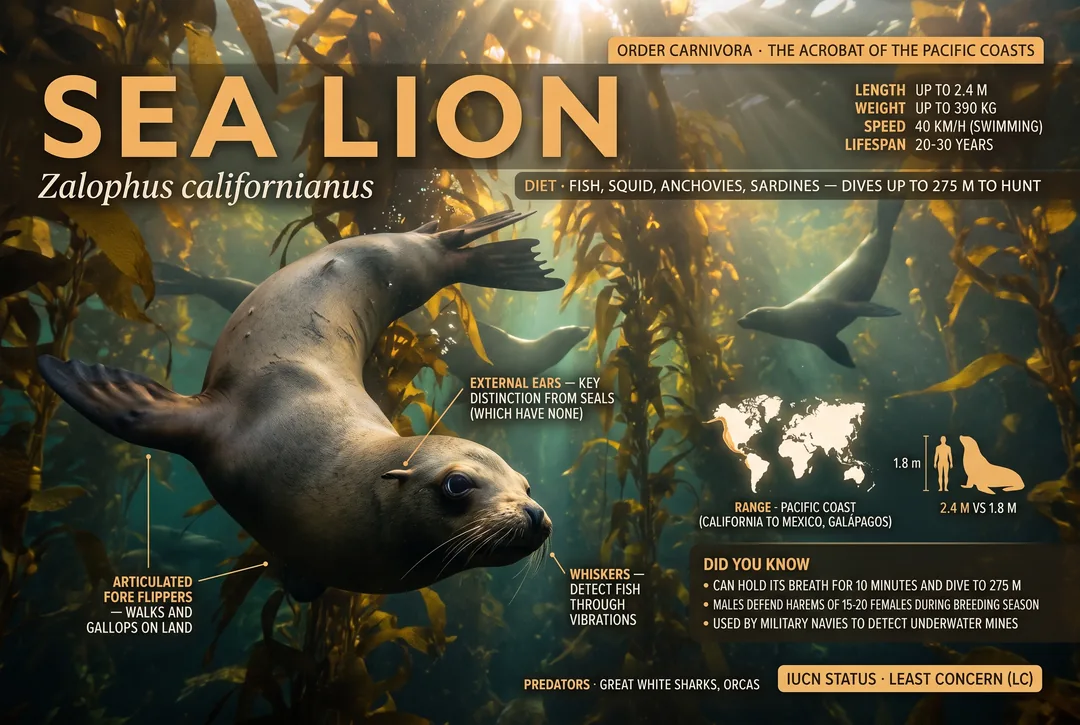
IDENTITY CARD
| Classification | Order Carnivora, family Otariidae (sea lions and fur seals) — 7 genera, 15 living species |
| Scientific name | Family Otariidae (Gray, 1825) |
| Size | 1.5 to 3.5 m depending on species and sex |
| Weight | 50 to 350 kg; male Steller's sea lion up to 1,100 kg |
| Speed | Up to 40 km/h (top speed), 10-15 km/h cruising |
| Lifespan | 15 to 25 years in the wild (up to 30) |
| Depth | Regular dives to 200 m, occasionally beyond 400 m |
| Diet | Fish, squid, crustaceans, sometimes penguins (larger species) |
| IUCN Status | Varies by species — Least Concern (LC) to Endangered (EN) |
PORTRAIT
Some animals you go to see. Others come to see you. The sea lion belongs firmly to the second category. It rockets out of the blue at full speed, brakes twenty centimetres from your mask, tilts its head to examine you with one enormous dark eye — then spirals away as if the entire encounter were a game only it understood the rules of. No other marine animal combines that velocity, that curiosity, and that unmistakable sense of humour.
Otariidae — fifteen species spread from the subantarctic ice shelves to the tropical lava shores of the Galapagos. The word "otary" comes from the Greek otarion, meaning "little ear," and that is the key: unlike true seals, which have no external ear flaps, every otariid wears a pair of small, pointed pinnae on the sides of its skull. But the real difference is locomotion. A sea lion walks — on powerful front flippers used as arms, rear flippers pivoting forward as feet. A seal crawls. Underwater the contrast sharpens: sea lions "fly," beating their front flippers like wings in a motion closer to a penguin than to any other marine mammal; seals undulate, propelled by their hind end. Sexual dimorphism is extreme — males of the large species weigh three to five times what females do, and grow a thick neck mane that earned the family its common name.
Intelligence in otariids is well documented — complex learning tasks, comprehension of logical sequences, social cooperation observed both in captivity and in the wild. Combined with their innate curiosity, it makes underwater encounters uniquely interactive. The sea lion does not simply show up on a dive. It engages — circling, mimicking, testing, retreating, returning. You are not watching wildlife. You are being interviewed by it.
HOW TO RECOGNIZE IT
You will usually identify a sea lion by its behaviour before you get a clear look at its body. No other animal combines that speed, that agility, and that direct frontal curiosity. It charges at a diver, circles at arm's length, blows bubbles, nibbles fin tips, and vanishes — only to reappear from behind.
When you do get a proper look: the body is fusiform, longer and noticeably more flexible than a true seal's. The front flippers are long, flat, and clawless — genuine wings, not paddles. The shorter rear flippers fold underneath the body on land, allowing the animal to walk and even gallop across rocks. The snout is pointed, the eyes large and dark, and the small external ears — the diagnostic field mark — sit just behind the eye line.
The coat is short and dense, ranging from dark chocolate brown to golden blond depending on species, sex, and how dry or wet the animal is. Males of the larger species — Steller's, South American — develop a massive, thickened neck and broad chest that dwarf the sleeker females hauled out beside them.
For subtitles in English: start the video firstthen click the gearat the top right of the video, select “Subtitles/CC”, then “Auto-translate” and choose “English”.
WAY OF LIFE
A sea lion's existence splits between two worlds. It hunts at sea — often at night, when fish and squid rise toward the surface — and rests on land in dense, cacophonous colonies draped over rocky shorelines, sandy beaches, and, increasingly, harbour docks and marina pontoons.
Hunting is built on agility, not brute power. A sea lion chases individual prey with lightning direction changes, banking and rolling through a baitball the way a fighter jet threads a canyon. Dives last three to eight minutes on average, though longer submersions have been recorded in Australian sea lions and Steller's.
Reproduction follows a rigid annual cycle. Males arrive at the breeding grounds first and fight — violently — to establish and hold territories. Successful bulls may hold a harem of a dozen or more females for weeks, barely eating. Gestation lasts about eleven months, with delayed implantation allowing the female to give birth and conceive again in the same short season. A single pup is born each year. The mother alternates between fishing trips at sea and nursing bouts on shore for six to twelve months, recognising her own pup among hundreds by a unique vocal duet learned in the first hours after birth.
At sea, sea lions practise unihemispheric sleep — one brain hemisphere sleeps while the other stays alert. The classic posture is the "sailboat": the animal floats at the surface with one flipper raised above the water to thermoregulate, apparently dozing. On land, both hemispheres shut down at once, and the snoring can be heard from fifty metres away.
WHERE TO SEE IT
Sea lions are found across the Pacific, the Southern Ocean, and parts of the South Atlantic. Here are the encounters that define the family for divers:
Galapagos — Ecuador. The Galapagos sea lion (Zalophus wollebaeki, EN) is endemic and utterly fearless. Juveniles are the most playful — they blow bubbles into your mask, nibble your fins, spiral around you in corkscrews, and stare into your lens from ten centimetres away. Gordon Rocks, North Seymour, and Kicker Rock are the marquee sites. Animals are present year-round, with peak playfulness from January to May when juveniles are most active.
La Paz — Sea of Cortez, Mexico. Isla Espiritu Santo and its satellite Los Islotes host a resident colony of California sea lions (Zalophus californianus) that has become legendary among underwater photographers. The juveniles are as interactive as their Galapagos cousins, and the water is warmer. Best conditions from September to December.
Baird Bay — South Australia. The Australian sea lion (Neophoca cinerea, EN) is endemic, non-migratory, and one of the rarest pinnipeds on Earth — fewer than 12,000 individuals remain. Baird Bay offers guided snorkelling encounters with a habituated group in shallow, clear water. Year-round.
Hornby Island — British Columbia, Canada. Steller's sea lion (Eumetopias jubatus) is the largest otariid — males exceed three metres and 1,000 kg. Diving with them in the cold green waters of British Columbia (7-12 C) is a radically different experience from the tropics: these are not playful juveniles but imposing adults, and the encounter is as much about awe as about interaction. Best from September to May.
Farne Islands — United Kingdom. A note of honesty: the pinnipeds at the Farnes are grey seals (Halichoerus grypus), not otariids. But their playful underwater behaviour — chewing on fins, barrel-rolling around divers, pressing their noses against masks — is so similar that any diver who loves sea lion encounters will love this one. Over 5,000 individuals. Best from July to October.
OBSERVATION CALENDAR
| Destination | J | F | M | A | M | J | J | A | S | O | N | D |
|---|---|---|---|---|---|---|---|---|---|---|---|---|
| Galapagos (Ecuador) | ||||||||||||
| La Paz (Mexico) | ||||||||||||
| Baird Bay (Australia) | ||||||||||||
| Hornby Island (Canada) | ||||||||||||
| Farne Islands (UK) |
Click each button to show/hide
CONSERVATION
Conservation status varies sharply across the family. The California sea lion is thriving — roughly 250,000 individuals, population stable or increasing, listed as Least Concern. At the other end of the spectrum, the Galapagos sea lion is Endangered, hammered by recurring El Nino events that collapse its food supply. The Australian sea lion is also Endangered, with an estimated 10,000 to 12,000 individuals remaining — the smallest population of any sea lion species. The South American sea lion is Least Concern globally but faces severe local declines in parts of its range.
Cross-cutting threats affect the entire family. Plastic pollution kills through entanglement — discarded fishing nets, packing bands, and debris wrap around necks and flippers, causing slow strangulation or starvation. Bioaccumulation of heavy metals and persistent organic pollutants concentrates up the food chain, weakening immune systems and reducing reproductive success. Colony disturbance from unregulated tourism and coastal development pushes animals off critical haul-out and breeding sites. And ocean warming — the deepest, slowest threat — is shifting prey distributions in ways that force longer foraging trips and lower pup survival rates.
Organisations to support:
- Galapagos Conservation Trust — protection and research in the Galapagos archipelago
- Marine Mammal Center — rescue, rehabilitation, and research on the US Pacific coast
- Seal Conservation Society — global pinniped conservation and education
- BirdLife International / Australian Sea Lion Research — monitoring of threatened Australian populations
3 THINGS YOU PROBABLY DON'T KNOW
1. It can sleep with one brain hemisphere at a time. Like dolphins, sea lions practise unihemispheric slow-wave sleep — one half of the brain rests while the other keeps watch for predators and maintains basic swimming. At the surface this produces the "sailboat" posture: the animal floats on its side with one flipper raised out of the water, apparently dozing. On land, it sleeps with both hemispheres simultaneously — and snores with enough volume to wake a dive guide at thirty paces.
2. Its whiskers work as passive sonar. The vibrissae — the long, stiff whiskers on the muzzle — detect hydrodynamic disturbances left by swimming fish. In controlled experiments, blindfolded and ear-plugged sea lions successfully followed the trail of a robot fish using only their whiskers, tracking the wake up to thirty seconds after the fish had passed. Each whisker sits in a richly innervated follicle, making the muzzle one of the most sensitive tactile organs in the mammalian world.
3. Every mother and pup share a unique vocal duet. In a colony of thousands, a mother returning from a fishing trip finds her pup within minutes. The mechanism is acoustic: from the first hours after birth, mother and pup learn each other's call — a unique combination of frequency, rhythm, and timbre that functions as a name. She calls from the water's edge; the pup answers from somewhere in the mass of bodies on shore; they converge, confirm identity by smell, and nursing begins. The system is so precise that playback experiments have shown a mother ignoring recorded calls of other pups while turning immediately toward her own.
PHOTO AND VIDEO TIPS
The sea lion is a formidable and exasperating photographic subject. It comes to you, it is spectacularly photogenic, it genuinely seems to enjoy the camera — but it moves too fast, gets too close, and is too unpredictable for careful composition.
Lens. Wide-angle fisheye (10-17 mm) or an action camera is the right choice. The animal will be at arm's length or closer, and you need to capture both the subject and the blue-water context. Telephoto is nearly useless — by the time you find it in the viewfinder, it has moved.
Light. Natural light is usually sufficient for wide-angle work. The encounters happen in shallow, sunlit water — strobes are optional and often a hindrance, since the sea lion may flinch at the first pop and vanish. Ambient light, a fast shutter speed, and a high ISO are the working formula.
Strategy. The sea lion is the only underwater subject where the best strategy is to not move at all. Sit on the bottom, stay completely immobile, and let the animal come to you. Chasing it produces blurred, badly framed images and shorter encounters. Stillness produces curiosity, proximity, and time.
Common mistake. Shooting too late. The sea lion arrives, you react, it is already gone. Set burst mode, pre-frame the area where the animal will pass, and press the shutter before it enters the frame. If you wait until you see it clearly in the viewfinder, you have already missed the shot.