Vampire Squid
Vampyroteuthis infernalis
Neither squid nor octopus: the sole survivor of an order 200 million years old drifts through the absolute darkness of the deep ocean.
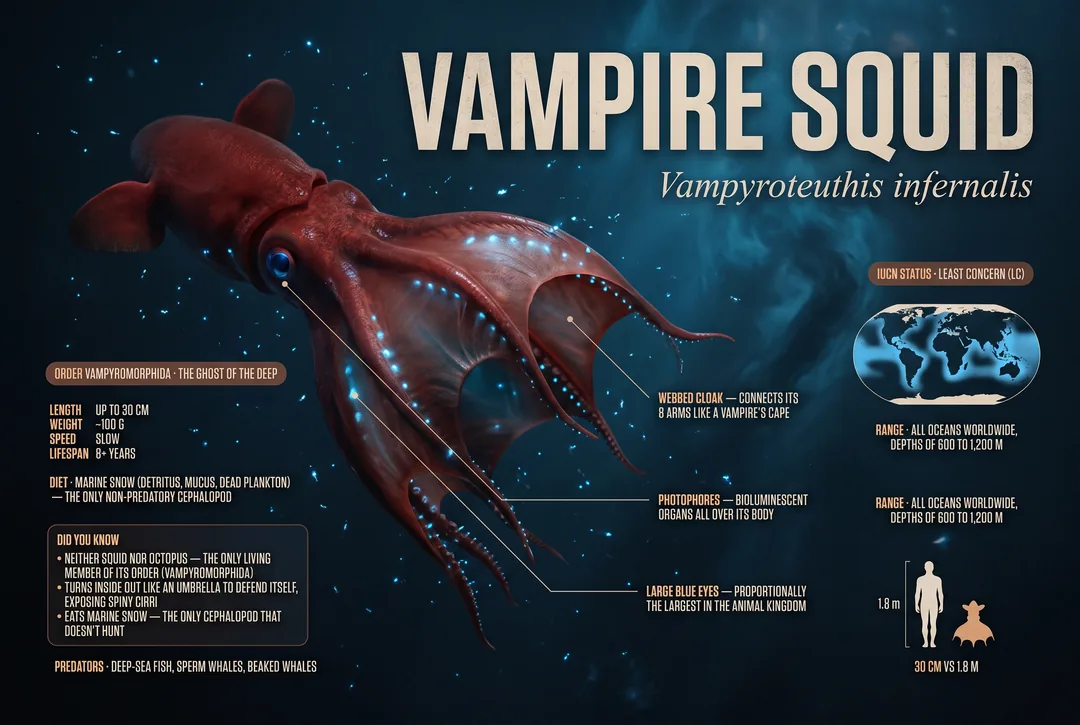
IDENTITY CARD
| Classification | Order Vampyromorphida, family Vampyroteuthidae — sole living species of the order |
| Scientific name | Vampyroteuthis infernalis (Chun, 1903) |
| Size | Up to 30 cm (mantle); total span with arms: approximately 40 cm |
| Weight | Less than 500 g |
| Speed | ~2 knots (~3.7 km/h) — slow, but capable of brief accelerations by jet propulsion |
| Lifespan | Estimated at 8 years or more (poorly known) |
| Depth | 600 to 1,200 m — the heart of the oxygen minimum zone (OMZ) |
| Diet | Detritivore — marine snow, organic aggregates, microscopic carcasses, planktonic mucus |
| IUCN Status | Least Concern (LC) — but data insufficient, species very poorly studied |
PORTRAIT
Its Latin name literally means "vampire squid from hell." In 1903, the German zoologist Carl Chun described it for the first time from specimens hauled up from the depths of the Atlantic, and the taxonomists hesitated: the eight webbed arms suggested an octopus, while the pair of retractile filaments recalled the tentacles of a squid. It was placed successively among one and then the other, before being accorded its own order — the Vampyromorphida. Only one living species remains today, making Vampyroteuthis infernalis a living fossil in the strictest sense: its lineage dates back to the Jurassic, more than 200 million years.
The animal lives between 600 and 1,200 metres deep, in the oxygen minimum zone — a band of water where dissolved oxygen concentration drops below 5% of surface saturation. At this depth, sunlight no longer penetrates, temperature hovers between 2 and 6 degrees Celsius, and pressure exceeds 100 atmospheres. Few predators are capable of surviving here. The vampire squid, however, thrives: its blood transports oxygen with remarkable efficiency thanks to a particularly high-performance haemocyanin, and its metabolism is among the lowest ever measured in a cephalopod.
Despite a name that promises terror, the animal is disarmingly gentle. It does not hunt. It does not bite. It deploys two long sticky filaments — structures unique in the animal kingdom — to capture "marine snow," the unending flux of organic detritus that drifts slowly from the surface toward the abyss. It is one of the few cephalopods that is entirely detritivorous. The vampire from hell feeds only on what others have left to die.
HOW TO RECOGNIZE IT
The first thing that strikes you on the rare images captured by ROVs or submersibles is the colour: a deep red, almost black in the darkness of the deep, which turns to velvety brown under the lights. This deep red, combined with its interdigital membrane, earned it the name "vampire" — the web of skin connecting the eight arms evokes a Dracula's cape. The interior of this membrane is black and lined with fleshy spine-shaped structures called cirri, which are not suckers but sensory organs.
The eyes are immense — proportionally the largest in the animal kingdom — of a crystalline blue or a deep red depending on the angle and the lighting. They measure up to 2.5 cm in diameter for an animal with a 15 cm mantle, the equivalent of a tennis-ball-sized eye in a human. These eyes are perfectly adapted to detecting the faintest glimmers in absolute darkness: flashes of bioluminescence from prey or predators, residual sunlight at the upper limits of its habitat.
The entire body is studded with photophores — light-producing organs that the animal controls at will. Two large photophores at the base of the fins produce an intense blue-white flash. Dozens of smaller ones cover the arm tips and the mantle surface. The animal can light them in sequence, creating complex luminous patterns, or extinguish them all at once to vanish into the darkness. Two small ear-shaped fins on the top of the mantle give it a round and almost comical silhouette when it swims slowly — a striking contrast with the monstrosity its name suggests.
For subtitles in English: start the video firstthen click the gearat the top right of the video, select “Subtitles/CC”, then “Auto-translate” and choose “English”.
WAY OF LIFE
Vampyroteuthis infernalis occupies an ecological niche without equivalent among cephalopods. Where squids hunt and octopuses forage, it harvests. Its two retractile filaments — which can extend up to eight times the body length — are covered in adhesive cells. The animal deploys them into the water column like passive fishing lines, capturing particles of marine snow: debris of dead plankton, faecal pellets from zooplankton, mucus from larvaceans, fragments of microscopic carcasses. The filaments retract, the animal scrapes the detritus with its arms and agglomerates it into a mucilaginous bolus that it brings to its mouth. This feeding mechanism, described in detail by MBARI in 2012, overturned decades of assumptions: scientists had long believed, on the basis of its name and morphology, that the animal was an active predator.
When a predator approaches — a lanternfish, a deep-sea squid — the vampire squid does not flee. Its defence strategy is unique. It literally turns its membrane inside out over its head in a posture known as the "pumpkin" or "pineapple": the arms fold back over the mantle, the black interior of the membrane faces outward, and the photophores at the arm tips light up. The predator faces a black sphere bristling with luminous points, devoid of any recognisable contour, with no eyes or mouth visible. If the stratagem fails, the animal can eject a cloud of bioluminescent mucus — not ink, which it no longer produces, but a veil of luminous particles that float for several minutes, drawing the predator's attention while the vampire retreats into the darkness.
Reproduction remains poorly understood. Females carry a small number of large eggs — perhaps a hundred — and appear to brood them for a long time, in a reproductive cycle that may be the slowest of any known cephalopod. Unlike octopuses and squids, which generally die after a single reproduction (semelparity), Vampyroteuthis appears capable of reproducing multiple times over its life (iteroparity) — a probable adaptation to the rarity of encounters in the darkness of the deep.
WHERE TO SEE IT
The vampire squid is not an animal one encounters on a recreational dive. Its habitat begins where scuba diving ends — between 600 and 1,200 metres, well beyond the reach of the most advanced rebreathers. To observe it alive requires a submersible or an ROV — and patience.
Monterey Bay — California. This is where science truly came to know Vampyroteuthis. The Monterey Bay Aquarium Research Institute (MBARI), founded by David Packard, operates a fleet of ROVs in the Monterey submarine canyon — a trench 3,600 metres deep that opens just a few kilometres from the coast. The cumulative observations by MBARI since the 1990s constitute the bulk of what is known about the species in situ. MBARI's videos, freely available on their public channel, remain the best way to see the animal alive.
Gulf of California (Sea of Cortez). The deep waters between Baja California and the Mexican mainland harbour a particularly extensive oxygen minimum zone. Oceanographic expeditions have filmed Vampyroteuthis here on multiple occasions. It is also one of the most accessible regions for visiting divers, who can explore the surface waters knowing that, 800 metres below, the vampire drifts in the dark.
Gulf of Guinea and tropical Atlantic. The species was first described in the Atlantic, and specimens have been observed or captured off the coast of West Africa, in the Caribbean, and off Brazil. Its distribution is probably cosmopolitan in temperate and tropical waters — wherever an oxygen minimum zone is sufficiently developed.
Tourist submersibles. The rise of civilian submersibles opens a possibility that remains marginal but real. Operators such as Triton Submarines offer deep dives accessible to a committed audience. Observation of the vampire squid is never guaranteed, but it is among the species regularly filmed during descents into the mesopelagic and bathypelagic zones.
OBSERVATION CALENDAR
Observation of Vampyroteuthis infernalis does not depend on seasons in the strict sense — the animal lives in an environment where temperature, light, and currents vary minimally throughout the year. The table below indicates the most favourable periods for research campaigns and submersible dives in the regions where the species is known.
| Destination | J | F | M | A | M | J | J | A | S | O | N | D |
|---|---|---|---|---|---|---|---|---|---|---|---|---|
| Monterey Bay (ROV/MBARI) | ||||||||||||
| Gulf of California | ||||||||||||
| Tropical Atlantic | ||||||||||||
| Gulf of Guinea |
Click each button to show/hide
Note: the symbols reflect weather and logistical conditions at the surface (navigable sea, scheduled research campaigns), not the presence of the animal at depth, which is permanent.
CONSERVATION
Vampyroteuthis infernalis is classified as Least Concern (LC) on the IUCN Red List, but this assessment reflects a lack of data more than an absence of threats. The species has no commercial value, is not fished, and lives at depths that human activity reaches only indirectly. But "indirectly" does not mean "without consequence."
The oxygen minimum zones — the species' sole known habitat — are expanding under the effect of climate change. At first glance, this might seem favourable to an animal adapted to low oxygen. In reality, models suggest that the expansion of OMZs is altering the composition of the marine snow descending from the surface — Vampyroteuthis' only food source. A reduction in surface planktonic productivity, well documented in certain basins, could affect the species upstream of its own zone of life. Microplastic pollution, which now reaches the deepest trenches, represents an emerging threat not yet quantified for deep-sea detritivores.
The greatest challenge remains the lack of knowledge. How many individuals exist? Where do they reproduce? What is the effective population size? These fundamental questions have no answer. The animal is too deep for routine surveys, too rare for research trawls, and too fragile to survive being brought to the surface. Every observation is precious.
Organisations and research programmes:
- MBARI — Monterey Bay Aquarium Research Institute — principal centre for in situ study of Vampyroteuthis, video archives spanning over 30 years
- Census of Marine Life — global inventory of marine biodiversity, including mesopelagic and bathypelagic species
- Deep-Sea Conservation Coalition — international coalition for the protection of deep-sea ecosystems
- IUCN Deep-Sea Specialist Group — conservation assessment of deep-sea species
3 THINGS YOU PROBABLY DON'T KNOW
1. It is neither a squid, nor an octopus, nor a vampire. Despite its name, Vampyroteuthis infernalis — literally "vampire squid from hell" — does not drink blood, does not hunt, and belongs to neither the squids (Teuthida) nor the octopuses (Octopoda). It is the sole living representative of the order Vampyromorphida, a distinct group older than either. Carl Chun, who described it in 1903, chose a spectacular name based on its appearance — the red-black membrane between the arms, the immense eyes, the spine-like cirri. The real animal is one of the most placid cephalopods in existence.
2. It breathes where others suffocate. The vampire squid lives in the heart of oxygen minimum zones, between 600 and 1,200 m — waters where O2 concentration can drop to 3% of surface saturation. At these levels, most cephalopods, which are heavy oxygen consumers, would die within minutes. Vampyroteuthis survives thanks to three adaptations: a haemocyanin with exceptional oxygen affinity, an extremely low metabolism (the lowest measured in any cephalopod), and a gelatinous body with low muscle density that reduces energy requirements. It barely swims: it floats, and waits for food to drift down to it.
3. It does not squirt ink — it squirts light. Squids and octopuses eject a cloud of black ink to cover their escape. The vampire squid has lost this ability through evolution — logically, since black ink is invisible in absolute darkness. Instead, it fires a jet of mucus laden with bioluminescent particles that form a glowing cloud persisting for several minutes. The predator attacks the cloud while the animal, all photophores extinguished, slips away into the dark. It is an inverted decoy: instead of creating darkness in light, it creates light in darkness.
PHOTO AND VIDEO TIPS
Photographing a living vampire squid in its natural environment is a logistical feat, not a matter of standard photographic technique. The animal lives between 600 and 1,200 metres — you need an ROV or a submersible, and the bulk of existing imagery comes from oceanographic research campaigns, not dive trips.
Equipment. Scientific ROVs are fitted with HD or 4K cameras at high sensitivity, powerful LED lighting, and manipulator arms. For dives in a tourist submersible, a camera capable of filming in low light (large sensor, high ISO capability) and a clean viewport are the only controllable factors. The thick viewports of submersibles distort the image — a fixed focal-length lens compensates for aberrations better than a zoom.
Lighting. The central paradox: you must illuminate the animal to film it, but artificial light disturbs it. ROV projectors often trigger the defensive "pumpkin" posture — spectacular, but a sign of the stress imposed. MBARI teams use dimmed red lighting for initial approaches, then switch to white light for close-up shots. The animal appears to tolerate red light far better than white — its photophores emit in the blue range, and its eyes are likely less sensitive to red wavelengths.
Patience. The encounter is fleeting. A Vampyroteuthis filmed by an ROV remains in the camera's field for between a few seconds and a few minutes. Its slowness is an advantage — it does not bolt — but its tendency to extinguish all photophores and let itself sink into the darkness makes tracking difficult once it decides to disappear. The best sequences are those where the animal is filmed in gentle lateral approach, without sudden changes in illumination.
For the armchair diver. The MBARI and Schmidt Ocean Institute videos, freely accessible online, offer the finest existing footage of the species. For presentations, club talks, or educational projects, these archives constitute an exceptional resource — and a reminder that the deep ocean, beyond the reach of our fins, harbours forms of life as strange as they are elegant.