Common Octopus
Octopus vulgaris
Three hearts, blue blood and nine brains: the ocean's most intelligent mollusc fits through a clenched fist — and escapes from it.
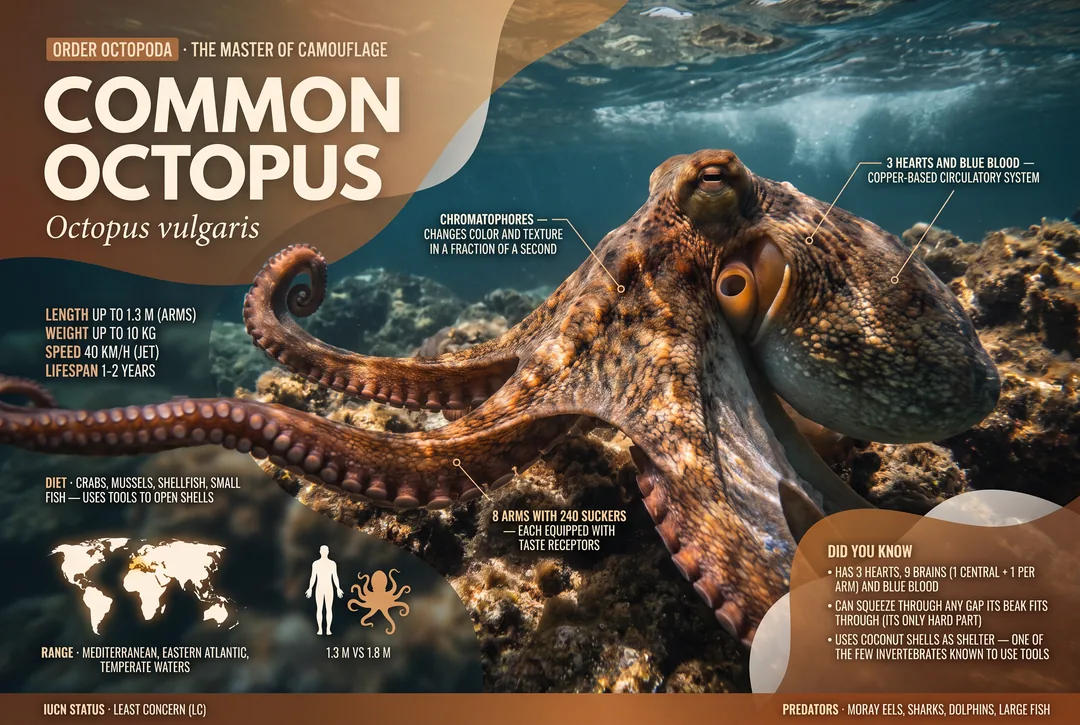
IDENTITY CARD
| Classification | Order Octopoda, family Octopodidae |
| Scientific name | Octopus vulgaris (Cuvier, 1797) |
| Size | Up to 1.3 m arm span (mantle: 15-25 cm) |
| Weight | Up to 10 kg (typically 3-5 kg at adult size) |
| Speed | Up to 40 km/h in short bursts via jet propulsion through its siphon — slow crawling day-to-day |
| Lifespan | 1 to 2 years only — one of the shortest life cycles in the animal kingdom for a creature this size |
| Depth | Surface to 200 m, most commonly observed between 0 and 30 m |
| Diet | Nocturnal predator — crabs, bivalves, shellfish, small fish |
| IUCN Status | Least Concern (LC) — one of the few iconic marine species in this category |
PORTRAIT
There is no underwater encounter quite like it. You spot a shapeless mass on the sand, the colour of sand, the texture of rock — and then something moves, an eye opens, and the rock reveals itself to be an animal. Octopus vulgaris is a camouflage master so accomplished that most divers swim right past without noticing, even those actively searching for one.
The common octopus is a mollusc — a cousin of the whelk and the oyster, which always surprises people the first time they hear it. Nothing in its anatomy gives this away: three hearts circulate blue blood, rich in haemocyanin rather than haemoglobin, and its nervous system contains roughly 500 million neurons distributed between a central brain and eight nerve clusters, one in each arm — to the point that each arm can taste, touch and react almost autonomously, even for a few seconds after being severed. This intelligence is not the invention of nature documentaries. It has been measured in laboratories for decades: unscrewing jars from the inside, solving mazes, recognising individual human faces, using tools. The documentary My Octopus Teacher, filmed with a wild common octopus off South Africa and awarded the Academy Award for Best Documentary Feature in 2021, brought this intelligence to a global audience — at the risk of obscuring the fact that science had already demonstrated it long before.
Its life is as brief as it is intense: one to two years, no more. The octopus grows fast, reproduces once, and dies — males shortly after mating, females after the hatching of eggs they have guarded without feeding. This strategy, known as semelparity, is exceptionally rare in an animal this large and this cognitively complex.
HOW TO RECOGNIZE IT
The common octopus has a soft body with no internal skeleton or shell, which leads to one simple and formidable rule for any diver trying to understand its behaviour: it can squeeze through any opening wider than its beak, the only rigid part of its body. A crack just a few centimetres across is enough to swallow an animal weighing several kilograms.
Eight arms of roughly equal length surround a central mouth armed with a horny beak resembling a parrot's. Each arm bears two rows of suckers — a feature that distinguishes it from closely related species with a single row. The skin, covered in small protuberances called papillae, can bristle in a fraction of a second to mimic the texture of algae, coral or an epibiont-encrusted rock.
It is the colour changes that strike a diver most. Thanks to pigment cells — chromatophores, complemented by iridophores and leucophores — the common octopus shifts from reddish-brown to creamy white, from mottled to striped, in a split second, without consciously choosing the shade of its surroundings: the system is largely reflex-driven, controlled directly by the skin itself, which possesses its own photoreceptors.
Two traits help you spot one even when motionless: its horizontally slit pupil, almost rectangular when seen head-on, and the heap of emptied crab and bivalve shells that accumulates outside the entrance of its den — a "midden," an unmistakable sign of the animal's presence even when it remains hidden inside.
For subtitles in English: start the video firstthen click the gearat the top right of the video, select “Subtitles/CC”, then “Auto-translate” and choose “English”.
WAY OF LIFE
The common octopus is solitary, sedentary and essentially nocturnal. It occupies a den — a rocky crevice, a shard of amphora, an abandoned tyre — which it defends and rarely leaves during the day, except to hunt at dawn or dusk. It hunts by sight and by touch, exploring the recesses of the reef with arms covered in chemoreceptors capable of "tasting" whatever they contact.
Tool use is documented in several octopus species, including the common octopus: barricading the den entrance with carefully selected stones, stacking shells as a defensive barrier. The most celebrated case involves a close relative, the coconut octopus (Amphioctopus marginatus), observed carrying halved coconut shells to fashion a portable shelter — a behaviour considered one of the best-established examples of tool use among invertebrates.
Reproduction occurs through transfer of spermatophores via a specialised arm, the hectocotylus, often at a safe distance — some males deliberately avoid close contact with a female substantially larger than themselves, wary of the risk of cannibalism after mating, which is documented in several cephalopod species. The female then lays several tens of thousands of eggs, suspending them in clusters from the ceiling of her den. She ventilates and cleans them continuously for several weeks, without feeding — a complete fast that hastens her death shortly after hatching.
When threatened, the animal deploys a formidable arsenal: jet-propelled flight by expelling water from its mantle cavity, ejection of an ink cloud that obscures vision and disrupts the predator's sense of smell, autotomy of an arm that continues to writhe and divert attention, and as a last resort, total camouflage — motionless, vanishing from the visual field of even the most attentive diver.
WHERE TO SEE IT
The common octopus ranks among the most widely distributed cephalopods in the world, found in the temperate and tropical waters of the Atlantic, the Mediterranean and much of the Indo-Pacific. It requires no exceptional dive site: it is a staple of night dives, where its most spectacular behaviour — active hunting, continuous colour changes — is best revealed.
Mediterranean — France, Croatia, Greece. The Mediterranean remains one of the finest grounds for observing the common octopus without long-haul travel. Along the French Riviera, in Corsica or among the calanques, night dives over rocky bottoms and Posidonia seagrass beds yield regular encounters, particularly in late summer when the water is warmest. In Croatia (Kornati Islands, Vis) and Greece (Cyclades, Ionian Sea), shallow rocky drop-offs harbour a high density of dens identifiable by their shell middens.
Red Sea — Egypt. Present year-round on shallow reefs, the common octopus shares these waters with a broader cephalopod fauna including the pharaoh cuttlefish. Night dives on the sheltered reefs of Hurghada, Marsa Alam or southern Sinai offer good encounter rates, often catching the animal mid-hunt.
Caribbean. Bonaire, Cozumel and the Lesser Antilles are among the best destinations for observing it at night on shallow sandy and reef bottoms, where its local relative, the Caribbean reef octopus (Octopus briareus), visually very similar, often shares the same dens.
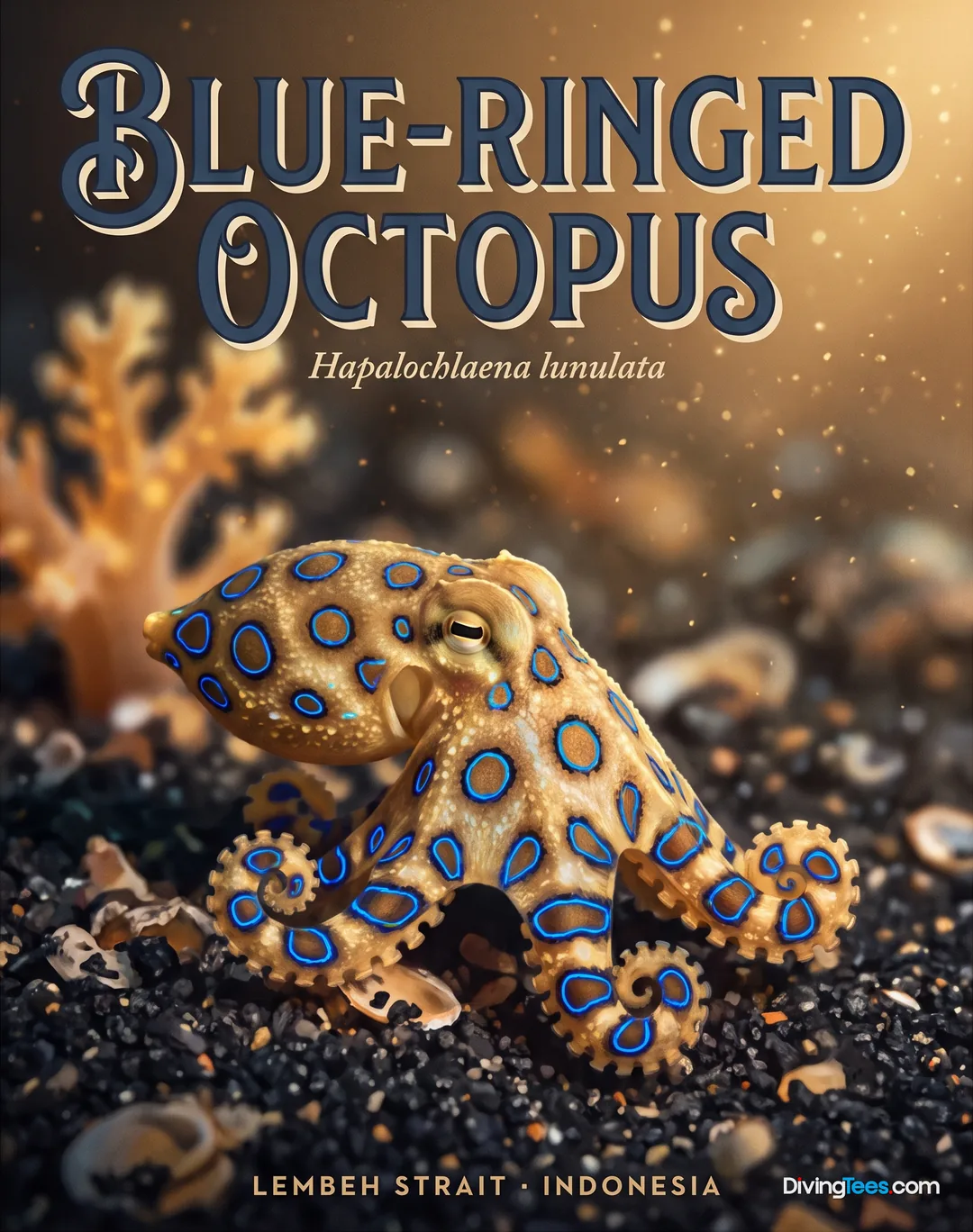
Indonesia — Lembeh Strait. The muck-diving capital of the world, Lembeh is home to the common octopus alongside far rarer and more spectacular species: the mimic octopus, capable of imitating the silhouette of around fifteen different species, and the blue-ringed octopus, tiny and venomous, recognisable by fluorescent rings that flash when it feels threatened. The dark, sheltered volcanic bottom of the strait makes encounters possible year-round, regardless of the monsoon.
Philippines — Anilao. Another muck-diving mecca, Anilao offers a cephalopod density comparable to Lembeh, with a marked preference for the dry season (October to May), when the sea is calmest and visibility most stable.
OBSERVATION CALENDAR
| Destination | J | F | M | A | M | J | J | A | S | O | N | D |
|---|---|---|---|---|---|---|---|---|---|---|---|---|
| Mediterranean (France) | ||||||||||||
| Mediterranean (Croatia/Greece) | ||||||||||||
| Red Sea (Egypt) | ||||||||||||
| Caribbean (Bonaire/Cozumel) | ||||||||||||
| Indonesia (Lembeh) | ||||||||||||
| Philippines (Anilao) |
Click each button to show/hide
Unlike large pelagic migrants, the common octopus follows no seasonal migration: it is present year-round at most of these sites. The nuances in the table mostly reflect diving windows — visibility, thermal comfort for extended night dives, sea conditions — rather than any migratory behaviour by the species.
CONSERVATION
Octopus vulgaris is listed as Least Concern (LC) on the IUCN Red List, a rare and valuable status among iconic marine species. Its wide geographic range, high fecundity (tens of thousands of eggs per clutch) and very short life cycle, which allows rapid population renewal, explain this relative resilience in the face of fishing pressure.
The species is nonetheless intensively exploited: it is one of the most heavily fished cephalopods in the world for human consumption, using methods ranging from traditional traps to trawling. Octopus farming projects are under development in several countries, a prospect that is generating growing ethical debate given the demonstrated cognitive sophistication of the species — several countries and the European Union have in recent years strengthened the legal protection of cephalopods in research and farming, in recognition of their capacity to feel pain.
The responsible diver never pulls an octopus from its den for a photograph, does not handle it, and avoids any contact that would disrupt its hunting or expose it to predators while it is away from its shelter. A headlamp that is too bright or held too long can be enough to interrupt a nocturnal hunt.
Organisations to follow:
- The Cephalopod Page — leading scientific resource on cephalopod biology
- CephRes — Association for Cephalopod Research — research and outreach on all cephalopods
- Compassion in World Farming — international campaign against industrial octopus farming
3 THINGS YOU PROBABLY DON'T KNOW
1. It has nine brains, not one. A central brain encircles the animal's oesophagus, but roughly two-thirds of its neurons are located elsewhere — distributed among eight nerve ganglia, one per arm. Each arm can therefore explore, react and even "decide" on an action largely on its own, without waiting for instructions from the central brain. This is what allows an octopus to hunt in two different directions at the same time with two separate arms.
2. Its blood is blue — and that is not a cosmetic accident. The common octopus transports oxygen using haemocyanin, a copper-based protein rather than an iron-based one, which gives the blood a blue tint once oxygenated. This molecule performs better than haemoglobin in cold, oxygen-poor water, but it transports oxygen less efficiently at higher temperatures — one reason the species shows signs of physiological stress in warming waters.
3. "Octopus vulgaris" may not be a single species. Genetic studies conducted since the 2010s suggest that what we call Octopus vulgaris is in fact a complex of several distinct species that are virtually impossible to tell apart by eye, distributed across the Mediterranean, the Atlantic and parts of the Indo-Pacific. Official taxonomy has not yet settled the question — which means the octopus encountered in Marseille and the one met in the Caribbean may already, scientifically speaking, no longer be quite the same animal.
PHOTO AND VIDEO TIPS
The common octopus is a demanding subject: small, often motionless or half-hidden, yet capable of producing one of the most photogenic spectacles in the underwater world when it shifts texture and colour before your eyes.
Lens. Macro is essential: 60 mm or 100 mm in a mirrorless or DSLR housing, or close-up macro mode on a compact camera. The subject is small and its camouflage makes precise framing critical — a tight, sharp shot will always outperform a wide, blurry frame of an animal half-melted into the scenery.
Lighting. A red light or low-intensity beam during approach prevents startling the animal on a night dive — octopuses perceive red poorly, unlike many fish. Switch to strobe or white light only at the moment of capture, never before, to avoid interrupting an ongoing hunt.
Approach. Stay still, at a comfortable distance, and let the animal continue its activity. An octopus that feels watched changes colour to signal its discomfort — a uniform pale pattern or a sudden bristling of the skin — and that is the signal to back off. The finest sequences are filmed by letting the animal hunt normally, never blocking the entrance to its den.
Classic mistake. Touching or attempting to coax an octopus out of its hiding place for "the perfect shot." Not only can the animal injure itself by retracting into too-tight a space, but the stress compromises its ability to hunt for hours afterwards. The best octopus photograph is almost always the one taken before the animal realised, until the very last moment, that it was being watched.