Dumbo Octopus
Grimpoteuthis
It lives so far beneath the surface that sunlight has never reached it — and yet it swims as though it were flying.
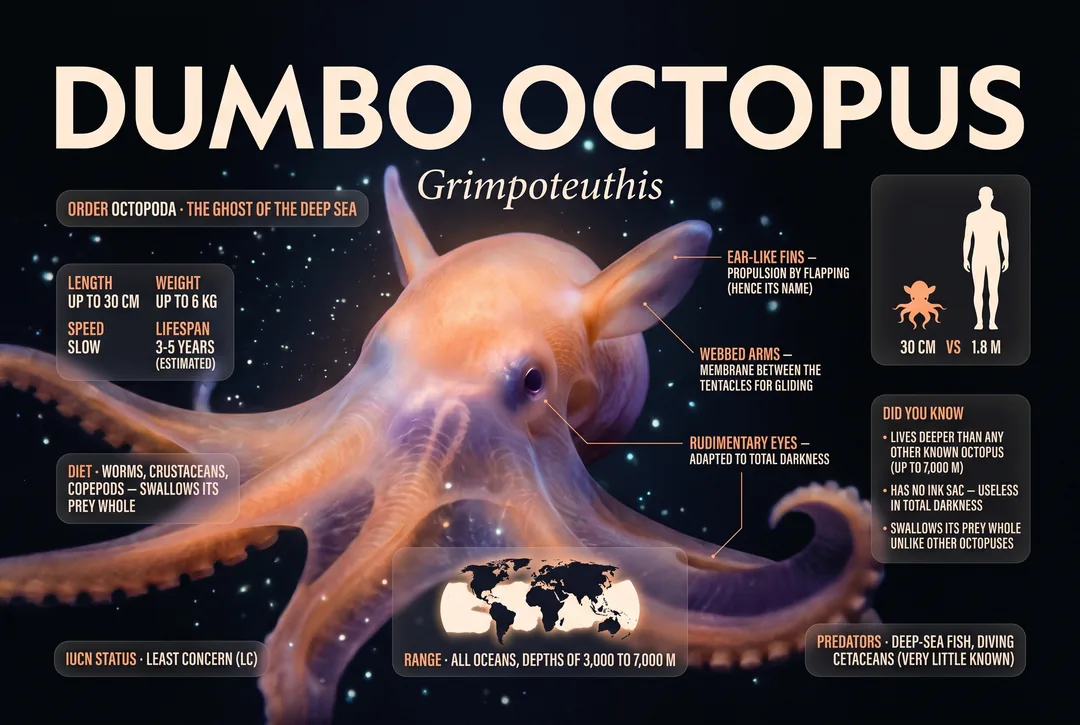
IDENTITY CARD
| Classification | Order Octopoda, family Opisthoteuthidae |
| Scientific name | Grimpoteuthis (Robson, 1932) — approximately 17 described species |
| Size | 20 to 30 cm on average, up to 1.80 m for the largest specimens |
| Weight | Up to 6 kg |
| Speed | ~1-2 km/h (slow propulsion by fin-flapping) |
| Lifespan | 3 to 5 years (estimates — never measured directly) |
| Depth | 1,000 to 7,000 m — one of the deepest cephalopods ever filmed |
| Diet | Benthic carnivore — polychaete worms, isopods, amphipods, copepods |
| IUCN Status | Data Deficient (DD) — habitat too deep for reliable surveying |
PORTRAIT
There exists, several kilometres beneath the surface of the oceans, an animal that looks like a cartoon character. Two wide fin-like appendages shaped like ears project from each side of its rounded mantle, and when it moves, it flaps them gently, like a bird flying in slow motion through total darkness. It is this silhouette that earned it its nickname: the dumbo octopus, after Disney's flying elephant. But the animal is no toy. It inhabits one of the most extreme environments on the planet — the hadal and abyssal zones, where pressure reaches 700 times that at the surface, where temperature hovers near zero, and where night is permanent.
Grimpoteuthis is not a single species but an entire genus, comprising roughly seventeen described species — and probably more awaiting names. Their body is semi-gelatinous, adapted to extreme pressure: no rigid internal shell as in other octopods, but a soft, compressible structure. The arms, connected by a fine membrane, form an umbrella that opens and closes with each stroke. The skin, often translucent, reveals internal organs under the lights of ROVs — the remotely operated vehicles that constitute, along with crewed submersibles, the only way to go and see it.
No diver will ever encounter a dumbo octopus on scuba. That is one of its paradoxes: the ocean's most endearing animal is also one of the most inaccessible. But for the traveller passionate about marine life, its existence illustrates a truth that every dive confirms — the ocean is immense, and what we see from the surface is only a fraction of what it harbours. The footage brought back by scientific expeditions and the rare tourist submersibles is enough to understand why Grimpoteuthis has become, in just a few years, the unofficial icon of the deep sea.
HOW TO RECOGNIZE IT
Recognising a dumbo octopus on ROV or submersible footage poses no difficulty, even for a non-specialist. The silhouette is unique: a rounded, almost spherical mantle, topped by two lateral fins shaped like paddles or ears. No other deep-sea cephalopod presents this combination.
Colour varies with species and depth: milky white, pale pink, dull orange, reddish brown. Some specimens appear almost transparent under ROV lighting, revealing muscles and viscera by translucency. The eight arms are connected by an inter-brachial membrane that forms a parachute when the animal uses it to glide toward the bottom.
Size is the main species indicator for biologists: the smallest Grimpoteuthis fit in the palm of a hand; the largest, such as Grimpoteuthis bathynectes, reach 1.80 m with arms extended. Confusion with other deep-sea octopods is theoretically possible — the genera Cirroteuthis and Stauroteuthis bear cirri along their arms and a vaguely comparable shape — but the presence of the large dorsal ear-fins settles identification immediately.
For subtitles in English: start the video firstthen click the gearat the top right of the video, select “Subtitles/CC”, then “Auto-translate” and choose “English”.
WAY OF LIFE
The dumbo octopus is a benthic predator. It moves just above the ocean floor, sometimes resting on the sediment, sometimes gliding a few metres above the bottom. Its hunting technique is direct: it pounces on its prey — a worm, a crustacean, a small mollusc — and envelops it with its webbed arms before swallowing it whole. Unlike reef octopuses, it does not possess a radula powerful enough to crush shells: it ingests its prey intact.
Its locomotion is threefold. The most characteristic is the flapping of the two lateral fins — the "Dumbo" swimming stroke that gave it its name. It can also use jet propulsion, expelling water through its siphon, like all cephalopods. Finally, it deploys its inter-brachial membrane as a parachute to glide passively in the current, conserving precious energy in an environment where food is scarce.
The reproduction of Grimpoteuthis remains largely enigmatic. Females are known to carry eggs at different stages of maturation simultaneously, suggesting they can lay at any time of year — an advantage in a seasonless environment. Eggs, protected by a thick envelope, are deposited individually on the substrate or on fixed structures on the bottom (rocks, shells, deep-sea corals). The absence of a breeding season is consistent with the thermal stability of the habitat: at 3,000 metres depth, temperature does not vary by half a degree from one month to the next.
WHERE TO SEE IT
The dumbo octopus lives in every ocean on Earth, wherever the bottom exceeds 1,000 metres. But "observe" takes on a different meaning here from what it means for a diver: no scuba tank reaches these depths. Here is where science has filmed Grimpoteuthis, and where a passionate traveller can hope to see the footage — or, in some cases, descend personally.
Mariana Trench — western Pacific. This is where Grimpoteuthis was filmed at its depth record: 6,957 metres, by a vehicle of the Five Deeps Expedition in 2019. The animal was gliding a few metres from the bottom, calmly flapping its fins in total darkness. This observation pushed the depth record for a cephalopod down by nearly 2,000 metres. The Mariana Trench remains inaccessible to tourism, but the expedition footage is freely available online.
Mid-Atlantic Ridge — North Atlantic. ROVs from the NOAA Ocean Exploration programme regularly film dumbos between 2,000 and 4,000 metres depth along the ridge. The Okeanos Explorer campaigns livestream their dives on the NOAA website — the most accessible, and entirely free, way to watch a Grimpoteuthis encounter in real time.
Monterey Bay — California. The MBARI (Monterey Bay Aquarium Research Institute) operates one of the most active ROV fleets in the world. Its vehicles have filmed dozens of Grimpoteuthis specimens in the Monterey submarine canyon, between 1,500 and 4,000 metres. The Monterey Bay Aquarium, open to the public, regularly screens this footage in its deep-sea exhibitions.
Norwegian Sea and Arctic. Norwegian oceanographic campaigns and ROVs operated from Tromso regularly document dumbos in cold waters between 1,000 and 3,000 metres. The Arctic, through programmes like MAREANO, provides some of the finest filmed sequences of the animal in its natural habitat.
Tourism by submersible. Several operators offer dives in crewed submersibles to depths where Grimpoteuthis has been observed. Expeditions by Caladan Oceanic (technical successor to Five Deeps) and deep dives organised in certain regions (Bahamas, Azores) reach 1,000-4,000 metres. These experiences remain rare, expensive, and reserved for a committed audience, but they represent the only way for a non-scientist to see a dumbo octopus with their own eyes.
OBSERVATION CALENDAR
The dumbo octopus lives in a world without seasons. At 2,000 metres depth and beyond, temperature, light (none), and currents barely vary from month to month. The animal does not migrate, follows no known seasonal cycle. What varies is the presence of expeditions and ROVs.
| Expedition / Institution | J | F | M | A | M | J | J | A | S | O | N | D |
|---|---|---|---|---|---|---|---|---|---|---|---|---|
| NOAA Okeanos Explorer | ||||||||||||
| MBARI (Monterey Bay) | ||||||||||||
| Arctic campaigns (MAREANO) | ||||||||||||
| Private submersibles (Bahamas, Azores) |
Click each button to show/hide
CONSERVATION
Grimpoteuthis is classified as Data Deficient (DD) on the IUCN Red List. This status does not mean the animal is doing well — it means we do not know. At 3,000 metres depth, counting a population is a luxury that science cannot yet afford. The few hundred specimens observed by ROV over fifty years do not constitute a sufficient sample to estimate the global population.
The threats, however, are identified. Deep-sea trawling, practised by certain fleets beyond 1,000 metres, destroys the benthic habitats where Grimpoteuthis hunts and reproduces. Deep-sea mining, under negotiation at the International Seabed Authority, directly threatens the abyssal plains rich in polymetallic nodules — exactly the type of substrate where the animal has been filmed. Pollution by microplastics, now detected at the bottom of the Mariana Trench, constitutes a third threat, whose impact on abyssal organisms remains to be measured.
For the traveller who will never encounter this animal on a dive, supporting its protection means supporting the protection of the deep sea as a whole — a still-young fight, but an increasingly structured one.
Organisations to support:
- Deep Sea Conservation Coalition — global campaign against deep-sea trawling and mining
- IUCN Deep-Sea Specialist Group — scientific expertise for classification and protection of abyssal species
- Ocean Census — global programme to discover and catalogue marine species, including deep-sea cephalopods
- Schmidt Ocean Institute — oceanographic expeditions and open-access data, including Grimpoteuthis observations
3 THINGS YOU PROBABLY DON'T KNOW
1. It swallows its prey whole — and that is an evolutionary choice. Unlike surface octopuses, which tear apart their food with a powerful beak and abrasive radula, the dumbo octopus ingests its prey in one piece. MBARI researchers filmed it pouncing on an isopod, capping it with its webbed arms like a net, then engulfing it without crushing. At 4,000 metres depth, where food is scarce and every calorie counts, losing crumbs is a luxury one cannot afford.
2. It is the deepest cephalopod ever observed. In May 2020, a team published in Marine Biology the filmed observation of a Grimpoteuthis at 6,957 metres depth in the Mariana Trench. At that depth, pressure exceeds 690 atmospheres — the equivalent of an SUV parked on every square centimetre of skin. No other octopus, cuttlefish, or squid has been documented that deep. The previous record, held by another Grimpoteuthis, was 5,145 metres.
3. It has no ink sac. Most cephalopods possess an ink sac to blind a predator and flee. Grimpoteuthis has lost this organ through evolution. The reason is simple: in the total darkness of the abyss, a cloud of ink would be invisible. The eyes themselves are reduced, barely functional in some species of the genus. At these depths, evolution has invested elsewhere than in sight: in the tactile sensitivity of the arms, in chemical receptors, and in that slow, energy-efficient swimming stroke that allows it to patrol the bottom with minimal expenditure.
PHOTO AND VIDEO TIPS
No underwater photographer will frame a dumbo octopus with their own equipment — the animal lives at depths where no autonomous human dive is possible. The images we have come exclusively from ROV and crewed submersible cameras. But for the videographer or filmmaker participating in a deep expedition, a few principles are worth knowing.
Lighting. The animal is semi-translucent and lives in absolute darkness. A powerful frontal light makes it spectacular but crushes the details: the fins become opaque, the gelatinous texture disappears. The best footage filmed by MBARI and NOAA uses lateral or slightly off-centre lighting, which reveals the transparency of the mantle and the internal movements of the body. If you are operating ROV lights or choosing your angle in a submersible, favour partial backlighting.
Approach speed. Modern ROVs are capable of very slow movements, but the hydrodynamics of a multi-tonne vehicle create a pressure front detectable by the animal. Specimens rarely flee in panic — the typical reaction is a retraction of the arms into an umbrella posture and a passive descent toward the bottom. A good ROV operator slows down at 50 metres and lets the current carry the vehicle over the last stretch.
Format. If you have the opportunity to participate in an expedition filming deep-sea cephalopods, favour video over stills. The fin-flapping, the membrane deployment, and the posture changes constitute the essence of the animal's visual interest. A photograph freezes a dumbo; a video brings it to life. Scientific ROV cameras shoot in 4K at 30 frames per second — a standard sufficient for all editorial uses.
Accessible archives. For the filmmaker or blogger seeking footage without descending to 3,000 metres: NOAA and MBARI publish their sequences under open licences. The NOAA Ocean Exploration YouTube channel contains dozens of encounters filmed in high definition, freely reusable for non-commercial projects.