Caribbean Reef Squid
Sepioteuthis lessoniana
It changes colour faster than a screen refreshes — the reef has its own language of light.
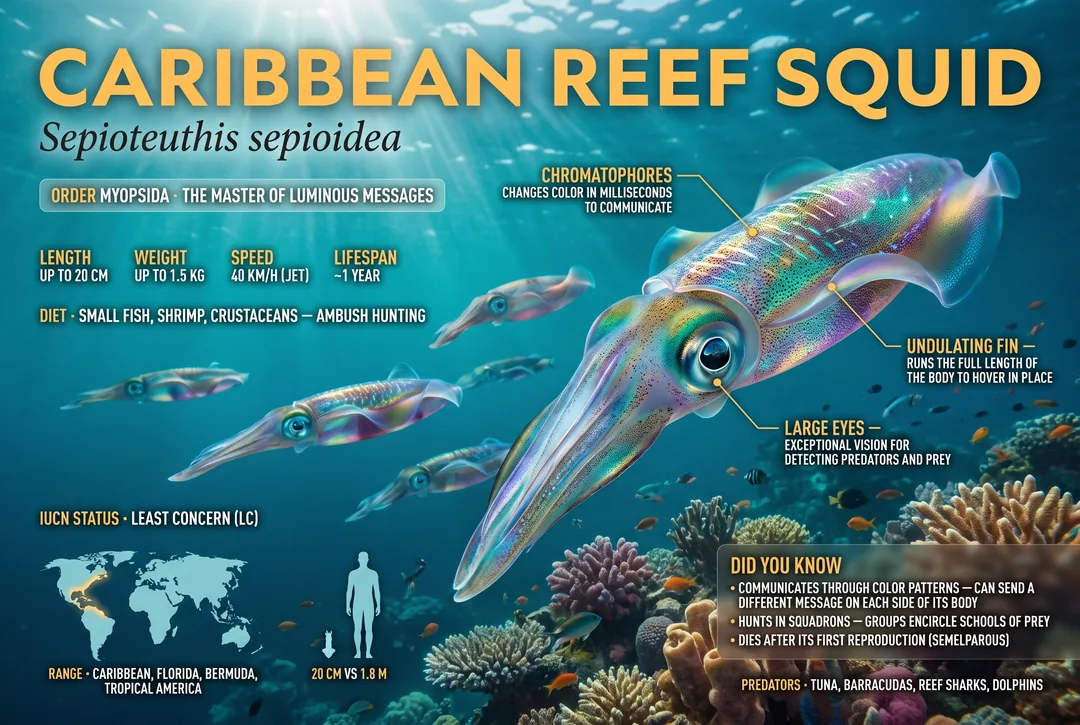
IDENTITY CARD
| Classification | Order Myopsida, family Loliginidae |
| Scientific name | Sepioteuthis lessoniana (Ferussac, 1831) |
| Size | Up to 38 cm mantle length (total length with tentacles: ~80 cm) |
| Weight | Up to 1.8 kg |
| Speed | Up to 30 km/h by jet propulsion |
| Lifespan | 6 to 9 months (rarely more than a year) |
| Depth | 1 to 100 m, most commonly seen between 3 and 30 m on the reef |
| Diet | Carnivore — small fish, shrimp, crustaceans, other small cephalopods |
| IUCN Status | Data Deficient (DD) — populations stable but poorly quantified |
PORTRAIT
There are animals that swim, and there are animals that talk while swimming. The bigfin reef squid does both at the same time. You spot a squadron of them suspended a metre above the bottom, their lateral fins undulating with a hypnotic slowness — then a signal passes, a wave of colour sweeps across the entire body in a fraction of a second, and the group reorganises without a single tentacle having touched a neighbour. What looks like a dance is in fact a conversation.
Sepioteuthis lessoniana, the bigfin reef squid, is one of the most widespread cephalopods of the Indo-Pacific. Its genus name — Sepioteuthis, literally "cuttlefish-squid" — betrays its appearance: fins shaped like wings that run along nearly the entire length of the mantle, giving it the rounded silhouette of a cuttlefish rather than the torpedo profile of pelagic squids. Those fins are not merely aesthetic: they allow a hovering precision remarkable for a reef predator that must manoeuvre between corals.
For the diver, the encounter is a spectacle apart. The animal is curious, often tolerant, and its skin is a living screen. Thousands of chromatophores — pigment cells commanded by the nervous system — contract and expand continuously, producing waves of colour that traverse the body like miniature northern lights. Brown, white, gold, violet, striped, spotted, plain: a single individual can display more than thirty different patterns within a few minutes. There is nothing comparable on the reef.
HOW TO RECOGNIZE IT
The bigfin reef squid is distinguished from other squids by its exceptionally wide lateral fins, which border the mantle along 80 to 90% of its length — hence the common name. Seen from the front, the silhouette is almost diamond-shaped, very different from the narrow fuselage of open-water squids.
The mantle is smooth, slightly flattened, and carries eight short arms equipped with suckers and two retractile tentacles that are longer, used for prey capture. The eyes are large, lateral, and covered by a fine transparent membrane — unlike the Oegopsida squids, whose eyes open directly onto the water.
Colour cannot serve as an identifier, since the animal changes it constantly. But the combination of size (mantle of 15 to 35 cm in adults), fin shape, and shallow reef habitat leaves little room for doubt. Juveniles, translucent and a few centimetres long, are harder to spot — they merge with the open water above the reef.
For subtitles in English: start the video firstthen click the gearat the top right of the video, select “Subtitles/CC”, then “Auto-translate” and choose “English”.
WAY OF LIFE
The bigfin reef squid is a gregarious animal. Groups number from a few individuals to several dozen, often organised in loose formations above the coral substrate or seagrass beds. Each individual maintains a precise distance from its neighbours — a spacing that tightens or loosens according to context, like a school of fish endowed with a language.
And that language exists. The squid's skin is a communication organ in its own right. Its chromatophores — elastic pigment sacs, each surrounded by radial muscle fibres — contract or expand on direct neuronal command, without passing through the hormonal system. The result is a speed of colour change unmatched in the animal kingdom: less than 200 milliseconds to go from pearly white to dark brown across the entire body. The animal also possesses iridophores (metallic reflections) and leucophores (diffusing white), which add structural components to its biochemical palette.
The courtship display is one of the most fascinating spectacles on the reef. The male displays an intense zebra pattern on the side of his body facing the female — and a different pattern, often plain and pale, on the side facing rival males. This ability to project two simultaneous visual messages is documented by biologists as dual signalling: the squid seduces on one side and deters on the other, at the same instant. Mating is brief. The male transfers a spermatophore into the female's buccal cavity, and she then fertilises her eggs one by one as she deposits them beneath corals, rocky overhangs, or artificial structures. The egg capsules, elongated and whitish, are grouped in clusters — a common sight on night dives.
Locomotion relies on two systems. For slow travel and hovering, the lateral fins undulate in series, offering remarkable manoeuvrability — the squid can move forward, backward, up, down, and pivot on the spot. For escape or fast hunting, jet propulsion takes over: the animal draws water into its mantle cavity then expels it violently through the siphon, a muscular tube that can aim through 360 degrees. Acceleration is brutal — up to 30 km/h — and is often accompanied by a cloud of ink that serves as a decoy.
The species is semelparous: adults die after reproduction, usually between six and nine months of age. This brief life explains a growth rate among the fastest in the animal kingdom — a juvenile of a few grams reaches adult size in three to four months, a rate that has made Sepioteuthis lessoniana a model organism in marine biology and experimental aquaculture.
WHERE TO SEE IT
The bigfin reef squid inhabits the entire tropical and subtropical Indo-Pacific, from Japan to Australia and from the Red Sea to Hawaii. Its preference for shallow reefs, seagrass beds, and lagoons makes it one of the most accessible cephalopods for divers. Here are the destinations where encounters are most reliable:
Indonesia — Lembeh Strait, North Sulawesi. The Lembeh Strait is one of the best sites in the world for observing reef squid behaviour: courtship displays, egg-laying, hunting. Night dives over sandy bottoms are particularly productive. Nearby Bunaken and the Coral Triangle in general (Raja Ampat, Komodo) also offer frequent encounters with sometimes impressive groups.
Philippines — Anilao, Dauin, and Moalboal. The muck-diving sites of the Visayas and Batangas are an exceptional playground for cephalopod enthusiasts. Reef squid are present year-round, often in dense groups above artificial reefs or seagrass beds. Twilight and night dives at Anilao regularly reveal egg-laying scenes.
Red Sea — Egypt and Sudan. The reefs of the Red Sea harbour a resident population of Sepioteuthis lessoniana. They are encountered regularly at Ras Mohamed, in the coral gardens of Dahab, and on the shallow reef flats of Marsa Alam. Encounters are frequent on night dives, when the squid hunt small fish attracted by dive lights.
Maldives — central atolls. The shallow lagoons of the Maldives and the coral drop-offs shelter resident groups, observable year-round. Late-afternoon dives on the house reefs of island resorts often deliver close encounters with hunting squadrons.
Japan — Okinawa and the Kerama Islands. The Sepioteuthis lessoniana population in Okinawa is one of the best studied in the world. The shallow sites of the Kerama Islands allow observation of reproduction from January to May, with egg clusters visible beneath tabular corals.
Australia — Great Barrier Reef. The warm waters of the GBR harbour resident populations on the outer reef and in lagoons. The southern Coral Sea offers occasional encounters with large groups, particularly from October to December.
Thailand — Similan Islands and Andaman Sea. The Similan and Surin Islands, during the dive season (November to April), offer regular encounters with reef squid above coral slopes and seagrass meadows.
OBSERVATION CALENDAR
| Destination | J | F | M | A | M | J | J | A | S | O | N | D |
|---|---|---|---|---|---|---|---|---|---|---|---|---|
| Indonesia (Lembeh) | ||||||||||||
| Philippines (Anilao) | ||||||||||||
| Red Sea (Egypt) | ||||||||||||
| Maldives (central atolls) | ||||||||||||
| Japan (Okinawa) | ||||||||||||
| Australia (Great Barrier Reef) | ||||||||||||
| Thailand (Similans/Andaman) |
Click each button to show/hide
CONSERVATION
Sepioteuthis lessoniana is classified as Data Deficient (DD) on the IUCN Red List. This status does not mean the species is safe — it reflects a lack of data on population dynamics at the global scale. The bigfin reef squid is commercially fished across much of its range, particularly in Southeast Asia, Japan, and Australia, where it constitutes a significant share of coastal cephalopod catches.
The threats are real. Light fishing (light attraction), which exploits the squid's attraction to light sources, can exert intense local pressure on breeding populations. The degradation of coral reefs and seagrass beds reduces spawning and nursery areas. Coastal pollution and surface water warming alter egg development conditions — incubation is strongly temperature-dependent, and a degree of warming can accelerate hatching by several days and modify larval survival.
The species' very short life cycle is a double-edged sword. It allows rapid population renewal when conditions are favourable, but makes every generation vulnerable to a shock — a year of overfishing or habitat destruction can eliminate an entire cohort without a previous generation remaining to rebuild the stock.
The responsible diver takes care not to touch egg clusters, not to chase fleeing groups, and to moderate lighting on night dives — a torch trained too long disrupts hunting and disturbs courtship displays.
Organisations to support:
- CephRes — Cephalopod Research — European centre for cephalopod biology and welfare research
- The Cephalopod Page — scientific database and educational resources on cephalopods
- Coral Triangle Initiative — reef and marine biodiversity protection in the Coral Triangle
- PADI AWARE — citizen science and marine conservation
3 THINGS YOU PROBABLY DON'T KNOW
1. It displays two messages at the same time. During courtship, the male projects a flamboyant zebra pattern on the half of his body facing the female — and a pale, plain pattern on the half facing rival males. This dual signalling, documented by researchers at the University of the Ryukyus in Okinawa, is the biological equivalent of holding two separate conversations with two people face to face. It relies on independent neuronal control of the chromatophores on each flank — a feat that even cuttlefish, though champions of camouflage, do not master with such contextual finesse.
2. It has the largest brain of any invertebrate, proportionally. The brain-to-body ratio of Sepioteuthis lessoniana exceeds that of most fish and some reptiles. Cephalopods possess a distributed nervous system — two thirds of their neurons are located in the arms, not in the central brain — which gives them remarkable capacities for learning, spatial memorisation, and behavioural adaptation. In laboratory settings, bigfin reef squid have demonstrated the ability to solve mazes, to modify their hunting strategy when faced with novel prey, and to recognise individual conspecifics.
3. It lives less than a year — and grows faster than almost anything. A bigfin reef squid hatches with a mantle of 7 mm. Six months later, it measures 30 cm, weighs more than a kilogram, has reproduced — and dies. Its growth rate is one of the highest in the animal kingdom: it converts food into body mass with an efficiency of 30 to 60%, compared to 10 to 15% for a fish of comparable size. This life in fast-forward means every dive is an encounter with an individual that did not exist six months ago and will not exist six months from now.
PHOTO AND VIDEO TIPS
The bigfin reef squid is a demanding and rewarding subject. Its tolerance of approach, its relative immobility when hovering, and its permanent colour changes make it technically accessible — as long as you do not break the comfort distance.
Lens. Macro and close-up for skin textures and chromatophores: 60 mm or 100 mm macro. For group scenes and behaviour: a 35-50 mm or moderate wide angle (24-35 mm rectilinear). The fisheye is rarely necessary — the animal is too small to fill it. With a GoPro, the minimum focus distance limits detail work, but 4K video is excellent for capturing chromatic waves in motion.
Lighting. Chromatophores react to artificial light — both an advantage and a trap. Moderate lighting (video light at low power, diffuser) reveals colours without altering behaviour. A direct frontal flash often triggers a reflex flight or defensive blanching. Favour lateral or slightly offset lighting, which brings out the iridescence without blinding the animal. On night dives, filter the torch to red during approach, then switch to white for the shot.
Approach. Slow, frontal or slightly lateral. The bigfin reef squid tolerates the presence of a motionless diver at 1-2 metres, sometimes less. The key is stillness: any abrupt movement triggers a retreat of the entire group. Exhale slowly. Settle on the bottom (if sandy and coral-free) and wait: curious squid often return on their own.
Common mistake. Wanting to photograph a monochrome squid. The skin changes constantly — if the current shade is not ideal, just wait ten seconds. The zebra patterns of courtship, the chromatic waves, and the iridescent reflections are the images that stand out. Patience and burst mode are the cephalopod photographer's two allies.