
Finz Dive Center and Tackle Shop
Google 4.9/5 (336 reviews)
United States · Americas
A 158-metre wreck, coral reefs, shallow artificial sites and 42-metre seabed depths frame short, boat-based diving from a lively island town.
For subtitles in English: start the video firstthen click the gearat the top right of the video, select “Subtitles/CC”, then “Auto-translate” and choose “English”.
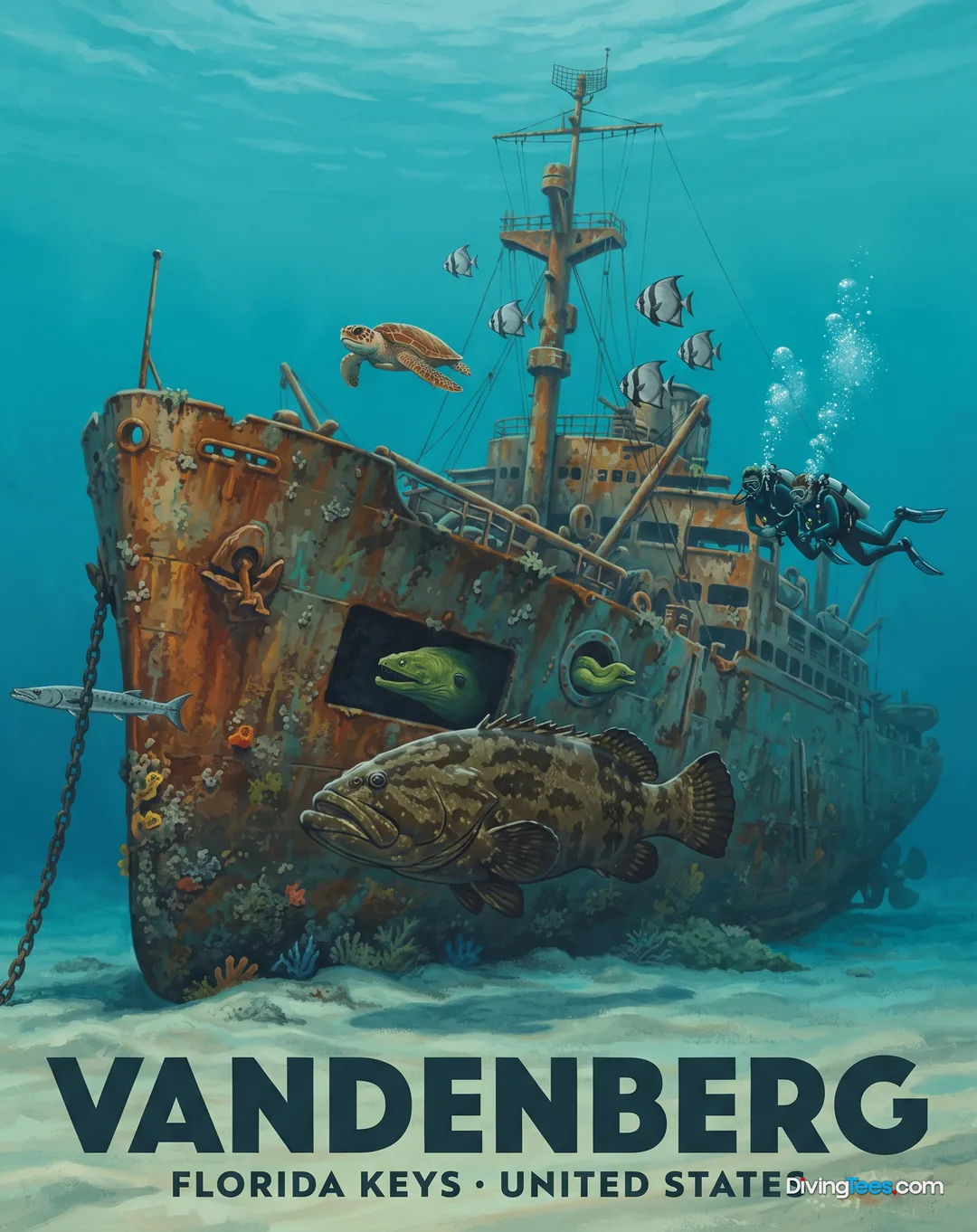
The 158-metre Vandenberg gives Key West its clearest underwater landmark: a vast artificial reef whose deck lies around 30 metres, with the seabed falling to 42 metres. Around it, day boats reach coral reefs, artificial sites and other wreck terrain suited to different levels of experience. The attraction is not diving in isolation. Key West works as a short land-based break, with diving, snorkelling and an easily explored town sharing the same compact island base.
Key West is primarily a boat-diving destination, with coral reefs, artificial reefs and wrecks reached on organised day trips from the local harbour. The Vandenberg Wreck is the serious end of the range: the deck is around 30 metres and the seabed reaches 42 metres, so divers need to manage depth, gas and a potentially moderate or strong current. A descent line helps with entry, but it does not remove the need to be comfortable in changing water movement. Other outings can be arranged around shallower, more forgiving profiles. Currents are variable, and sea conditions can change with the weather. Visibility is likewise not something to take for granted or assume will be consistent. Ask whether the boat is heading for a natural offshore reef, an inner reef or an artificial wreck, because the scenery and demands underwater can differ markedly.
Sea turtles and rays are the dependable wildlife interest around Key West, with encounters possible throughout the year. They fit naturally into reef and wreck dives: turtles moving over the bottom and rays passing across the sand or low relief, rather than a destination built around a single guaranteed animal encounter. Nurse sharks are an occasional spring-and-summer possibility, adding interest without being a reason to plan the whole trip around shark sightings. The artificial structure of the Vandenberg changes the wildlife experience from a natural reef dive. Its railings, decks and open sections invite a slower exploration of the wreck itself, while reef outings put more emphasis on watching the bottom and maintaining careful buoyancy around protected coral.
For the most settled overall planning, November to May is the sensible period, when the drier season generally brings a more stable sea. The measured pattern shows the calmest sea from May to September, while rainfall is usually lowest from January to May, so May sits at an useful crossover for divers able to accept more variable seasonal weather later on. August to October is the least attractive window because it overlaps the hurricane season and more unsettled conditions. Winter and spring are also the busiest periods for boat trips, so popular departures need more forward planning. A four-to-seven-day stay leaves room for weather changes rather than making one morning’s sea state decisive.
This coast is exposed to sargassum strandings, whose intensity varies greatly from year to year. To find out more, see the “Sargassum alert” panel on this page.
Key West can suit Open Water divers when the day’s sites and conditions are appropriate, while Advanced Open Water training is useful for deeper or more exposed profiles. The Vandenberg is firmly an advanced proposition because of its 30-metre deck, 42-metre seabed and possible current. BSAC, PADI and SSI qualifications should all translate into the relevant operator requirements. Nitrox is useful for repeated, moderate-depth day-boat diving, but it does not replace depth, gas-management and current competence on the wreck.
From London Heathrow, London Gatwick or Manchester, the usual arrangement is a connection through a major United States hub towards Miami or Fort Lauderdale, followed by either a domestic flight to Key West or the road journey along the US-1 Overseas Highway. There is no structural need for a ferry to reach the town. The final connection should be planned with some tolerance, particularly if the itinerary combines an international arrival, an internal flight and baggage for diving. Once in Key West, boats leave from the local harbour. Divers staying near the historic centre can generally reach the diving area on foot, by bicycle or by taxi, depending on the address.
Put the boat days early in the stay, and keep one day flexible: afternoon sea conditions can become less comfortable, while a poor weather window may cancel or shorten a trip. Ask specifically whether each outing is aimed at a natural reef, an inner reef, an offshore reef or an artificial wreck; treating all Key West diving as the same experience leads to false expectations. The Vandenberg deserves a separate assessment of depth, gas and current rather than being added casually to a novice itinerary. Nitrox makes sense when the plan involves repeated moderate-depth dives from the same boat. Booking both dives on one day can reduce dead time, and checking whether the boat covers inner or offshore reefs helps match the day to the forecast. The Florida Keys National Marine Sanctuary also makes the practical rules non-negotiable: no touching coral or wildlife, no anchoring on reef and no collecting marine life. Plan a town day for any weather-enforced pause.
A four-to-seven-day stay suits Key West’s rhythm: several day-boat outings, a margin for changing weather and at least one day away from the water. Most divers stay on the island and combine morning or full-day boat trips with walks through the historic centre. A non-diving companion has genuine alternatives, including snorkelling, kayaking, paddleboarding, boat excursions and time around the waterfront, so the trip need not revolve around a dive schedule every day.
Hello, I'm Marina, DivingDeal.com's AI assistant. I guide you through destinations, areas and countries.
Thinking about the whole trip and the flights? Talk it over with Edith →
Marina is an AI. Some links are affiliate links: DivingDeal may earn a commission, at no extra cost to you. Bookings are made with the partner.
Your last day stays dry: no diving in the 18-24 hours before a flight, the perfect window to see the destination from another angle.
 Culture
⏱ 3 h · ★ 5.0 (18 reviews)
from £281$376€336
see on Viator ↗
 Culture
⏱ 10 h · ★ 5.0 (10 reviews)
from £129$172€154
see on Viator ↗
 City
City⏱ 2 h · ★ 5.0 (10 reviews)
from £64$85€76
see on Viator ↗
 Nature
⏱ 2 h · ★ 5.0 (7 reviews)
from £95$127€114
see on Viator ↗
Ratings and reviews collected by Viator and Tripadvisor.
November to May generally brings a drier season and more stable sea, while May to September has the calmer sea pattern. Rainfall is usually lowest from January to May. August to October overlaps hurricane season and can be more unsettled. Winter and spring are busier for boat trips, so plan departures ahead.
Key West can suit Open Water divers when sites and conditions are appropriate, with shallower, more forgiving profiles available. The Vandenberg is an advanced proposition because its deck lies around 30 metres, the seabed reaches 42 metres, and currents may be moderate or strong. Advanced training helps with deeper, exposed diving.
You can explore coral reefs, artificial reefs, historic wreck structures and the 158-metre Vandenberg, whose railings, decks and open sections create a different experience from natural reef diving. Turtles and rays are present throughout the year. Nurse sharks are an occasional possibility in spring and summer, not a guaranteed encounter.
Plan a four-to-seven-day stay with boat days early and one flexible day for changing weather. Ask whether trips visit natural reefs, inner reefs, offshore reefs or artificial wrecks. Most divers stay on the island, where boats leave from the harbour, and combine diving with time in the historic centre or waterfront.