
Lanj Karayib
Google 5/5 (92 reviews)
4.6 km away as the crow flies
Basse-Terre · Guadeloupe · Caribbean
Max. depth · 40 mExplore the impressive 49-meter cargo ship, the Gustavia, an upright wreck transformed into a vibrant artificial reef, offering a unique 'spiral' exploration.
For subtitles in English: start the video firstthen click the gearat the top right of the video, select “Subtitles/CC”, then “Auto-translate” and choose “English”.
Dropping down onto the Epave du Gustavia, you immediately sense the scale of this cargo ship, which measures 49 meters in length. Originally built in 1953 as the Geocanique, she was renamed in 1982 and transported goods between Guadeloupe and the northern islands before being purposely sunk in May 1991 following damage from Hurricane Hugo. She now rests perfectly upright on a sandy bottom, her deck reaching towards the light while her keel is firmly embedded at a maximum depth of 40 meters. The visibility here often provides a striking panoramic view as you make your initial descent, revealing the ship's entire profile and giving you a sense of the dive to come.
As you approach the wreck, the intricate details of the ship's superstructure become clearer. The Gustavia has been extensively colonized by marine life, transforming it into a thriving artificial reef. The hull is now adorned with a dense covering of tubular sponges, appearing in shades of yellow and grey, alongside various multicoloured corals. This organic growth softens the industrial lines of the ship and provides a rich habitat that attracts a diversity of reef species. French angelfish (Pomacanthus paru), with their distinctive dark bodies and bright yellow tails, are often seen flitting around the wreck, exploring its nooks and crannies. These curious fish add a dynamic splash of colour against the ship's somber metallic tones, making for excellent photographic opportunities as you slowly explore the various sections.
One of the defining features of this dive is the possibility to execute a 'spiral' exploration of the wreck. This involves circumnavigating the vessel while gradually increasing your depth, allowing you to take in the ship's entire dimension from bow to stern. This methodical approach ensures you experience the changing light and the different ecosystems that have established themselves at various depths along the ship's hull. Particular attention should be paid to the stern, where the three-bladed propeller is still visible, providing a tangible link to its operational past. The structural integrity of the upright wreck makes this a truly engaging and immersive underwater journey, unlike many other wreck dives where the vessel might be broken or listed.
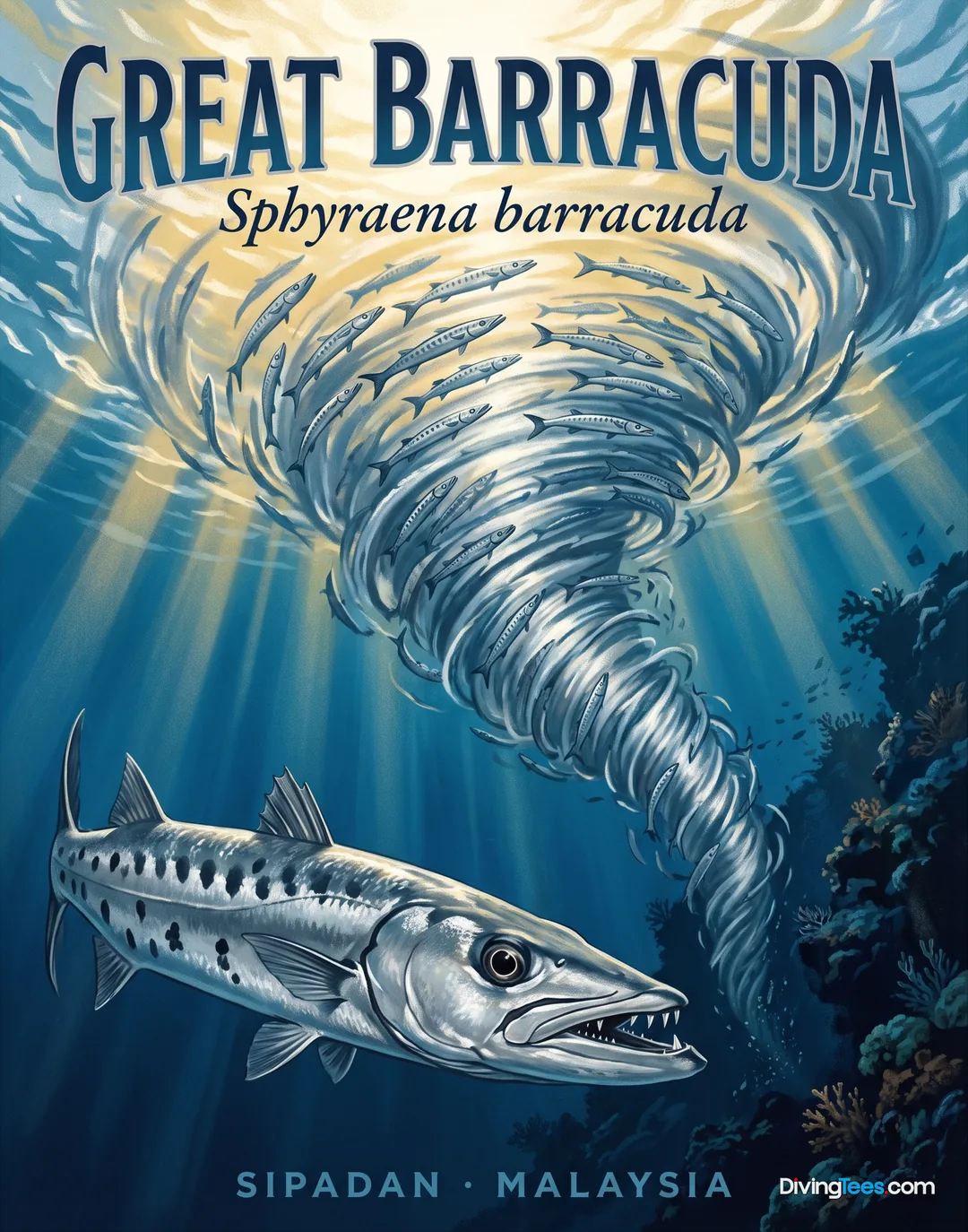
While exploring the Gustavia, keep an eye out for larger pelagic visitors. It's not uncommon to encounter a bustling school of barracudas (Sphyraena barracuda) patrolling the upper sections of the wreck or hanging ghost-like in the blue above the mast. These impressive predators often gather in significant numbers, creating a shimmering wall of silver that can be both exhilarating and slightly eerie. Their presence adds an exciting dimension to the dive, reminding you of the open ocean beyond the wreck's immediate vicinity and the dynamic nature of this underwater world. The light plays an important role here; at 40 metres, the ambient light filters down, creating a dramatic atmosphere that enhances the wreck's mystique. Careful buoyancy control is, as always, paramount for a controlled exploration of the structure without disturbing the delicate marine growth. This dive site is situated southeast of the Ilets Pigeon.
The Epave du Gustavia is a dive for those comfortable with depth, accessible from PE40, which translates to Open Water Diver certification along with Deep Dive training. The maximum depth of the dive reaches 40 meters on a sandy bottom. Diving in Guadeloupe offers pleasant conditions year-round, with calmer seas and optimal visibility typically between December and April. From May to November, while visibility remains good, the water temperature averages around 30 degrees Celsius. Expect a light current on occasion, which typically does not significantly impede the dive but requires awareness and contributes to the site's rich biodiversity.
You can dive the Epave du Gustavia year-round in Guadeloupe. Seas are typically calmer and visibility is optimal from December to April. From May to November, visibility remains good and water temperature averages around 30 degrees Celsius, offering warm conditions while you explore the upright wreck.
The Epave du Gustavia is suited to divers comfortable with depth. Access requires PE40, described as Open Water Diver certification together with Deep Dive training. The wreck rests upright on a sandy bottom, and the dive reaches a maximum depth of 40 meters.
At the Epave du Gustavia, you may encounter a light current. It typically does not significantly impede the dive, but you should remain aware of it while moving around the wreck. The current also contributes to the site’s biodiversity, where marine life gathers around the vessel.
The Epave du Gustavia is a 49-meter cargo ship wreck standing upright, with a visible three-bladed propeller at the stern. Yellow and grey tubular sponges and multicoloured corals cover the hull. You may also see French angelfish, schools of barracudas, and the wreck’s changing views during a spiral exploration.